What does a product really need? Same material, same machine, and the outcome still depends on design
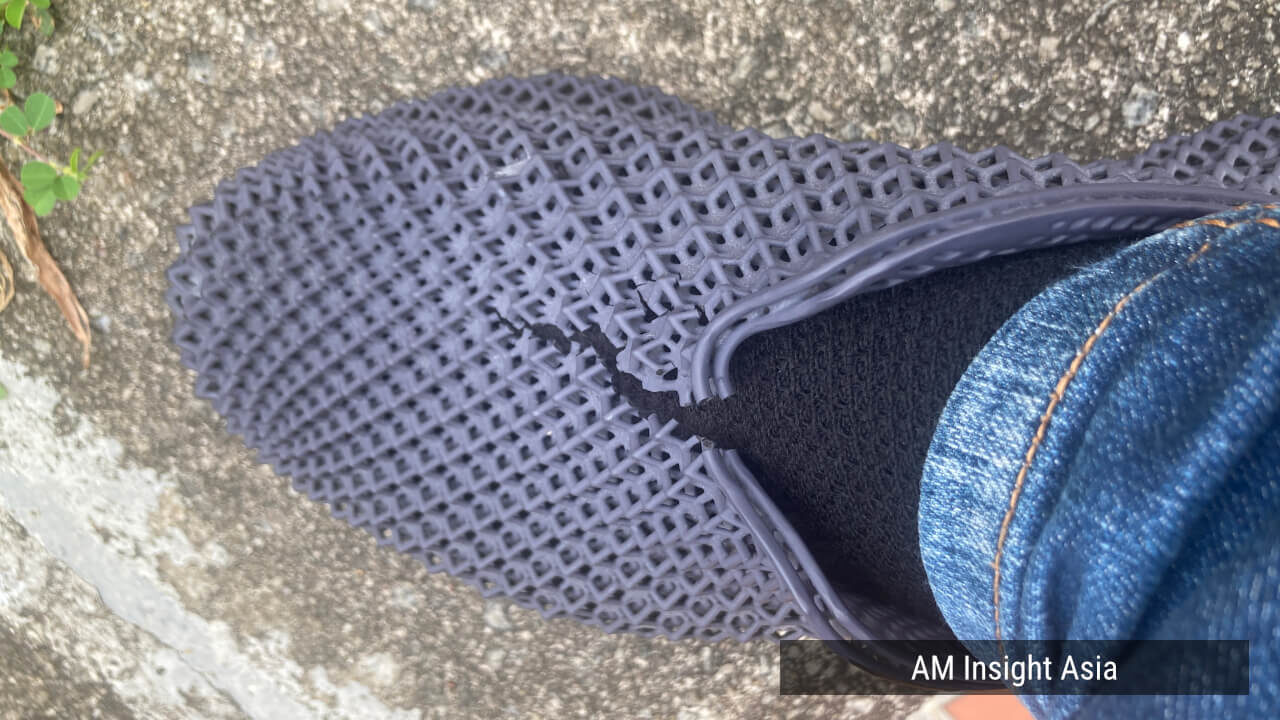
I paid around 26,000 yen (about US$165) for a pair of 3D printed shoes, and they broke after a year and a half. I posted just two lines and a photo of the broken shoe on LinkedIn. In two days, the post drew more than 41,000 impressions and comments from AM specialists, designers, design engineers, materials and 3D printer professionals, people in manufacturing and researchers. Including my own replies, the thread reached 136 comments. This is not an article about any particular company. So many people took an interest that leaving the discussion scattered across LinkedIn comments felt like a waste, so I decided to bring it together here. What broke was the upper, not the sole, and I believe the cause lies in the design. I should add that I am not an expert in design or manufacturing in any sense. I am simply a journalist at an AM media outlet, and I ask readers to keep that in mind.
A two-line post, and fail-safe design on my mind
The post itself was two lines beginning “My 3D-printed shoes just broke…” and a photo of the broken shoe. But there was a backstory. On October 8 and 9, I volunteered at CDFAM Tokyo, thanks to the kindness of its organizer, Duann Scott. While listening to the many talks, a thought came to me. Isn’t optimization premised on a perfect state in which everything goes as expected? When some small, unexpected damage occurs, might that perfect state collapse all at once and fail? That is where my interest in fail-safe topology optimization came from, an approach that optimizes a structure so it keeps carrying its loads even after local damage.
The shoe broke while that thought was still on my mind, and on the day before I was due to attend the Global AM Summit in Singapore. Luckily, or rather unluckily, a fitting case study turned up quite literally at my feet.
I shared it as a case study, and the response was more than I had expected. Perhaps because LinkedIn is where working professionals gather, every comment taught me something, and I replied to as many as I could.
Torn at the opening of the upper, with the sole largely intact
The shoe has a lattice structure formed from resin as a single piece. To see how durable it was, I made a point of wearing it every other day. The exception was winter, when it was simply too cold, and I hardly wore it at all.
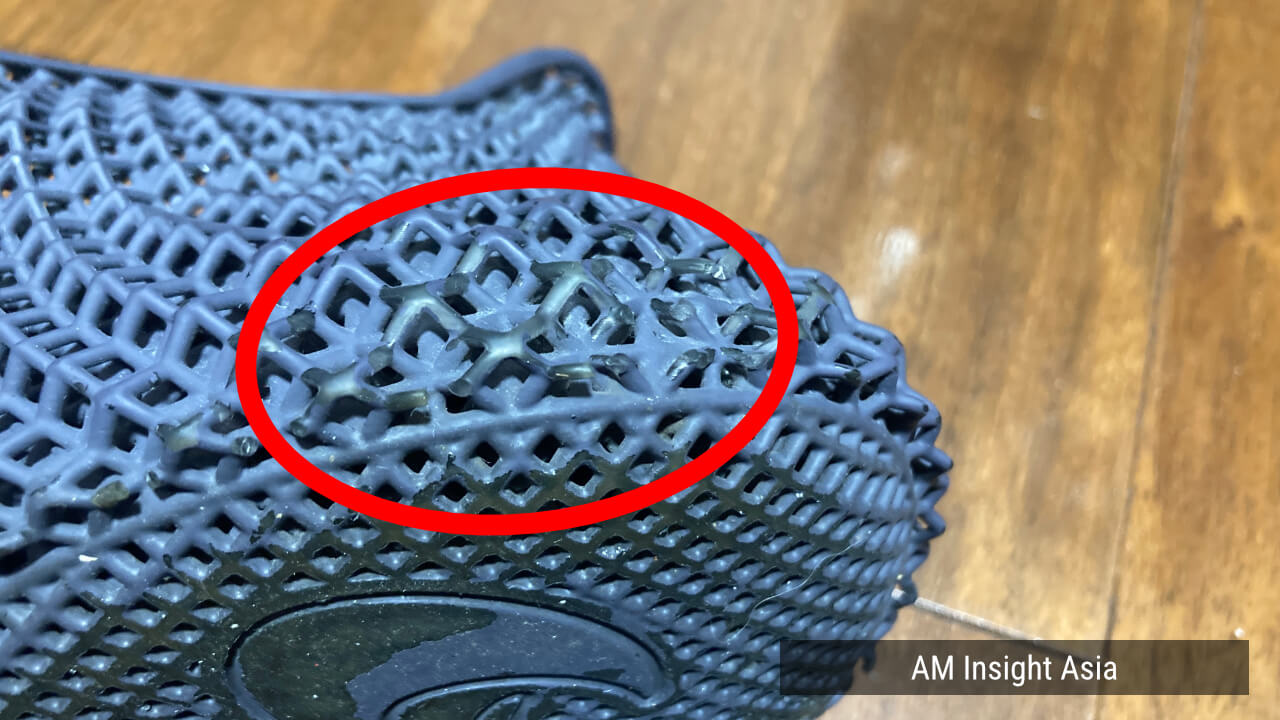
The sole has no major problems. There is a little damage around its outer edge, but not enough to tell whether it came from walking or from a step.
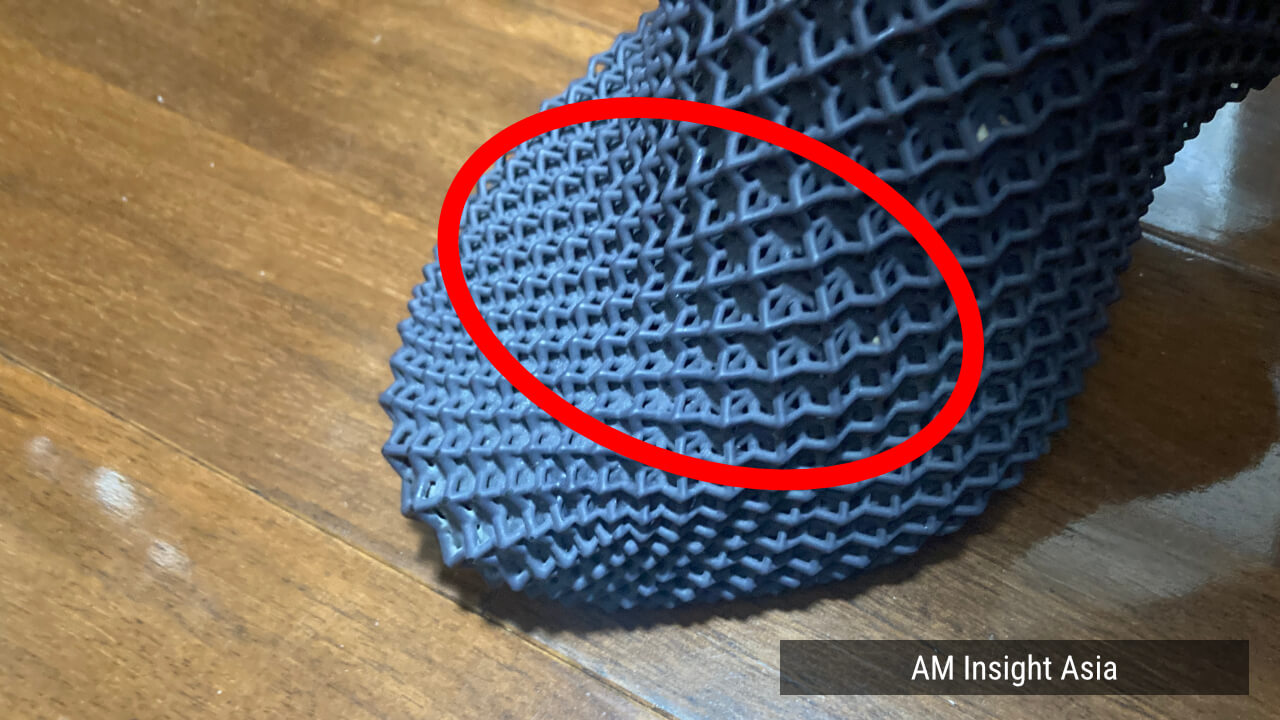
On the upper, too, the toe-side instep, which flexes with every step, shows no problems at all.
What broke was the V-shaped opening where the foot goes in. Once a crack formed, nothing stopped it, and the tear simply kept spreading.
The tear follows a clear pattern. It runs from the apex of the V-shaped opening diagonally toward the toe. The lattice is made up of peaks and valleys, and the fractures sit at the apexes of the valleys.
Why I believe it is design, not material or printing
There are three possible causes: material, printing and design. How the shoes were worn may play a part, but it is hard to imagine I wore them in a way that put unexpectedly heavy loads on the upper. With the sole, that might be possible.
I do not think it is the material, because the sole, made of the same material, is largely intact. On the upper, too, as noted above, the toe side that flexes with every step has no problems at all. The lattice firmly disperses and absorbs ground impact in the sole and the bending of each step in the upper. The only place a problem occurred is where the foot goes in.
I do not think it is the printing either, because the sole and upper were printed together as a single piece on the same machine.
That leaves design. The key is the V shape of the opening, probably chosen with both looks and ease of putting the shoe on in mind. But when you put your foot in, this part is pushed hard toward the toe.
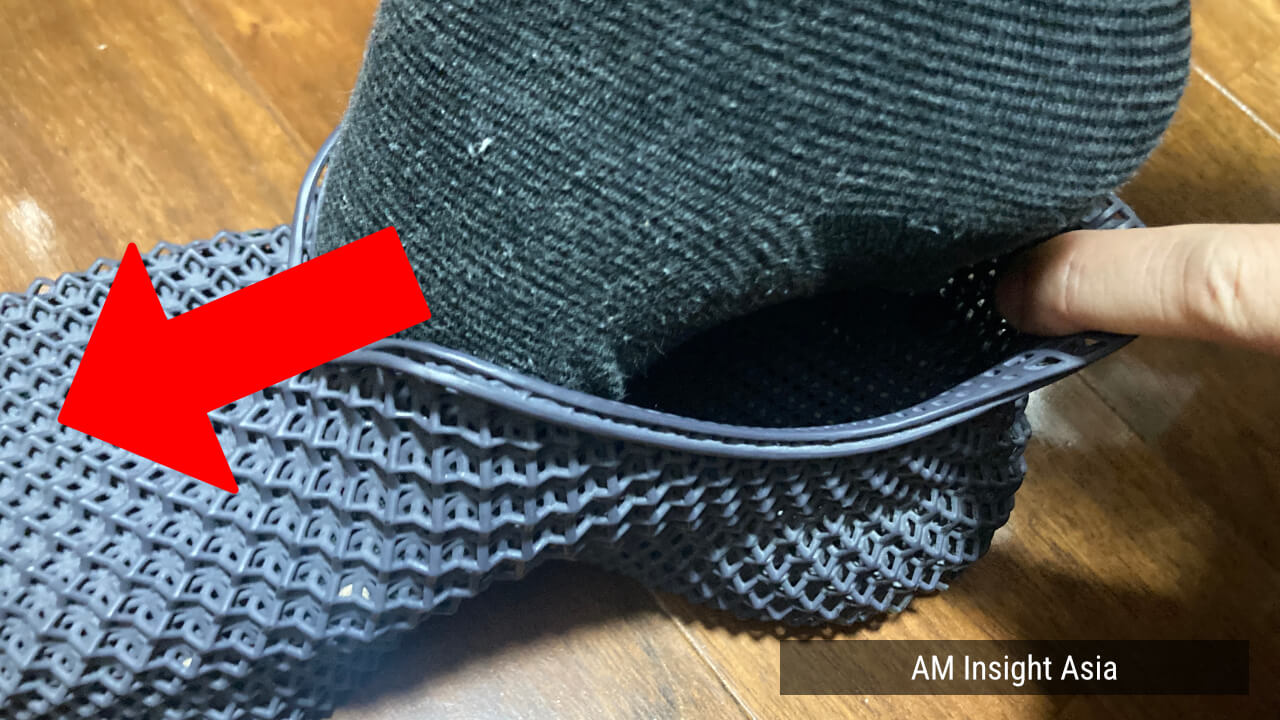
If the opening were wide enough for the foot to slip straight in, the shoe would be loose once on. This force, it seems, then flows diagonally forward to the left and right along the V. The apex of the V becomes the starting point of a stress concentration, where forces pulling in opposite directions converge. The tear began at exactly that apex, at the base where the rim of the opening meets from both sides. It is not as strong as when the shoe is put on, but since the ankle bends with every step, I imagine a similar force acts here as you walk.
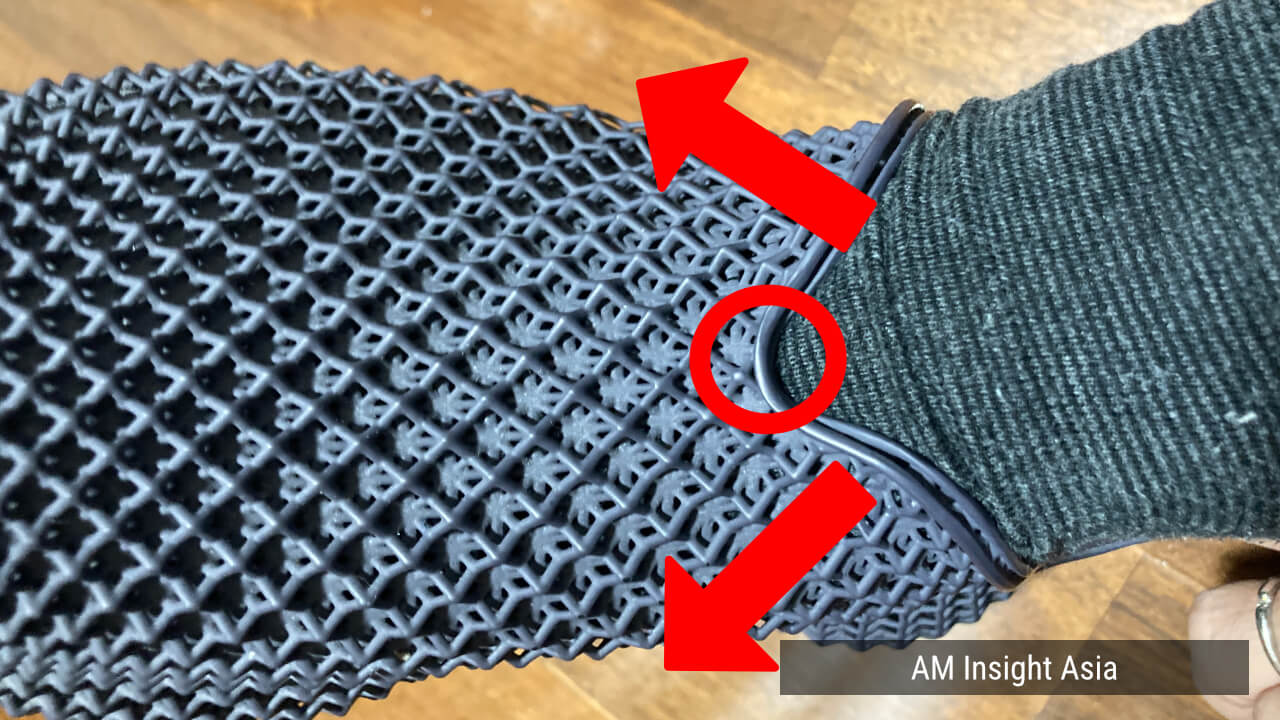
The apexes of the lattice valleys are shaped like small Vs, and gather force in the same way. The crack that started at the apex of the large V seems to have advanced by following the apexes of the small valleys.
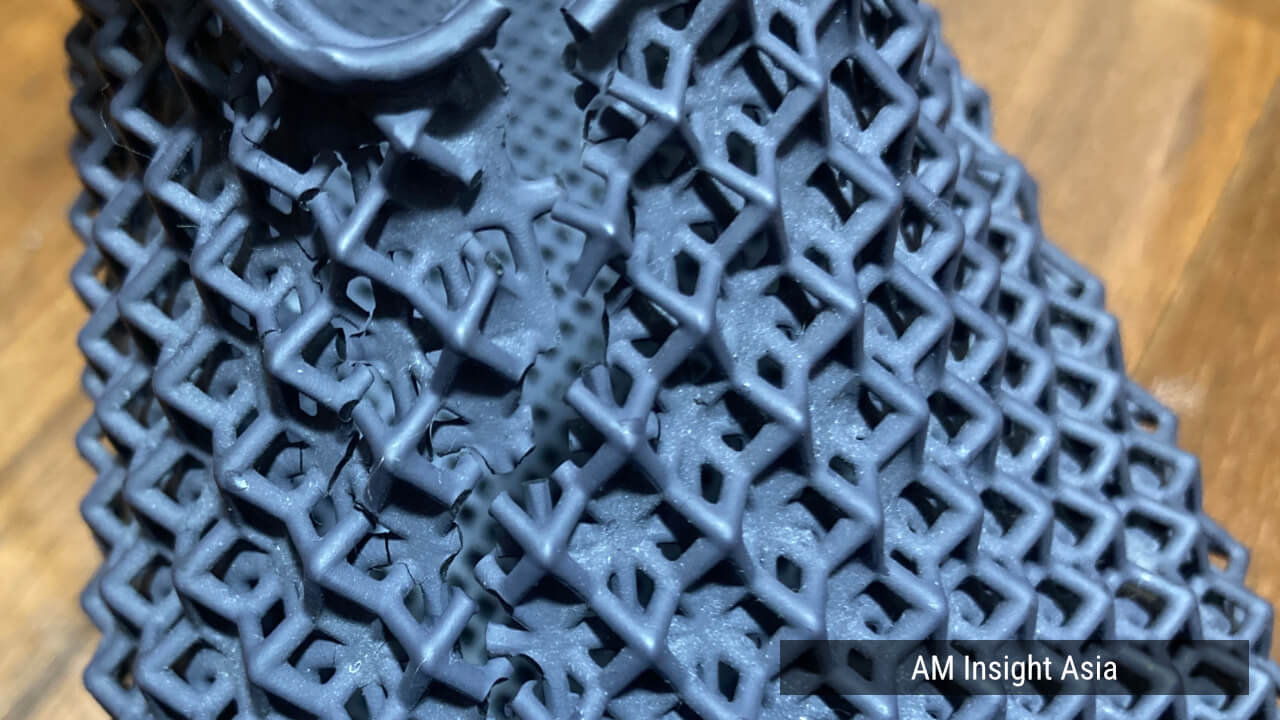
Seen from a fail-safe perspective, the shoe did not appear to have been built with what happens after damage in mind. As a single-piece structure, it seems to have nowhere to stop a crack once it forms, because the same lattice structure continues throughout without any section where strength increases. If the rim of the opening had been a little thicker, say, or if thin and thick lattice had been combined, a fail-safe effect might have kicked in, and the tear might not have grown so large that the shoe could no longer be worn.
The comments were split on this point. Some questioned the design, pointing out that the lattice’s countless nodes become starting points for fatigue failure, with stress concentrating there each time the shoe bends. Others pointed to the material, noting that 3D printed polymers differ from injection molded parts in fatigue behavior and long-term durability, and that anisotropy from build orientation or UV degradation could also play a role. One researcher read the photo of the tear as stable crack growth under tensile load.
I do not rule out material factors also playing a part. Even so, I believe the main cause is design. Everyone pays attention to the sole, but the upper may have been overlooked.
AM Insight Asia Perspective
As someone involved in AM and working in media, I am not too bothered by this failure. What concerns me is how an ordinary consumer would take it.
Some commenters said a year and a half is reasonable, noting that even ordinary sneakers can wear out within six months to a year. Some shoes surely do. But usually, even shoes costing a few thousand yen (a few tens of US dollars) last for years. This is the first time a pair of mine has broken after a year and a half, and I have sneakers that cost about 5,000 yen (around US$30) that I have worn for more than five years. Seeing a year and a half as reasonable may be a view that comes from experts who understand the technology. How many ordinary consumers buy shoes costing around 26,000 yen (about US$165) knowing that will be their lifespan? Only a small group interested in the technology may be satisfied with “it was fun because they were made on a 3D printer.” The more people expected, the more let down they are likely to feel. That reaction may not stop at “3D printed shoes are no good” and could spread to “3D printing doesn’t work.”
In my Formnext Asia Shenzhen report in September, I wrote that the 3D printed footwear on display centered on color, form and design, and that exhibits backing up durability or comfort with data were hard to find. This failure strengthened my impression that design is taking priority over specifications and function.
That is exactly why I want to rethink what design is, and what it means to make a product. Designing for function and appearance is not enough. How long does it last? How does it fail? When it does fail, can the person using it accept that? I believe thinking through what a product should be, as a whole, is also part of design. Some may say that goes without saying. But not only with 3D printed shoes, 3D printers have lowered the barriers to making things, for better and for worse. We are now in an era where people who are not manufacturing professionals can make things easily. What a product truly needs is decided not by the material or the machine, but by its design.
Personally, I accept that this sort of thing happens when you take on a challenge in making things. Even so, I feel my own bar for buying another pair of 3D printed shoes has risen a little. I hope the failure of this one pair does not shape how 3D printers and the AM industry as a whole are judged.