A metal-plus-scaffold process that uses neither lasers nor binders, as competition in desktop metal AM heats up
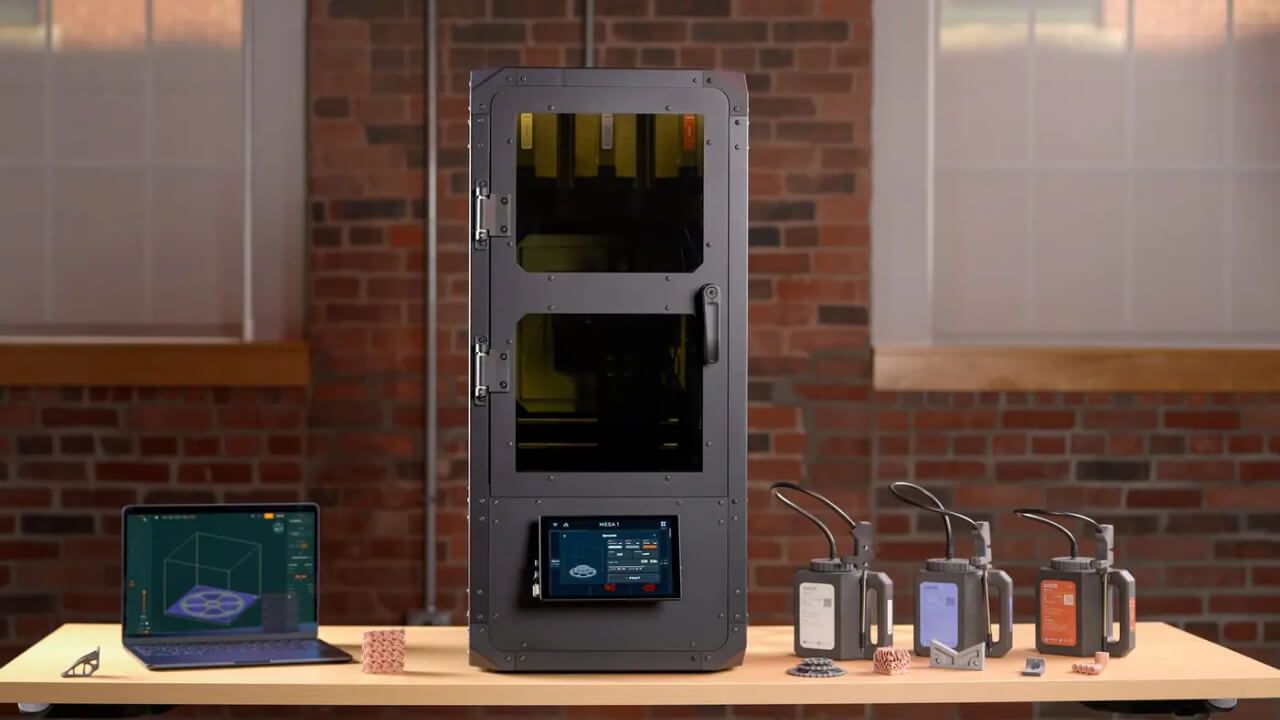
Studio 3e8, a startup based in Somerville, Massachusetts, unveiled the Mesa 1 on October 28, 2026, a desktop metal 3D printer with a built-in sintering furnace. The machine deposits two powders, metal and scaffold, layer by layer, and then sinters the printed part right where it sits inside the furnace. It uses no lasers and no binders. Sales open on Kickstarter on December 1, starting at $3,500.
Metal and scaffold, placed layer by layer and sintered inside the furnace
The Mesa 1 workflow has three steps, which the company calls Slice, Shape and Solid. Studio 3e8’s slicer, running on the user’s laptop, splits a 3D model into print data for two materials: metal and scaffold. The printer deposits both from fully sealed powder cartridges. The metal forms the part, and the scaffold holds its shape. The reveal video shows the nozzle laying down white scaffold powder in lines and placing dark gray metal powder in the spaces between them that form the part. Because the scaffold fills the space under overhangs and inside cavities, no support structures are needed.
The part is printed directly into a crucible inside the integrated furnace, and once printing ends, the furnace automatically sinters it into dense metal. There is no step where the part has to be moved or handled in between. The company says there are no supports to remove and no loose metal powder to handle. And because no binder is used, there is no debinding step at all.
The Mesa 1 runs on a standard 120 V wall outlet, and its first metals are carbon steel and copper. The company lists scaffold alongside these in its material lineup, which means users need scaffold cartridges in addition to metal ones. Whether the scaffold can be reused has not been disclosed. The machine is patent pending.
Folding post-processing and powder equipment into one machine
Compact metal AM has largely followed two paths so far. The first extrudes metal filament, made of metal powder held together with a polymer binder, and then removes the binder in a separate unit (debinding) before sintering. Its advantage is that parts can be printed on ordinary 3D printers, but a separate debinding and sintering furnace is required. The second is laser powder bed fusion (L-PBF), which assumes dedicated powder handling equipment and a supply of inert gas. SnowPod, the desktop machine announced by Suzhou, China-based SnowX, uses this approach and is now taking early reservations on Kickstarter.
SnowPod targets fine detail with a 40 μm laser spot and uses sealed, replaceable cartridges for both powder supply and recovery. It needs a nitrogen supply to print, and the early reservation price for the set with NitroPod, a generator that extracts nitrogen from ambient air, is $5,599, against a suggested retail price of $9,999. The Mesa 1’s $3,500 is nearly 40 percent lower. Both are campaign prices, and Studio 3e8 has not announced a regular price for the Mesa 1. By combining deposition and sintering in one machine and keeping the metal powder in sealed cartridges, the Mesa 1 aims to eliminate both the debinding and sintering furnace of the first approach and the powder equipment of the second. Faced with the same goal of printing metal in an office, SnowPod answers by shrinking L-PBF, while the Mesa 1 answers by integrating the sintering-based process.
What remains undisclosed about the scaffold
Much of the information at the heart of the process has not been made public. The scaffold’s composition, how it is separated from the part after sintering, the sintering temperature and atmosphere, build volume, layer thickness, dimensional tolerances and how sintering shrinkage is compensated have all yet to be disclosed.
One clue lies in the company’s trademark filings. Alongside metal powders for 3D printers, the listed goods include ceramic powders for use in 3D printers. This suggests the scaffold may be a ceramic-based material, but the company has not disclosed what the scaffold is made of.
AM Insight Asia Perspective
By eliminating the binder, the Mesa 1 has taken on a new challenge: separating the scaffold from the part after sintering. A binder is drawn out of the part’s interior with heat or solvents, but the scaffold physically sits around the part and inside its cavities, so in the end it can only be pulled away mechanically. If it bonds to the part surface even slightly at high temperature, separation marks or a rough surface will remain.
Design freedom is affected as well. A filament process places material only where it is needed, so a cavity can be closed off while still empty. In a process that fills every layer completely with powder, cavities are likely to end up full of scaffold. Parts with fully enclosed cavities would trap the powder inside, making such shapes effectively impossible. Even internal channels with an outlet raise the question of whether all the sintered scaffold can be cleared from long, narrow or winding passages. It is the same problem L-PBF faces with depowdering.
Fine detail is likely to have limits too. In the reveal video, the nozzle’s paths remain on the powder surface wide enough to follow by eye, and the finest feature the machine can reproduce is bound by that deposition width. None of the sample parts shown so far display the kind of fine detail seen in the SnowPod samples AMIA examined at TCT. Sintering shrinkage also has a larger effect on thinner features. It seems fair to see the Mesa 1 as a machine suited to functional parts such as jigs and brackets rather than jewelry or small precision components.
At the same time, the idea of supporting metal with a ceramic that sinters at a higher temperature and removing it afterward is not new. Choosing a material alone should not be enough to lock competitors out with patents. So what has the company filed for? How does it lay down two dry powders, layer by layer, without a binder and without them collapsing? How well does the boundary between metal and scaffold stay unmixed, and can the part be released cleanly after sintering? The core of the technology seems to lie less in the material itself than in this process of combining deposition and sintering in one machine, but there is not yet enough information to judge. We look forward to a more detailed announcement.
As long as the scaffold, and not just the metal, comes in proprietary cartridges, the Mesa 1’s main revenue stream could be ongoing consumable sales rather than hardware. The $3,500 machine price can also be read as the entry point to that model.
If used scaffold could be recovered and reused after sintering, running costs would come down. However, scaffold near the boundary with the part is likely to pick up metal particles, and it is questionable whether those can be separated out while keeping quality consistent. The detailed Kickstarter information may address this, but if reuse proves difficult, the scaffold becomes a consumable used up with every print, and cartridge sales carry even more weight.
When the Kickstarter campaign opens on December 1, one more thing worth watching, ahead of build volume or accuracy figures, is how much of the post-sintering work is automated. The powder itself sits in cartridges, so users may never touch it during printing, but does scaffold removal happen entirely inside the machine, or do users knock it off by hand after taking the part out? How is the removed powder collected and disposed of, and can it go back into a cartridge? Not handling loose metal powder is not the same as not handling powder at all. Whether the claim of a metal printer fit for the office holds up depends on how much of the hassle of cleaning up powder has actually gone away.
About the Company
Studio 3e8 is a Somerville, Massachusetts-based developer of desktop metal 3D printing. Casey Johnson (co-founder and CEO) founded the company in 2023 and was joined by co-founder and CPO Cassie Lowell. The company grew from an attic to a garage before settling at Greentown Labs in Somerville, and it was selected for Harvard Innovation Labs’ Launch Lab X accelerator. Its first product, the Mesa 1, was developed as an ecosystem that integrates a new printing technology with software, hardware and materials.