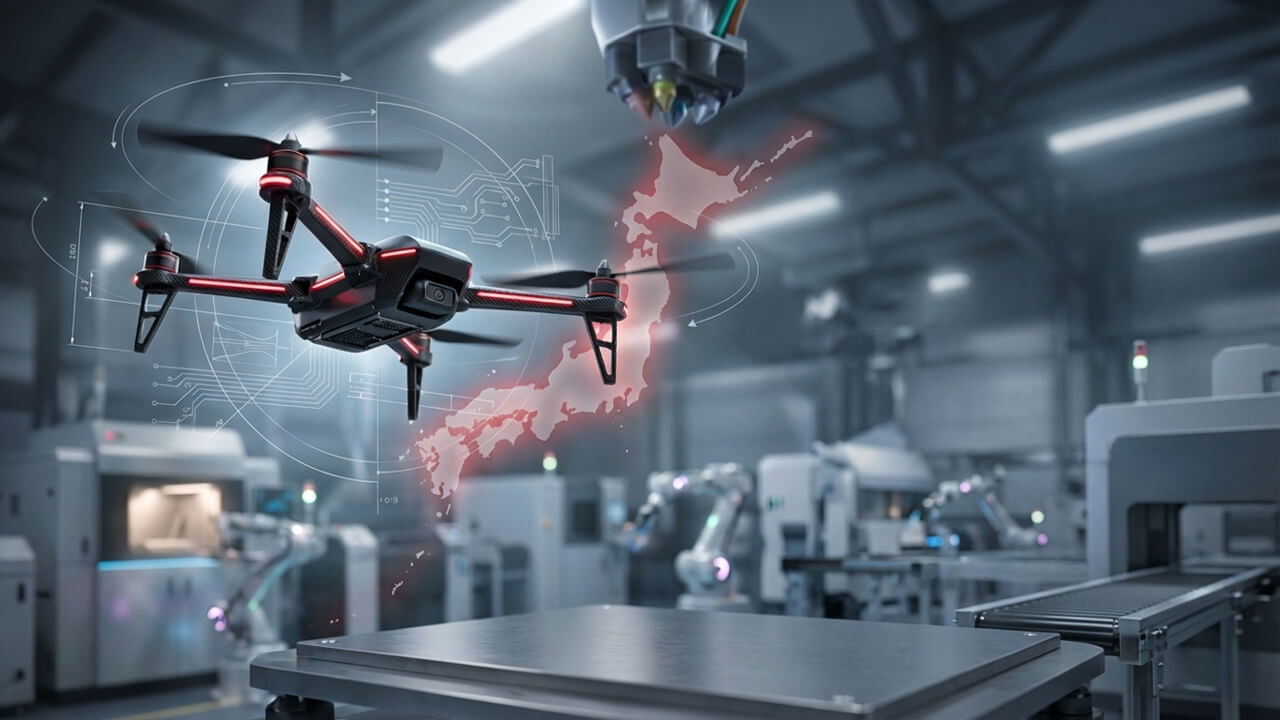
The Japanese government has designated drones as specified critical materials under the Economic Security Promotion Act and is launching support for domestic production. It will subsidize up to 50% of costs for research, development, and capital investment, aiming to establish an annual production capacity of 80,000 units by 2030. The Ministry of Economy, Trade and Industry (METI) is expected to open applications within fiscal year 2025.
Support targets include drones used for disaster response such as firefighting, infrastructure inspection of bridges and roads, and agricultural applications like pesticide spraying. The policy covers not only airframes but also production facilities for key components such as motors and batteries.
Current State and Challenge: 80-Fold Production Scale-Up
According to a survey conducted by the Japan Industrial Unmanned Aircraft Association of its 73 member companies, domestic production in 2024 was limited to approximately 1,000 units annually. Meanwhile, unmanned aircraft weighing over 100 grams registered under the Aviation Act reached 447,000 units as of the end of March 2025, doubling from 213,000 units when the registration system began in June 2022.
From a situation where over 90% of supply is dominated by Chinese manufacturers to an annual domestic production capacity of 80,000 units—this represents an 80-fold production expansion. Achieving this target using only conventional manufacturing methods presents significant challenges.
Anduril Case Study: LFAM Technology Reduces Development Time to One-Third
In December 2025, U.S. defense tech company Anduril Industries, valued at $47 billion, established a Japanese subsidiary and announced development of “Kizuna,” a drone made with 100% Japanese components. The company acquired Large Format Additive Manufacturing (LFAM) technology through its 2022 acquisition of Boston-based Dive Technologies.
This technology has been proven in the Ghost Shark underwater drone program. For Ghost Shark development for the Royal Australian Navy, LFAM technology enabled manufacturing of pressure-resistant composite hulls on a weekly basis. The development period was reduced from the typical 10+ years for defense equipment procurement to under three years, securing a formal contract worth A$1.7 billion (US$1.12 billion) from the Australian Department of Defence in 2025. The prototype was completed one year ahead of schedule and within budget.
The success of Ghost Shark stems from integrating Dive Technologies’ LFAM-based manufacturing with Anduril’s autonomy software. This enabled the transition from concept to production in under three years, achieving a development speed dramatically different from traditional defense acquisition processes.
Key advantages of LFAM technology include reduced part counts through integrated molding of complex shapes, design flexibility, establishment of mass production systems through modular design, and significant cost reduction compared to traditional steel or titanium pressure hulls.
Implications for the AM Industry: Is There Readiness to Seize the Opportunity?
The government subsidy program targets not only airframe manufacturers but also production facilities for key components. Multiple entry opportunities exist for AM-related companies, including supply of high-temperature resistant materials and carbon fiber composites, and provision of large-format fabrication equipment.
However, the issue is not the general proposition that “AM technology can be used for drone manufacturing.” What materials are suitable for mass production systems of 80,000 units annually? Do machines exist with cost-performance adequate for mass production? Most critically, Japan lacks large-scale manufacturing farms like the facility Anduril built in Sydney.
Anduril constructed a dedicated manufacturing facility in Australia and established a mass production system in collaboration with multiple suppliers. In contrast, Japan faces an 80-fold expansion from 1,000 units annually to 80,000 units—yet no concrete vision exists for the manufacturing system to achieve this.
METI’s application period begins within this fiscal year. As drone manufacturers consider applications, can AM-related companies propose “materials optimized for mass production,” “equipment with superior cost-performance,” and “manufacturing systems supporting large-scale production”?
The AM industry has historically failed to approach such opportunities in a timely manner. While track records in prototyping and small-lot production are abundant, proposing production of tens of thousands of units annually is a different matter entirely. Whether this barrier can be overcome will determine entry into the massive market of domestic drone production.
The stage of discussing technical possibilities has ended. What is now demanded are concrete solutions for realistic mass production systems.
Sources:
- Government to Subsidize Domestic Drone Mass Production, Aiming for 80,000 Units Annually – Livedoor News
https://news.livedoor.com/article/detail/30328306/ - U.S. Defense Tech Anduril Enters Japan, Pure Domestic Drone Manufacturing – Nikkei
https://www.nikkei.com/article/DGKKZO92990380T01C25A2EA2000/ - Anduril Establishes Japanese Subsidiary, Palmer Luckey: “Creating Defense Equipment for Japan, in Japan” – Jitsugyo no Nihon Forum
https://forum.j-n.co.jp/narrative/8924/