Introduction: The Gap Between Technical Possibility and Structural Reality
In Part 1, we examined how AM is transforming the Thailand automotive industry from the perspectives of technical necessity and industrial ecosystem. The manufacturing paradigm changes brought by the transition to EVs—parts count reduction, development period shortening, weight reduction demands, high-mix low-volume production response—strongly suggest the utilization of AM. The Thai government’s EEC policy and BOI investment incentives, fusion with the automation industry, and accumulation of specific use cases indicate that an environment for AM introduction in the Thailand automotive industry is indeed taking shape.
However, a deep chasm exists between technical possibility and actual implementation.
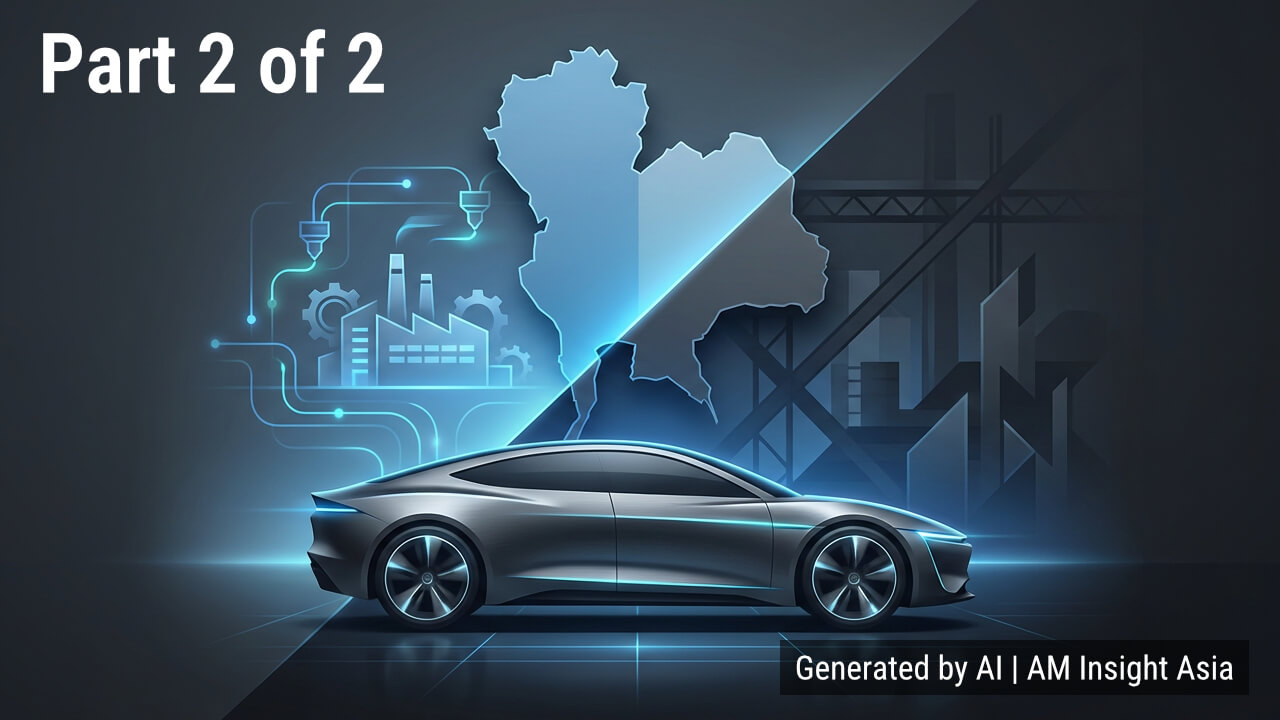
This article reveals the true nature of that chasm—namely, the reality of decision-making structures in the Thailand automotive industry supply chain. Who determines whether Thailand automotive industry suppliers can introduce AM technology? And why do those decisions polarize the future of the Thailand automotive industry into “light” and “shadow”?
Chapter 4: Parent Company Strategies That Determine Thailand Automotive Industry Supplier Fate
The Reality of Pyramid-Type Supply Chains
When discussing the Thailand automotive industry, one important fact is often overlooked. That is the reality that Thai domestic suppliers do not substantially hold the authority to decide whether or not to introduce AM technology.
The Thailand automotive industry supply chain is formed in a strict pyramid-type order structure. Complete vehicle manufacturers positioned at the apex define technical specifications and manufacturing processes, and those directives flow down to Tier 1, Tier 2, and Tier 3. In this structure, the flow of information and decision-making is fundamentally a one-way street “from top to bottom.”
When Thailand automotive industry suppliers attempt to introduce AM equipment, the following approval processes are necessary:
- Approval of AM equipment specifications by the parent company’s technical department
- Confirmation of AM manufactured products’ conformity to quality standards
- Audit and certification of the entire manufacturing process
- Parent company approval or financial support for AM initial investment
In other words, suppliers “independently deciding” to introduce AM is substantially impossible from the perspectives of contractual relationships and quality control systems in the Thailand automotive industry.
Strategic Stance Differences Create Disparities
So, are parent companies’ attitudes toward AM uniform in the Thailand automotive industry? The answer is clearly “no.” Complete vehicle manufacturer strategies differ greatly not by nationality but rather by “corporate strategic stance.”
Speed and Innovation-Oriented Type: This type of company positions lead time reduction to market as the highest priority and actively embraces AM. In the new product category of EVs, they dislike being constrained by existing supply chains and show a strong tendency to actively utilize AM.
Some Chinese manufacturers like BYD belong to this category, but Western emerging EV manufacturers and some Asian startups also take similar approaches. These companies perceive AM not as a “prototyping tool” but as “part of the mass production process,” and also demand active AM introduction from Thailand automotive industry suppliers.
Quality and Existing Relationship-Oriented Type: In contrast, this type of company emphasizes quality control systems cultivated over many years and maintenance of relationships with existing suppliers. While recognizing the possibilities of AM, they take a cautious stance toward introduction, considering mass production quality stability, long-term supply systems, and investment recovery in existing molds.
Some Japanese manufacturers like Toyota and Honda and Western legacy automotive manufacturers tend to be classified in this category. For these companies, AM is a “complementary tool,” not something that fundamentally transforms existing Thailand automotive industry manufacturing processes.
Hybrid Type: As a third category, there also exists a corporate group positioned between the two. This is an approach of using strategies differently by product line, such as actively adopting AM in EV-dedicated platforms while maintaining conventional manufacturing methods for existing ICE vehicles and hybrid vehicles.
Thailand Automotive Industry Suppliers’ Reality
This difference in parent company strategy holds decisive meaning for Thailand automotive industry suppliers.
Suppliers belonging to speed-oriented company systems receive AM equipment introduction support, are provided with DfAM (Design for Additive Manufacturing) technical training, and are required to transition to new manufacturing methods. While this means the burden of AM investment and human resource development in the short term, it potentially leads to acquiring competitiveness adapted to the EV era in the long term.
On the other hand, suppliers belonging to quality-oriented company systems are required to maintain existing manufacturing processes and may not receive opportunities to introduce AM. While this means stable orders in the short term, it contains the risk of being left behind by rapid EV market changes and AM technology advancement in the long term.
What is important is that this choice is not made by Thailand automotive industry suppliers themselves but is effectively determined by “which parent company they have transactional relationships with.”
Proposals Are Possible, Adoption Decisions Rest with Parent Companies
Of course, it is possible for Tier 2 or Tier 3 suppliers to propose AM utilization to parent companies. In fact, cases exist where parent company interest is drawn by showing specific merits of cost reduction or delivery period shortening.
However, whether that proposal is adopted ultimately depends on parent company strategic judgment in the Thailand automotive industry. If the parent company:
- Does not recognize AM products under current quality standards → Proposal is rejected
- Prioritizes maintaining relationships with existing suppliers over AM adoption → Proposal is held
- Judges that the timing for AM introduction is not right → Proposal is postponed
In other words, what is decisively important for Thailand automotive industry suppliers is not “their own technical capabilities” or “enthusiasm for innovation” but “to which parent company system with what strategic stance they belong.”
Conclusion: Thailand Automotive Industry Outlook Toward 2030—Light and Shadow
Thailand Is the Stage, Parent Companies Are the Decision Makers
As we have seen in this article, EV shift and AM technology introduction in the Thailand automotive industry is a technically extremely rational and inevitable process. Parts count reduction, weight reduction demands, development period shortening—all of these strongly suggest AM utilization.
However, whether “possibility” actually becomes “reality” is not determined solely by the efforts of companies and government within the Thailand automotive industry. True decision-making power lies in the headquarters strategy rooms of complete vehicle manufacturers with factories in Thailand—many of which are Chinese, Japanese, and Western companies.
The title “Detroit of Asia” for the Thailand automotive industry does not mean that Thailand proactively became the center of automotive industry innovation. Rather, it indicates that Thailand is a “chosen stage.” Those deciding whether AM is implemented are always foreign capital complete vehicle manufacturers.
Light and Shadow—The Polarizing Future of Thailand Automotive Industry Suppliers
Toward 2030, Thailand automotive industry suppliers may polarize based on their parent companies’ stance.
Suppliers Enjoying the “Light”: Suppliers with transactional relationships with speed and innovation-oriented parent companies receive AM investment support, acquire DfAM specialized knowledge, and build manufacturing capabilities adapted to the EV era. These Thailand automotive industry suppliers expand along with parent company growth and potentially possess competitiveness with other complete vehicle manufacturers also in view.
Suppliers Facing the “Shadow”: Suppliers with transactional relationships with quality and existing relationship-oriented parent companies maintain stable orders in the short term but do not gain AM investment opportunities. The more their parent companies’ EV strategies and AM adoption are delayed, the more delayed their response to new manufacturing technologies becomes, ultimately facing the risk of being forced to exit the Thailand automotive industry market.
Government’s Role—Limitations and Possibilities
The Thai government’s EEC policy and BOI investment incentives are certainly preparing the environment for AM introduction in the Thailand automotive industry. MTEC (National Metal and Materials Technology Center) material research and standardization efforts are also important.
However, whether these policies actually connect to industrial competitiveness ultimately depends on “which complete vehicle manufacturers with what strategic stances choose the Thailand automotive industry.” What the government can do is provide an attractive investment environment and prepare technical infrastructure. Actual AM introduction decision-making is entrusted to private companies—and moreover, foreign capital companies.
Facing the Reality of Thailand Automotive Industry
Therefore, when looking ahead to the Thailand automotive industry in 2030, what we should ask is not “how Thailand will change” but “what strategies the corporate group that chose Thailand as a stage will take.”
AM certainly accelerates the EV shift. However, whether the Thailand automotive industry can enjoy those benefits is not determined by Thailand’s own efforts alone. Depending on parent company nationality, corporate culture, and strategic stance, the future of Thailand automotive industry suppliers can become either “light” or “shadow.”
Behind the light of the title “Detroit of Asia,” deep shadows always exist. Facing that reality directly is the first step in understanding the true nature of the Thailand automotive industry.
> Light and Shadow of Thailand Automotive Industry: AM Possibilities Accelerating EV Shift – Part 1
Sources:
- Thailand Automotive Institute (2019) – Production capacity data
- Mongabay (2023) – ICE vs EV parts count comparison
- Reuters, Rest of World, McKinsey (2025) – Chinese EV development timelines
- Thailand Board of Investment (2025) – Tax incentive guidelines