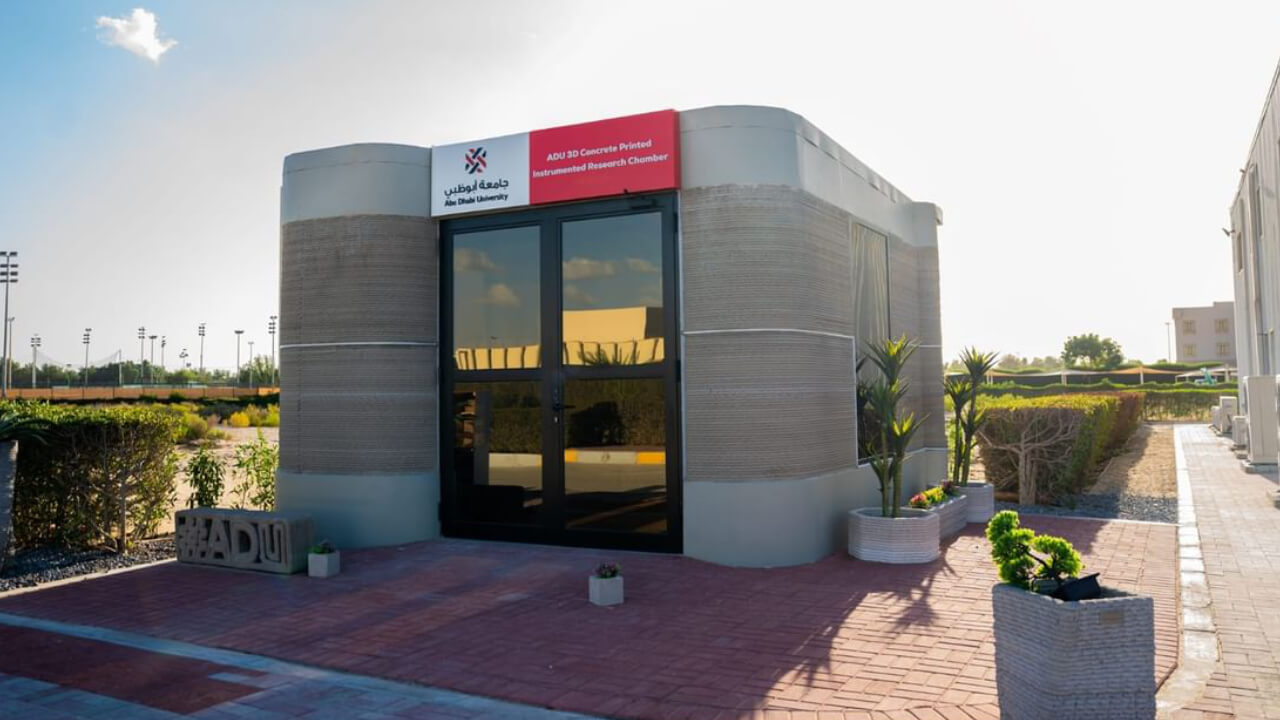
Abu Dhabi, January 16, 2026 — Abu Dhabi University (ADU) has inaugurated its first construction 3D printing research chamber, marking a milestone as the UAE’s first full-scale research facility built by an academic institution dedicated to this emerging technology. This research chamber is a full-scale structure constructed using construction 3D printing technology, equipped with integrated sensors to evaluate the long-term performance of 3D-printed concrete structures under real environmental conditions. The facility aims to advance scientific understanding and support the future development of smart, sustainable construction practices.
The inauguration ceremony took place at ADU’s Innovation Center (ADUi) and 3D Concrete Printing Research Lab, attended by the Chancellor, senior academic leadership, faculty members, and key government and industry stakeholders.
Four Years of Construction 3D Printing Research and Development
The chamber represents the culmination of four years of dedicated research and experimentation by ADU’s research team. Every aspect—from design and printing to assembly and instrumentation installation—was handled by the research team led by Professor Samer Al Martini and Associate Professor Dr. Reem Sabouni from the Department of Civil Engineering. The structure was developed at ADU’s 3D Concrete Printing Research Lab, which was inaugurated in 2023 and provides faculty and students with access to advanced construction 3D printing technologies and hands-on research opportunities.
While several 3D-printed concrete structures have been developed across the UAE as industry-led demonstration projects focused on constructability and architectural feasibility, this project is the first to be developed entirely within a university-led research framework. ADU’s chamber has been designed as an integrated research-driven platform to evaluate how construction 3D printing structures perform over time under environmental and operational loading conditions.
Continuous Monitoring with Advanced Sensor System
The facility is fully instrumented with advanced sensors and monitoring systems, enabling continuous, real-time assessment of structural behavior. The data generated will help advance research in building performance and materials, supporting smarter, more sustainable construction and the development of future 3D-printed buildings.
Professor Al Martini, Project Lead, stated, “This chamber enables long-term, data-driven research into how 3D-printed concrete structures perform in real conditions, helping move the technology towards scalable and well-informed future applications.”
A key feature of the project is the use of research-developed concrete mixes, formulated in-house by the ADU team using locally sourced UAE materials. These mixes are supported by published research outcomes, including internationally recognized US publications, contributing original scientific knowledge to the field of construction 3D printing.
Modular Construction Principles Applied to Construction 3D Printing
Dr. Sabouni, Project Lead, explained, “This project applies modular construction principles to 3D concrete printing, with all wall elements fully 3D-printed and assembled as an integrated modular system. This approach enhances scalability, transportability, quality control, and repeatability, which are critical for future large-scale deployment and sustainable infrastructure applications.”
Professor Ghassan Aouad, Chancellor of Abu Dhabi University, said, “This inauguration reflects our commitment to advancing research excellence and applied innovation that delivers real-world impact in the field of civil engineering. The UAE provides an environment that empowers universities to innovate, experiment, and push the limits of what is possible. This 3D concrete printed instrumented research chamber strengthens our contribution to national priorities in developing sustainable infrastructure, smart construction, and future-ready engineering solutions.”
Preparing Future-Ready Engineering Graduates
Beyond its research objectives, the facility plays a key role in enhancing experiential learning for civil engineering students, offering practical exposure to advanced construction technologies, materials development, structural monitoring, and real-world research applications. This hands-on engagement supports ADU’s commitment to preparing future-ready graduates with industry-relevant skills in sustainable and smart construction.
Industry Implications: The Need for Region-Specific Long-Term Performance Data in Construction 3D Printing
While construction 3D printing projects are rapidly increasing worldwide, empirical data on long-term structural performance remains limited. Concrete mix designs are significantly influenced by region-specific environmental factors such as temperature, humidity, diurnal temperature variations, and UV radiation intensity. A mix design that succeeds in one region may not necessarily perform well in another.
In coastal areas like Abu Dhabi, summer temperatures can reach 45-50°C with humidity levels soaring to 80-90%, creating an extremely hot and humid environment. Concrete performance under such harsh environmental conditions becomes critical. ADU’s research chamber continuously monitors the behavior of construction 3D printing structures under these real-world conditions, contributing to the development of material formulations and construction methods optimized for regional characteristics.
What makes this research particularly significant is its use of “locally sourced UAE materials.” While many countries rely on imported cement and admixtures, the utilization of local materials is essential from a sustainable construction perspective. ADU’s approach could serve as a model case for Asian countries seeking to establish construction 3D printing technologies based on their unique climatic conditions and local materials.
Whereas demonstration projects prove that construction “can be done,” ADU’s research facility scientifically verifies that structures “can be safely used over the long term.” This distinction represents the key to overcoming the final hurdle in the practical implementation of construction 3D printing technology.