Over the past few years, the Japan industrial AM market has seen Japanese distributors successively announce partnerships with Chinese industrial AM manufacturers. When press releases are organized chronologically, a clear trend emerges. Behind this lies the possibility that Japan’s industrial AM market, particularly the metal sector, is entering a new phase, along with strategic competition over the limited resource of distributors.
Timeline of Distributor Contracts
When organizing the relationships between major Chinese industrial AM manufacturers entering Japan’s industrial AM market and their distributors, the following movements can be confirmed:
| Manufacturer | Technology | Distributor | Contract |
|---|---|---|---|
| Farsoon | SLS (Polymer) LPBF (Metal) | Japan 3D Printer | January 2022 |
| UnionTech | SLA (Polymer) SLM (Metal) | CMET | March 2022 |
| HBD | LPBF (Metal) | SK Additive | April 2023 |
| BLT | LPBF (Metal) | ORIX Rentec | June 2023 |
| Farsoon | SLS (Polymer) | Japan 3D Printer, SOLIZE PARTNERS, Farsoon (3-party partnership) | July 2025 |
| UnionTech | SLA (Polymer) SLM (Metal) | JMC (with Nihon Mirai Giken) | October 2025 |
| INTAMSYS | FDM (Polymer) | Sunstella, Brule | November 2025 |
| Eplus3D | LPBF (Metal) | Distributor TBD | 2026? |
What’s notable is the continuous movement over recent years. Contracts with metal AM manufacturers stand out, but movements are also occurring in other technology areas such as polymer SLS and SLA.
Structural Characteristics of the Japanese Market
The Absolute Role of Distributors
In the Japan industrial AM market, direct sales are nearly impossible for equipment manufacturers. Customer companies prioritize post-purchase maintenance services, technical support, training, and consumables supply. Only distributors with bases in Japan, Japanese language support, and the ability to quickly dispatch to sites can provide these.
Moreover, the larger the company, the more they can only purchase from companies with which they have established trading accounts. Even if new manufacturers approach directly, passing through the purchasing department is difficult. Distributors are not merely sales windows but essential partners for overcoming the entry barrier of existing business-to-business relationships.
The Difficulty of Handling Competing Manufacturers
What’s important is the difficulty for distributors to handle competing manufacturers simultaneously. While technically possible, and some distributors do handle multiple manufacturers, practical challenges exist including relationships with existing manufacturers, setting customer recommendation criteria, and allocating limited sales resources.
For example, when handling multiple manufacturers in the same metal LPBF field, what criteria should be used to recommend products to customers? If sales staff cannot explain clear differentiation points, it causes customer confusion. Additionally, each manufacturer has expectations for sales target achievement and requires investment in marketing support and technical training.
While handling many manufacturers is possible, implementing concentrated sales activities and marketing strategies for specific manufacturers becomes difficult. As a result, distributors tend to narrow down to main manufacturers for each technology area.
In other words, newly adopting manufacturers means a strategic choice for distributors in the Japan industrial AM market. It’s a decision about what to focus on and what portfolio to build within limited sales resources.
Competition Over Limited Slots
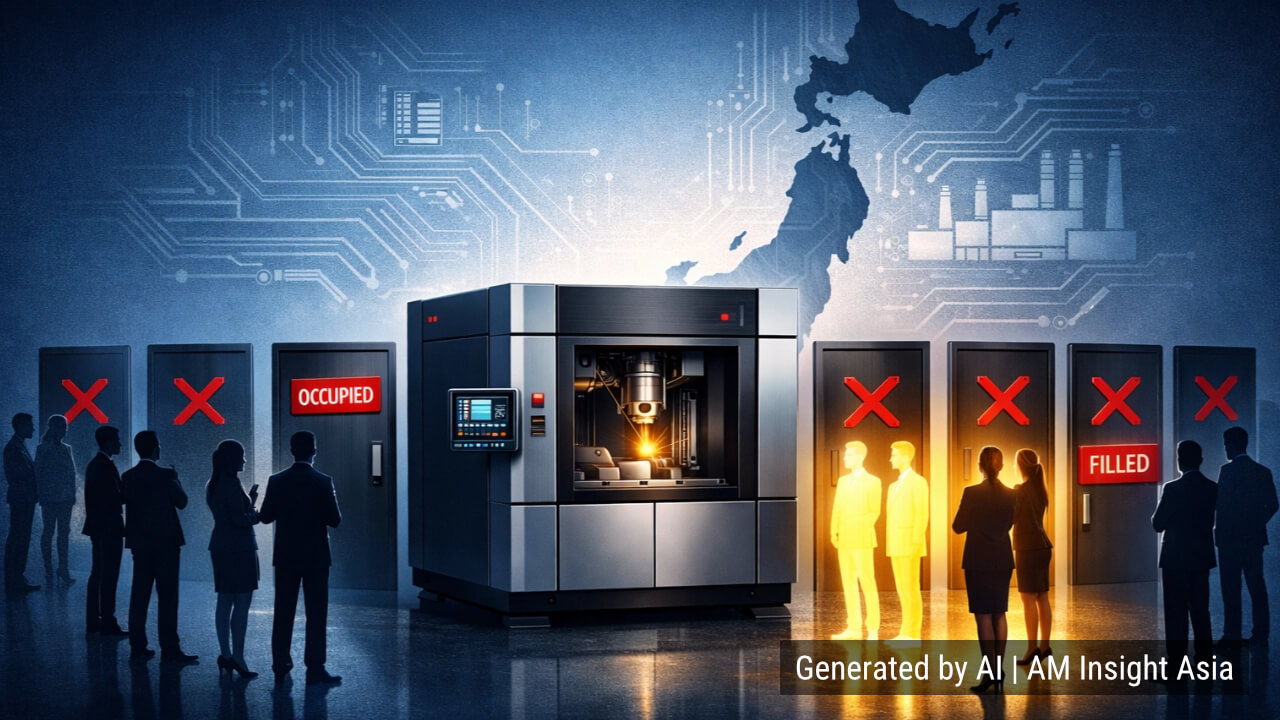
Premium Distributors Are Already Occupied
“Strong distributors” capable of effectively selling industrial AM equipment are limited in the Japan industrial AM market. Distributors combining technical understanding, customer networks, service systems, and sales capabilities are not abundant.
And the better the distributor, the more likely they’ve already contracted with established manufacturers. Particularly, well-funded major Western manufacturers can provide marketing support budgets, brand recognition, and comprehensive support systems. For distributors, the expected return on sales costs is high and customer explanation is easy.
Options for Late-Entry Manufacturers
Even if late-entry manufacturers try to enter the Japanese market, options are limited:
- Target “available technology areas” at existing premium distributors
- Partner with emerging distributors and develop them (time and risk involved)
- Build direct sales systems (requires large investment)
None are easy. In case 1, premium distributors already handle multiple manufacturers, making resource allocation for new manufacturers limited. In case 2, it takes time to build sales results, losing market opportunities during that period. Case 3 requires the largest investment with the longest payback period.
Strategies Manufacturers Should Take: Conditions for Being Chosen by Distributors
Global Brand Recognition Comes First
When distributors in the Japan industrial AM market adopt new manufacturers, what they value most is “ease of explanation to customers.” For this, the manufacturer must have a certain level of global recognition and track record as a prerequisite.
Specifically:
- Continuous exhibition at major trade shows
- Exposure in industry media
- Accumulation of case studies globally
- Clarification of technical differentiation points
If these are insufficient when trying to enter the Japan industrial AM market, attracting distributor interest is difficult. This is because internal explanation of “why should we handle products from manufacturers no one knows” cannot be made.
Success Patterns of Chinese Manufacturers
The Chinese manufacturers analyzed this time had all succeeded in building global recognition before entering the Japan industrial AM market. Farsoon built results in Western markets with polymer SLS, BLT with metal LPBF. UnionTech advanced global expansion backed by overwhelming domestic Chinese share in industrial SLA.
In other words, Japan market entry was positioned as “part of global expansion.” They didn’t enter targeting only Japan.
Reality Facing Manufacturers Entering Now
“Good Distributor Slots” Are Being Filled
Manufacturers trying to enter the Japan industrial AM market as of 2026 face this reality:
- Strong distributors have already contracted with major manufacturers
- To be chosen by distributors in the first place, prior brand recognition building is necessary
For companies trying to start now, especially those whose global recognition is not yet established, they must first begin with brand building. Then they will need to search for distributors through advisors with deep knowledge of the Japan industrial AM market and objective judgment capabilities.
Not Just Chinese Manufacturers
While this analysis focused on Chinese manufacturers, this is not a phenomenon unique to China in the Japan industrial AM market.
Western manufacturers also continue activities in the Japanese market. Expectations for industrial AM market growth are a shared recognition among global manufacturers.
The characteristic of Chinese manufacturers is taking a positioning suitable for the market launch phase with a combination of cost performance and a certain technical level.
For Companies Considering Asian Expansion: Too Late After Markets Are Established
The movements in the Japan industrial AM market analyzed here are likely to repeat in other Asian countries.
Each country has only a limited number of strong distributors. Handling competing manufacturers has practical difficulties, and by the time markets mature, all “good slots” are filled. And what can definitely be said is that partnering with strong distributors leads to success. There are reasons they are strong.
India, Thailand, Vietnam, Malaysia—many countries have manufacturing concentrations but AM markets not yet matured. If considering entry to these markets, it’s necessary to move before markets take off.
To be chosen by distributors, prior brand recognition building is essential. Accumulating global results, industry media exposure, and exhibition presence. Building relationships with local strong distributors on top of these.
What the current situation in the Japan industrial AM market demonstrates is this principle: Too late after markets are established.
Sources:
- Japan 3D Printer – Farsoon partnership announcements (2022, 2025)
- ORIX Rentec – BLT partnership announcement (2023)
- CMET – UnionTech partnership announcement (2022)
- JMC – UnionTech partnership announcement (2025)
- Sunstella and Brule – INTAMSYS partnership announcements (2025)
- SK Additive – HBD partnership (2021)