What ISRO’s Choice of a Domestic Startup Says About India’s Space Strategy
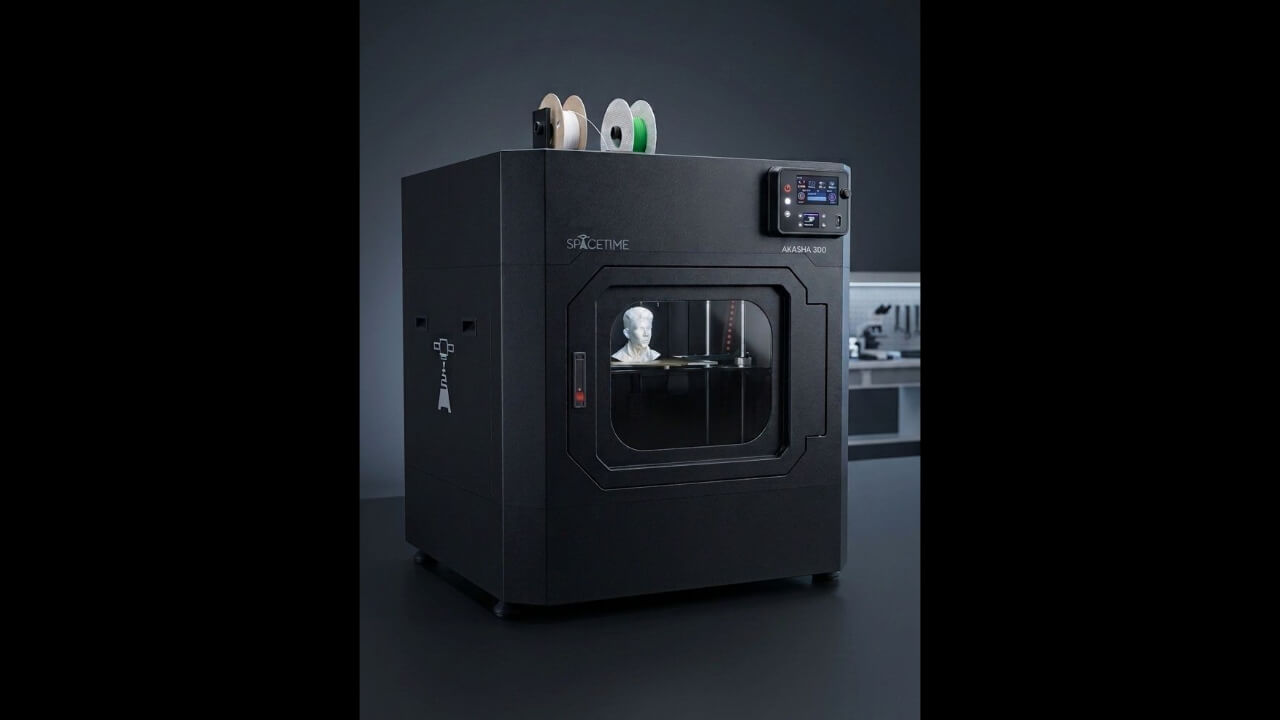
Kerala-based startup Spacetime 4D has delivered its high-temperature 3D printer, the Akasha300, to ISRO’s Liquid Propulsion Systems Centre (LPSC). The decision to turn to a domestic startup rather than an established global manufacturer marks a new chapter in India space 3D printing, and reflects the country’s industrial ambition to move beyond “Make in India” toward true self-reliance.
Spacetime 4D Delivers the Akasha300 to ISRO’s LPSC
Spacetime 4D Printing Solution was founded in 2020 by Akhil Madhavan, Jithin V, Prathyush T, and Amal Ashokan — a four-person team based in Kerala. The company’s flagship product, the Akasha300, is a high-temperature multi-material extrusion 3D printer, now delivered to ISRO’s LPSC facility in Valiyamala.
The startup’s journey to this milestone was supported by the Space Technology Innovation and Incubation Centre (STIIC) at the Indian Institute of Space Science and Technology (IIST) and the Kerala Startup Mission (KSUM). A visit by IIST Vice Chancellor Dipankar Banerjee and mentor K G Sreejalekshmi allowed the team to demonstrate the Akasha300’s capabilities firsthand, deepening the relationship between the startup and India’s space establishment.
What the Akasha300 Brings to ISRO’s Lab
The Akasha300 is built around a dual-extrusion architecture capable of handling high-performance engineering materials. Nozzle temperatures reach up to 350°C — with upgrades planned to 550°C — enabling the printer to process demanding materials such as PEEK and PEKK thermoplastics as well as carbon fiber-reinforced composites. A heated build platform reaches up to 110°C, while the enclosed chamber maintains up to 80°C, ensuring the thermal stability required for precision aerospace components.
At ISRO’s LPSC, the printer will be used for rapid prototyping of rocket engine components and propulsion system parts, as well as advanced materials research. Design cycles that previously took months can now be compressed to days, enabling engineers to iterate quickly on parts that meet flight-grade material standards.
India Space 3D Printing’s Statement of Self-Reliance
ISRO’s choice of a four-year-old domestic startup over globally established manufacturers is more than a procurement decision. India’s “Make in India” policy has long encouraged manufacturing within the country’s borders — but this acquisition goes a step further. It signals a commitment to building capability through Indian companies, using Indian technology: the essence of true self-reliance.
The role of IIST and KSUM in nurturing Spacetime 4D underscores the strategic depth behind this decision. The collaboration between startups, academic institutions, and government agencies is quietly but steadily advancing India’s indigenous capability in space technology — and this delivery is one of its most concrete results to date.
AM Insight Asia Perspective
ISRO’s adoption of Spacetime 4D’s Akasha300 is not just a procurement decision — it is a signal that reflects a much broader global shift. In an era of deeply entangled supply chains, aerospace and defence have become acutely sensitive domains. The question of which country’s technology a nation depends on has never carried more strategic weight.
India and China have already moved decisively, embedding self-reliance into national strategy. Elsewhere in Asia, the need is widely understood — but the reality is that few countries have meaningfully acted. The barriers of capital, technical talent, and ecosystem maturity are high, and the gap between wanting self-reliance and achieving it remains wide.
For those unable to develop their own systems, the choice of whose equipment to adopt becomes a geopolitical decision as much as a technical one. And the dependency does not stop at the machine itself. Even domestically assembled hardware often relies on imported components and raw materials — offering the appearance of self-reliance without fully addressing supply chain vulnerability. True independence demands vertical integration across the entire stack: from the printer, to its parts, to the materials it runs on. That goal remains a long way off for most.
Source:
・Indian Startup Delivers Akasha300 3D Printer to ISRO — Here’s What It Will Do – India Today
Photo: Courtesy of Spacetime 4D