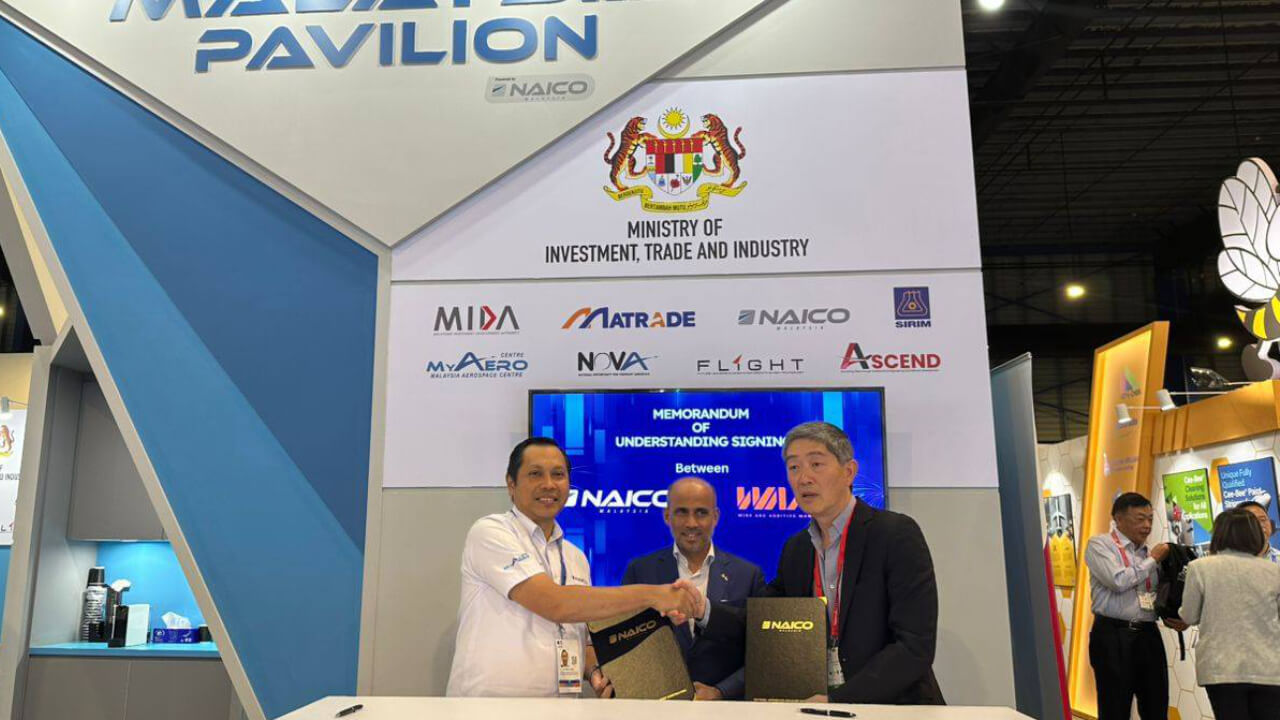
National Aerospace Industry Corporation Malaysia (NAICO Malaysia) and UK-based WAAM3D have signed a Memorandum of Understanding (MoU) at Singapore Airshow 2026, establishing a strategic partnership to develop wire arc additive manufacturing capabilities at Malaysia’s MyAERO Centre. The collaboration focuses on technology facilitation, applied research, talent development, and industrial capability building to support the Malaysia aerospace industry ecosystem.
MoU Signing at Singapore Airshow 2026
NAICO Malaysia and WAAM3D signed a strategic partnership MoU at the Malaysia Pavilion during Singapore Airshow 2026, which took place from February 3-8, 2026.
The signing ceremony was witnessed by Malaysia’s High Commissioner to Singapore, HE Dato’ Dr Azfar Mohamad Mustafar.
Singapore Airshow is recognized as Asia’s largest aerospace and defense industry international exhibition, held biennially at the Changi Exhibition Centre in Singapore.
Partnership Details and Malaysia Aerospace Ecosystem Support
The partnership establishes a comprehensive collaboration framework to strengthen Malaysia’s aerospace manufacturing capabilities.
At the core of this collaboration is the deployment of a miniWAAM cell at the MyAERO Centre. The partnership also includes development of an engineering skills program focused on production use cases.
The partnership focuses on four key areas: technology facilitation, applied research and technology cooperation, talent development, and long-term industrial capability building.
This partnership aligns with the Malaysia Aerospace Industry Blueprint 2030 (MAIB 2030) and reflects NAICO Malaysia’s commitment to strengthening advanced manufacturing readiness and future supply chain competitiveness.
NAICO Malaysia and Malaysia Aerospace Industry Strategy
National Aerospace Industry Corporation Malaysia (NAICO Malaysia) is an agency under the Ministry of Investment, Trade and Industry (MITI), tasked with leading the overall development of the aerospace industry and overseeing the implementation of strategies and initiatives in the Malaysia Aerospace Industry Blueprint 2030.
Malaysia’s aerospace industry, while not widely recognized, actually occupies a critical position in the global supply chain. Malaysian-manufactured components are used in every Airbus commercial aircraft and A400M military aircraft flying worldwide, and parts are also supplied to Boeing’s 787 Dreamliner. Currently, more than 230 aerospace-related companies operate in Malaysia, with Boeing maintaining a manufacturing facility (Boeing Composites Malaysia) in Kedah state, and Airbus positioning Malaysia as its largest supplier base in Southeast Asia.
Local companies also demonstrate strong competitiveness, with firms such as CTRM (composite manufacturing), SME Aerospace (manufacturing over one million components annually), Spirit AeroSystems Malaysia, and UMW Aerospace functioning as key suppliers to global OEMs including Airbus, Boeing, and Rolls-Royce. Malaysia aims to become Southeast Asia’s second-largest aerospace industry hub after Singapore and represents Airbus’s third-largest market in the Asia-Pacific region.
NAICO Malaysia serves as the focal point linking aerospace industry players, relevant government ministries and agencies, and academia to collectively strengthen the capability and capacity of Malaysia’s aerospace industry.
The MyAERO Centre is an initiative led by NAICO Malaysia that plays a pivotal role in driving the development of a sustainable aerospace ecosystem in Malaysia. The center focuses on three key areas: ecosystem development, research and technology, and talent development.
Following a soft launch in May 2024, the MyAERO Centre’s full operational status was announced at NAICO Malaysia’s 10th anniversary celebration in September 2025. Located at NAICO Malaysia’s headquarters in Kuala Lumpur, the center provides the following facilities to support industry and professional development:
- CNC training simulator for hands-on advanced machining practice
- 3D printer capable of printing with carbon fiber materials
- 3D surface scanners and portable measurement arms for reverse engineering (for SME use)
- Access to design software for training and leasing purposes
- 3D visualization lab equipped with virtual reality (VR) for immersive design and simulation
By providing access to these advanced technologies and tools, the MyAERO Centre helps upskill Malaysia’s aerospace workforce, enhances SME capabilities, and accelerates technology adoption across the value chain.
Malaysia’s aerospace industry has demonstrated significant growth, recording RM25.1 billion in revenue in 2024—the highest in the past decade—supported by 30,000 skilled workers. The aerospace industry revenue is projected to reach RM30 billion in 2025.
The Malaysia Aerospace Industry Blueprint 2030 (MAIB 2030) sets targets to achieve RM55.2 billion (€10.9 billion) in annual revenue and create 32,000 jobs by 2030. This blueprint aims to position Malaysia as the preferred aerospace economy in Southeast Asia and an integral part of the global aerospace value chain by 2030.
Industry forecasts indicate that the Asia-Pacific region is expected to account for over 40% of global aircraft deliveries by 2040, positioning Malaysia strategically to capture this growth opportunity.
AM Insight Asia Perspective
This MoU signals Malaysia’s ambition to establish WAAM manufacturing capabilities within Southeast Asia’s aerospace sector. While WAAM adoption remains relatively limited across Asian aerospace markets, Malaysia’s partnership with an established UK technology provider demonstrates the country’s commitment to advanced manufacturing readiness and future supply chain competitiveness.
Furthermore, establishing WAAM capabilities at the MyAERO Centre holds potential for technology spillover beyond aerospace. WAAM technology is applicable to diverse industries including large component repair, maritime industry, energy sector, and defense industry. Technologies and know-how cultivated in the aerospace sector may expand to other manufacturing fields. Particularly in Malaysia’s maritime and oil and gas industries, improved local manufacturing and repair capabilities for large components could contribute to supply chain efficiency and cost reduction.