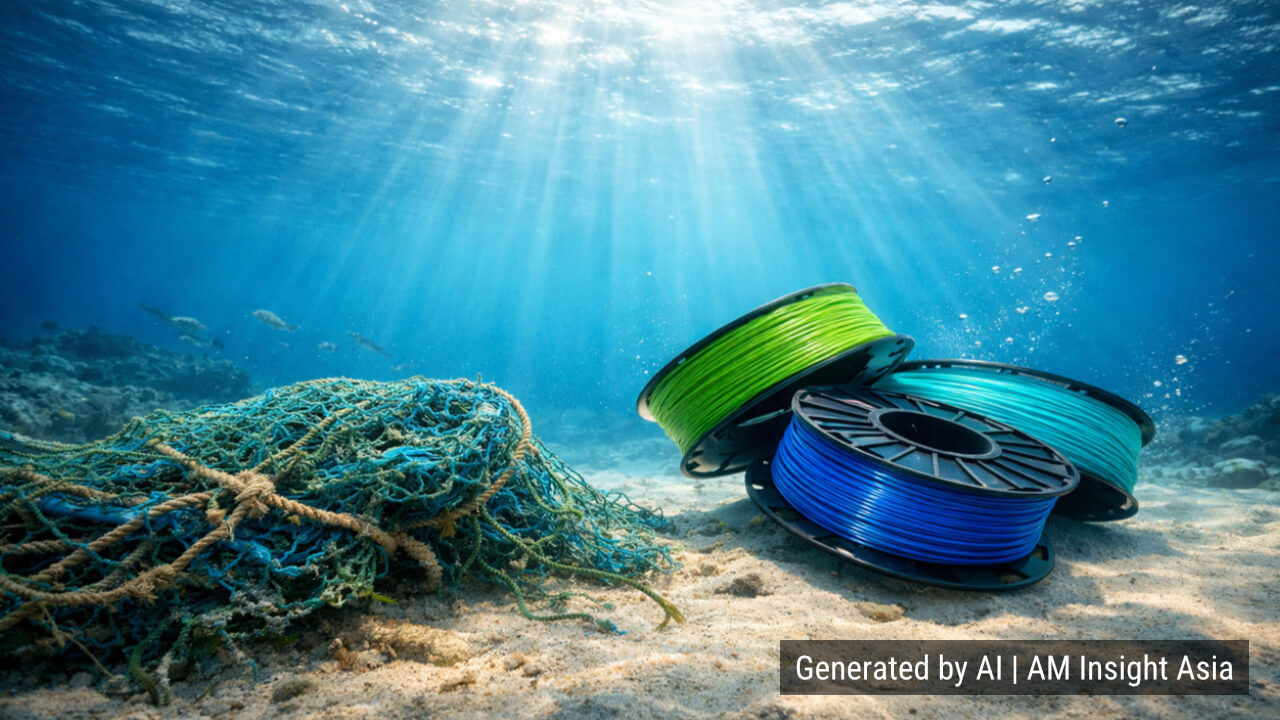
A researcher at Chulalongkorn University in Thailand is working to develop a recycled fishing net filament from ghost nets — abandoned fishing gear that continues to trap marine life and degrade into microplastics long after it is discarded. The project, led by Dr. Nuttapol Risangud of the Petroleum and Petrochemical College, aims to bring together polymer chemistry, environmental recovery, and community economic development into a single initiative that the additive manufacturing industry would do well to watch.
Ghost Nets: A Silent Threat to Marine Ecosystems
Ghost nets are fishing nets that have been lost or deliberately abandoned at sea. Drifting without direction, they continue to entangle fish, sea turtles, and other marine creatures indiscriminately. Over time, exposure to UV radiation and wave action causes the nylon fibers to break down into microplastics, which enter the food chain through plankton and juvenile fish and ultimately reach the human table through seafood consumption.
In Thailand, an informal recycling network already exists — fishermen sell old nets to dealers who process them into recycled pellets — but high-value applications for that material have remained largely absent. The gap between raw recycled nylon and premium end-use products is precisely where this research aims to intervene.
Turning Ghost Nets into Recycled Fishing Net Filament
The project, formally titled “Development of an Innovative Prototype for Recycling Nylon from Fishing Nets for 3D Printing Technology,” launched in June 2025 with funding from the Center of Excellence for Petrochemical and Materials Technology (PETROMAT) and in collaboration with Ube Technical Center (Asia) Co., Ltd., which is providing recycled nylon pellets from fishing nets and materials expertise.
The research is exploring a four-stage manufacturing process. First, recovered nets would be sorted to remove weights, floats, and ropes, then washed to eliminate sand, sediment, and marine fouling. Second, the cleaned and dried material would be shredded and compounded into recycled PCR plastic pellets. Third, those pellets would be re-melted, blended with additives to stabilize performance, and extruded into filament. The target filament diameter is 1.75mm, the standard for FDM-based 3D printers.
The decision to pelletize before extruding into filament reflects a deliberate quality control approach. Because nets collected from different locations are expected to vary in age, degradation level, and contamination, pelletization is intended to homogenize material properties before final processing — a critical consideration for achieving consistent mechanical performance in printed parts.
Three Goals: Academic, Environmental, and Community
The project is pursuing three parallel objectives.
On the academic side, the team is working to develop formulations that could bring recycled nylon to mechanical and dimensional performance comparable to virgin-grade filament — a challenge that requires deep expertise in polymer chemistry, as recycled plastics behave differently from new material.
On the environmental side, the research hopes that creating new demand for recycled fishing net material could increase collection rates. If a viable market can be established, more nets may be recovered, fewer ghost nets would accumulate, and less microplastic could enter the ocean. The underlying hypothesis is straightforward: sustained market demand may drive better environmental outcomes than awareness campaigns alone.
On the community side, the vision extends beyond the laboratory. The pre-processing steps — washing, drying, and initial shredding — could potentially be carried out by fishing communities, generating income at the source. This is where the concept of upcycling becomes central to the project’s ambition. Rather than simply recycling waste into a low-value commodity, the research envisions transforming material that currently holds little economic value into something that could command a premium — and distributing that value across the supply chain.
The story embedded in the material itself could become part of that value. A souvenir or product 3D printed from ghost nets recovered off the Thai coast would carry a provenance that a standard nylon product cannot match. If the full chain of custody were disclosed — the fishermen who collected the nets, the community that processed them, the researcher who developed the filament — the act of purchasing could become an act of participation in ocean conservation. That narrative has the potential to be a commercial asset, not just a moral one.
Ultimately, whether this project can sustain itself over time will depend on whether it generates self-sustaining economic flows. Environmental goodwill and grant funding alone are unlikely to maintain a system indefinitely. The cycle would become durable only when fishermen earn from selling nets, communities earn from pre-processing, and finished products find paying customers. Building that autonomous economic loop — independent of subsidies — remains the central challenge ahead.
AM Insight Asia Perspective
What distinguishes this research is its willingness to treat sustainability not as a label, but as a process to be scrutinized.
Dr. Nuttapol Risangud has explicitly acknowledged that the washing stage — necessary to remove salt, biological fouling, and heavy metal contamination from recovered nets — would consume large quantities of water and require significant physical space. This raises the possibility of a secondary environmental burden that sits in tension with the project’s green credentials. Pursuing sustainability while potentially generating new environmental harm in the process is a contradiction that the broader AM industry often overlooks. The fact that this research names the problem and flags it as a target for future process improvement reflects a level of intellectual honesty worth noting.
For the additive manufacturing sector, this is a timely reminder. As recycled and bio-based materials gain prominence in AM, the industry needs frameworks that evaluate sustainability across the full lifecycle — not just at the point of material origin. A filament made from ocean plastic is not automatically sustainable if the processing chain imposes disproportionate environmental costs elsewhere.
This project, currently in Phase 1 of a three-phase roadmap, represents an early but meaningful signal that Southeast Asia’s AM ecosystem is beginning to engage with the question of not just how to print, but what to print with — and what that choice may mean for the communities and environments that supply the raw material.