
Published on February 17, 2026, the Wohlers Report 2026 confirms that global additive manufacturing (AM) revenues reached $24.2 billion in 2025, representing a 10.9% year-over-year increase. Growth continues — but what the report truly reveals is not a uniform expansion. It is a story of stark regional divergence. And when we turn our attention to Asia, a structural challenge emerges beneath the numbers.
Wohlers Report 2026: What the Global AM Market Looks Like Today
The $24.2 billion global AM market in 2025 breaks down as follows: printing services accounted for the largest share at 48%, followed by system sales and servicing at 26%, materials at 20%, and software at 6%.
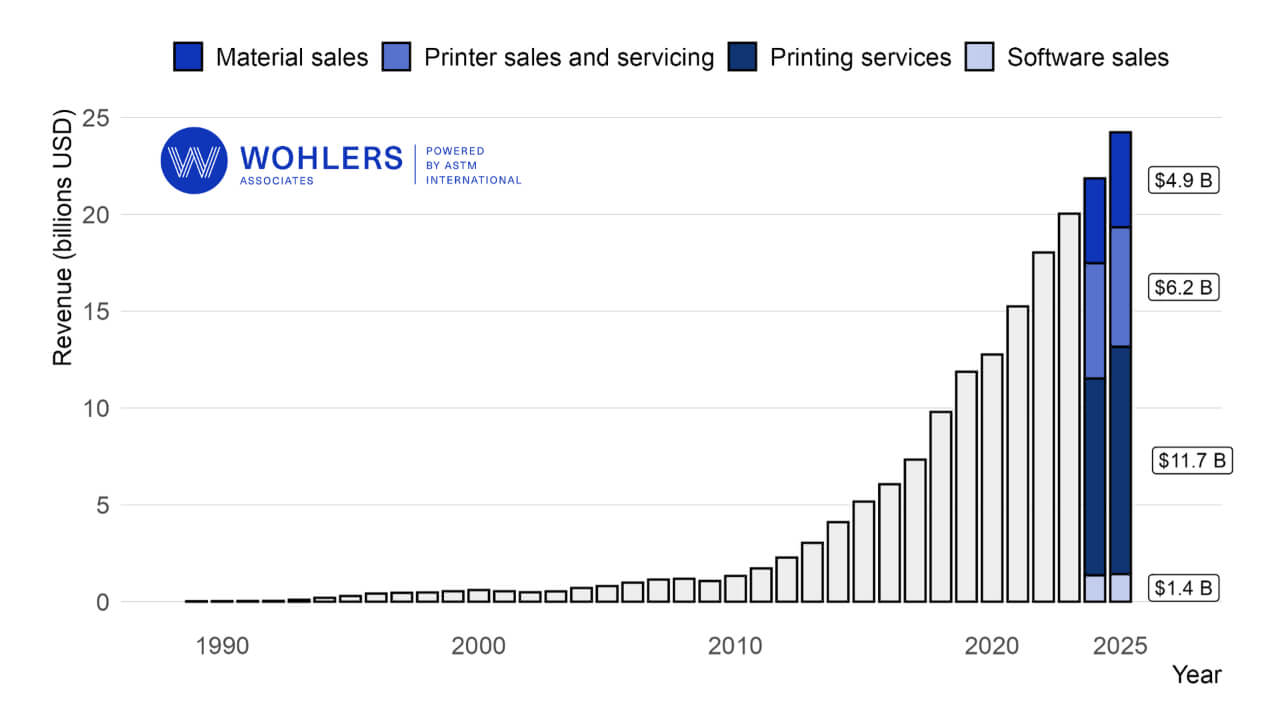
The contrast in growth rates between segments is striking. AM services grew by 15.5%, while system sales grew by just 3.6%. This shift — away from new machine adoption and toward maximising the utilisation of installed capacity — points to a maturing market at the global level. The emphasis is no longer on how many machines are being deployed, but on how effectively existing equipment is being put to work to deliver real production outcomes. This reflects the current reality of AM markets in Western countries and other established regions.
Dr. Mahdi Jamshid, Director of Market Intelligence at Wohlers Associates, put it plainly: “Additive manufacturing is no longer advancing on a single, uniform growth curve. What we see in Wohlers Report 2026 is an industry adjusting to tighter capital conditions, more selective investment, and higher expectations for utilisation and return. Growth continues, but it is more uneven, more regional, and more closely tied to real production outcomes.”
Asia-Pacific Leads the World — But the Story Is More Complicated
While signs of maturity appear at the global level, Asia-Pacific tells a very different story. Companies in the region achieved an average revenue growth of 19.8%, far outpacing the Americas at 12.6% and Europe, the Middle East and Africa (EMEA) at 9.0%. Asia is firmly in expansion mode.
This edition of the Wohlers Report 2026 also features expanded coverage of China’s growing influence on the global AM landscape — a signal that Asia’s role will only become more significant in the years ahead.
Yet the 19.8% figure does not tell the whole story. This growth is being driven primarily by countries where AM adoption is already underway — China, India, Singapore, Japan, and South Korea. For the vast majority of Asian countries — a region spanning 48 nations and 60% of the world’s population — AM remains an emerging technology. The potential market is far larger than what current figures suggest.
Is Talent Development Keeping Pace? The Real Question Is Understanding
Asia has momentum. Asia has potential. But what will it take for AM to truly take off across the region? The answer is talent. And the challenge is not simply a matter of numbers. The more fundamental question is this:
Do all AM stakeholders actually understand what additive manufacturing is and what it can do?
Do governments and public agencies have an accurate grasp of the value AM brings to industry? Do AM providers and their customers understand both its possibilities and its limitations? Do manufacturers who could become AM users even know that this technology might solve their production challenges? And do educational institutions teaching the next generation have the knowledge to do so accurately and effectively?
There is another dimension that is often overlooked: design. AM is not simply about operating a machine. Without understanding DfAM — Design for Additive Manufacturing — the true potential of the technology cannot be realised. Having a machine is one thing. Having people who can design for it is another entirely.
If the answer to any of these questions is unclear, talent development cannot function as it should. And what makes these questions so difficult to answer is a structural problem: the lack of information flow. In many Asian countries, specialised AM media either does not exist or remains extremely limited. Where information does not circulate, understanding cannot grow. Where understanding is absent, education, policy, and investment cannot follow.
So who will deliver that information? Who will teach AM correctly? In most Asian countries, the infrastructure to answer those questions has yet to be built.
AM Insight Asia Perspective
Asia’s AM sector has both momentum and potential. The 19.8% growth figure in the Wohlers Report 2026 makes that clear. But whether this momentum remains concentrated in a handful of countries, or becomes a region-wide reality, depends on what happens next in talent development.
Talent requires education. Education requires that those who teach have a genuine and accurate understanding of the subject. And that understanding cannot exist without access to reliable information. In many Asian countries, the information infrastructure for AM has yet to take shape. The chain has not yet begun.
Who will start it? AM Insight Asia holds that question as its own.