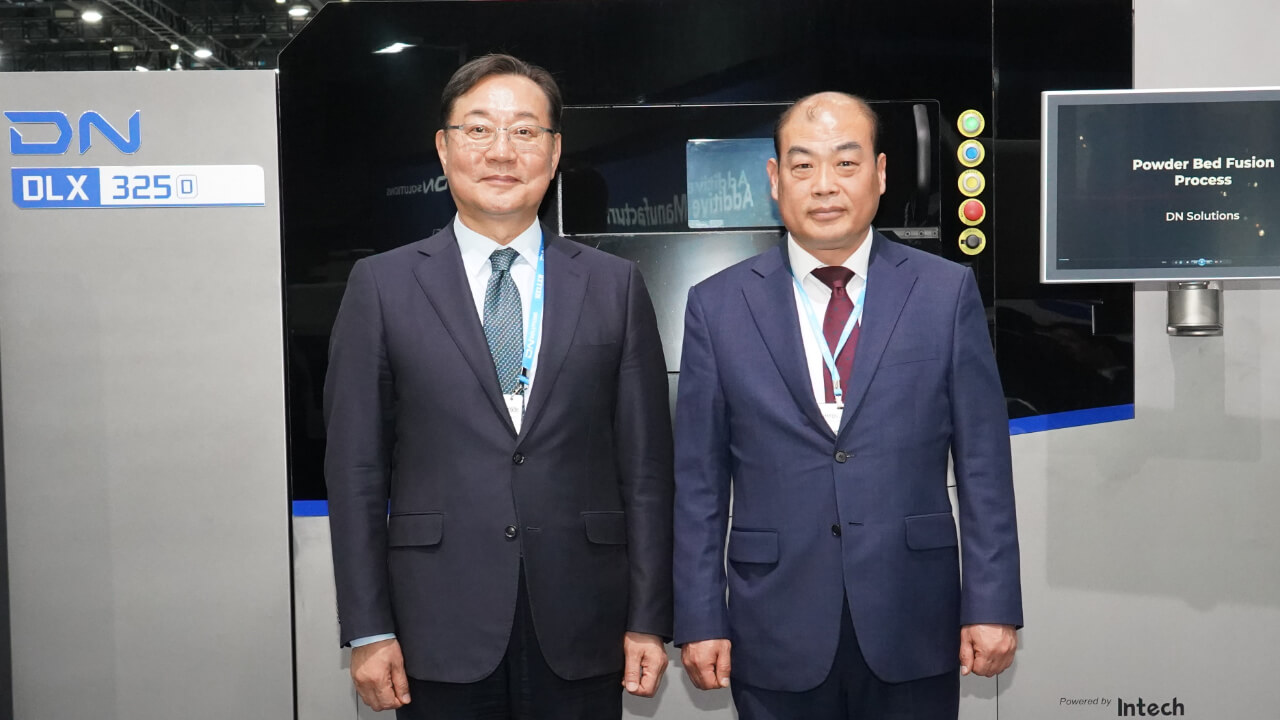
South Korean machine tool maker DN Solutions has signed a contract to supply its AM2CNC platform — integrating additive manufacturing for defense applications with precision CNC machining — to LDAS, a South Korean defense company specializing in small arms components and systems. The agreement marks a significant step in DN Solutions’ expansion into the defense manufacturing sector.
Photo: DN Solutions CEO Kim Won-jong (left) and LDAS CEO Lee Geun (right) pose in front of the DLX 325D additive manufacturing machine at SIMTOS, held at KINTEX in Goyang, Gyeonggi-do, on April 14, 2026. Courtesy of DN Solutions
What the DN Solutions and LDAS Contract Covers
On April 14, 2026, DN Solutions and LDAS signed the supply contract at the Seoul International Manufacturing Technology Show (SIMTOS), held at KINTEX in Goyang, Gyeonggi-do. The agreement, formally announced on April 17, covers the delivery of DN Solutions’ metal additive manufacturing machine DLX 325D and post-processing cutting equipment. Based in Gyeonggi-do, LDAS develops and manufactures precision components and assembly parts for small arms, aircraft, autonomous systems, and combat vehicles. Through the introduction of the AM2CNC platform, LDAS plans to strengthen both its prototyping capabilities and its capacity to scale toward mass production.
“This collaboration is significant in that it provides an integrated manufacturing solution capable of meeting the precision, productivity, and process stability requirements demanded by defense customers,” a DN Solutions representative stated. An LDAS representative added that the introduction of this equipment “will be a significant turning point in terms of shortening product development lead times and advancing processes.”
What Is DN Solutions?
DN Solutions is the world’s third-largest and South Korea’s top machine tool manufacturer, offering a broad range of manufacturing solutions spanning cutting machines to additive manufacturing equipment. In March 2026, the company opened an Additive Manufacturing Solutions Center (ASC) in Gütersloh, Germany. Spanning approximately 1,000 square meters, the facility houses the metal additive manufacturing DLX series, multi-tasking DNX series, and five-axis DVF series machines, alongside integrated automation solutions, providing comprehensive technical support from training and live demonstrations to full turnkey project implementation. In January 2026, DN Solutions also completed the acquisition of Heller Group, a German machine tool company with over 100 years of history, further expanding its machining center technology lineup.
Inside the AM2CNC Platform
AM2CNC is DN Solutions’ proprietary platform that integrates metal 3D printing with precision CNC machining in a single workflow. In conventional manufacturing, additive manufacturing and CNC finishing are handled as separate processes, creating handoffs that introduce delays and potential quality variation. AM2CNC allows both operations to be performed in sequence within one platform, reducing lead times and improving consistency.
While additive manufacturing excels at producing complex geometries, it has inherent limitations in surface finish and dimensional accuracy when used alone. AM2CNC addresses this gap by applying CNC precision machining to complete what additive processes cannot — enabling the production of components that go beyond prototypes to meet the rigorous standards required for actual operational use. For defense applications, where precision, productivity, and process stability are non-negotiable, this integrated approach represents a meaningful advance.
Additive Manufacturing for Defense: A Growing Strategic Priority
Additive manufacturing has gained rapid traction across the global defense industry in recent years. The technology enables the production of complex components that are difficult or impossible to achieve through conventional subtractive methods, supports low-volume, high-mix production without tooling, and dramatically shortens lead times from prototype to production. Its ability to reduce dependence on extended supply chains has also made it a strategic priority in defense procurement, where supply chain resilience is increasingly valued.
AM Insight Asia Perspective
The adoption of additive manufacturing for defense is accelerating not only in the West but across Asia. Singapore’s Armed Forces (SAF) have been active early movers, deploying the technology for submarine components and custom-designed drones for military use. China’s People’s Liberation Army (PLA) has advanced even further — integrating additive manufacturing into fighter jet production, deploying 3D printing equipment aboard naval vessels for at-sea component fabrication, and conducting field drills in which printed parts are delivered to frontline units via drone. South Korea, as demonstrated by this DN Solutions–LDAS partnership, is advancing through collaboration between civilian machine tool manufacturers and defense suppliers.
By contrast, countries such as Japan have made limited progress in applying additive manufacturing within their defense sectors. The gap between nations moving quickly and those falling behind is already widening, and the divergence shows no signs of slowing.
Adding further momentum to this trend is the U.S. National Defense Authorization Act (NDAA) for Fiscal Year 2026. Section 849 of the Act prohibits the Department of Defense from procuring or operating additive manufacturing equipment manufactured by entities linked to China, Russia, Iran, or North Korea — formally designating additive manufacturing as critical defense infrastructure. While this restriction applies directly to the United States, its implications are likely to extend beyond U.S. borders. As defense procurement policies tighten globally, countries may increasingly prioritize domestically produced or ally-sourced additive manufacturing solutions. Integrated platforms from manufacturers such as DN Solutions could well emerge as preferred options in this evolving landscape.
What this contract also illustrates is that additive manufacturing alone is no longer sufficient. The hybrid approach — combining AM with CNC machining — is becoming the standard for serious defense manufacturing. Additive processes provide geometric freedom and material efficiency, but CNC precision finishing is what bridges the gap between a printed part and one that can withstand real operational conditions. As Asia’s defense manufacturing supply chains evolve, providers capable of delivering this kind of integrated solution will hold an increasingly decisive advantage.
Source:
・South Korea’s DN Solutions Secures LDAS Contract for Additive Manufacturing Tech (The Defense Post)
Photo: Courtesy of DN Solutions