This is a story shared by Nibsaka Tsukasa, a maker who uses a wheelchair. From a chance encounter with a 3D printer in Akihabara to building custom parts for his own wheelchair, his is a story of how a 3D printer changed my life — quietly, but for real. We share his story here, in his own words, with a small reflection at the end.
My First Encounter with a 3D Printer
It was around 2015, I think, when I first became interested in 3D printers.
Back then, there was a 3D printer corner at the Yodobashi Camera in Akihabara. Seeing one actually running in person is what sparked it all for me. The 3D printers of that era were, to put it kindly, not impressive. The sample output at the corner — a cylindrical castle tower — wasn’t clean, and failed prints were just lying around.
But seeing that sample made me want to find a machine that could produce genuinely usable output. I started working and saving money, with the goal of buying a Zortrax M200.
Life Took a Different Turn
Around 2018, the strain of work caused a chronic illness to flare up, and I ended up in a wheelchair. The rental apartment I was living in was on the third floor, so I had to move. Between arranging the wheelchair, installing ramps, and everything else during my leave of absence, my savings ran dry.
At that point, a 3D printer was the last thing on my mind.
About six months later, I somehow managed to return to work and shifted to working from home. Every day, I was doing 3D modeling on my company-issued PC. Even back when I was in the office, I always thought it would be great if we could prototype things with a 3D printer.
How Bambu Lab and a 3D Printer Changed My Life
A few years passed, and I learned that the precision of affordable consumer 3D printers had improved dramatically. I didn’t know the details, but I gathered that something called Klipper had pushed machine performance forward. Still, this was the era where you were still sliding a sheet of copy paper between the nozzle and the build plate to calibrate things — Klipper was beyond me, and fine-tuning felt out of reach.
Then, like a comet, Bambu Lab appeared. The P1P was within striking distance price-wise, and it could print at high speed. High-speed printing!? That genuinely shocked me. I had always assumed that printing with quality meant printing slowly. Fast and clean output!? And no complicated calibration. No copy paper needed… What was going on… I didn’t understand 3D printers at all… but I thought: here, finally, is a 3D printer that even someone like me — a complete novice — could actually use.
By the time I got around to seriously thinking about it, the P1P had evolved into the P1S, and the compact, lower-priced A1 mini had arrived. AMS!? Multi-color!? High-performance machines had suddenly become much more accessible.
The truth is, the Bambu Lab A1 mini I use isn’t something I bought myself. I won it in Psych0h3ad (@YuTR0N)’s “Summer 3D Printer Super Premium Giveaway (2024).”
If that giveaway hadn’t existed, I might still be making excuses — “I don’t have space for it” — and never buying one. But maybe that was exactly what I needed in 2024. Honestly, ever since becoming a wheelchair user, my mental health had been taking a beating and I had no energy. But from the moment the 3D printer arrived, I haven’t been able to stop modeling every single day. I can print things at home without outsourcing anything. I can’t believe it — so this is what a 3D printer is. I was moved. Every day became something to look forward to.
My First Creation: A Tipping Lever for My Wheelchair
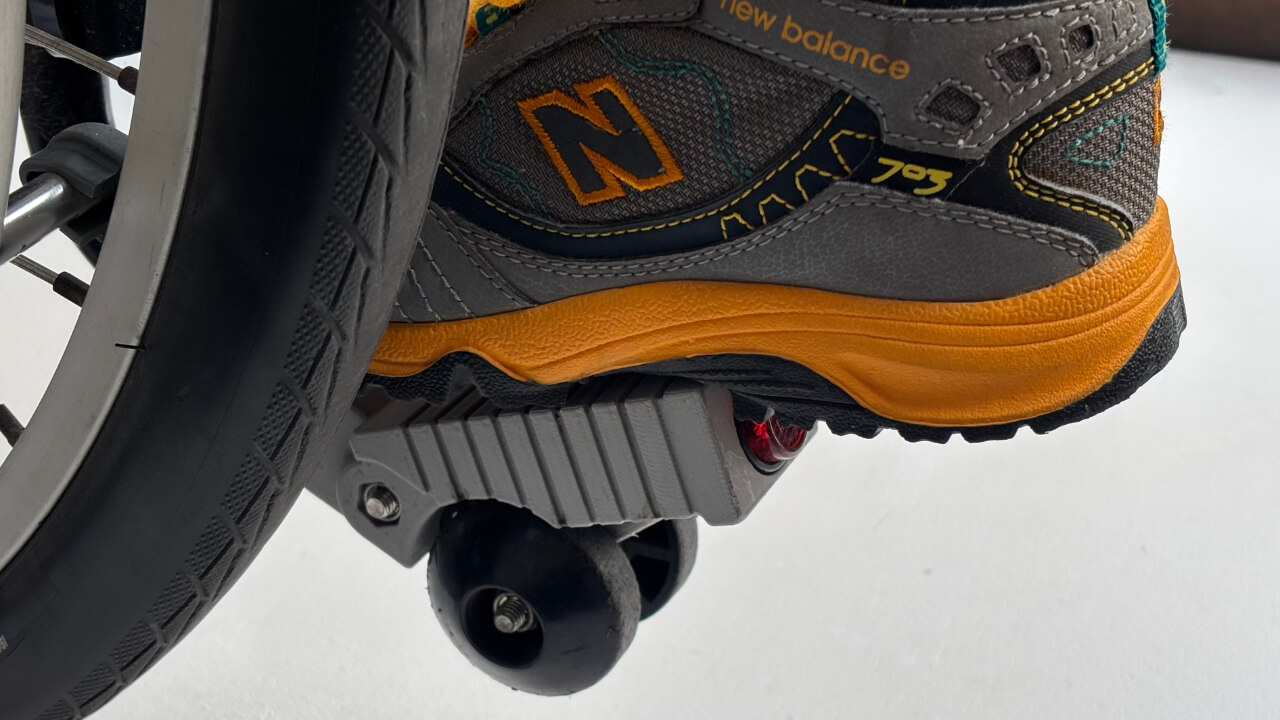
Let me introduce one of the first things I made after getting my 3D printer. It’s a fall-prevention bar and tipping lever for use with the YAMAHA power assist wheelchair unit. (Only the gray parts were 3D printed.)
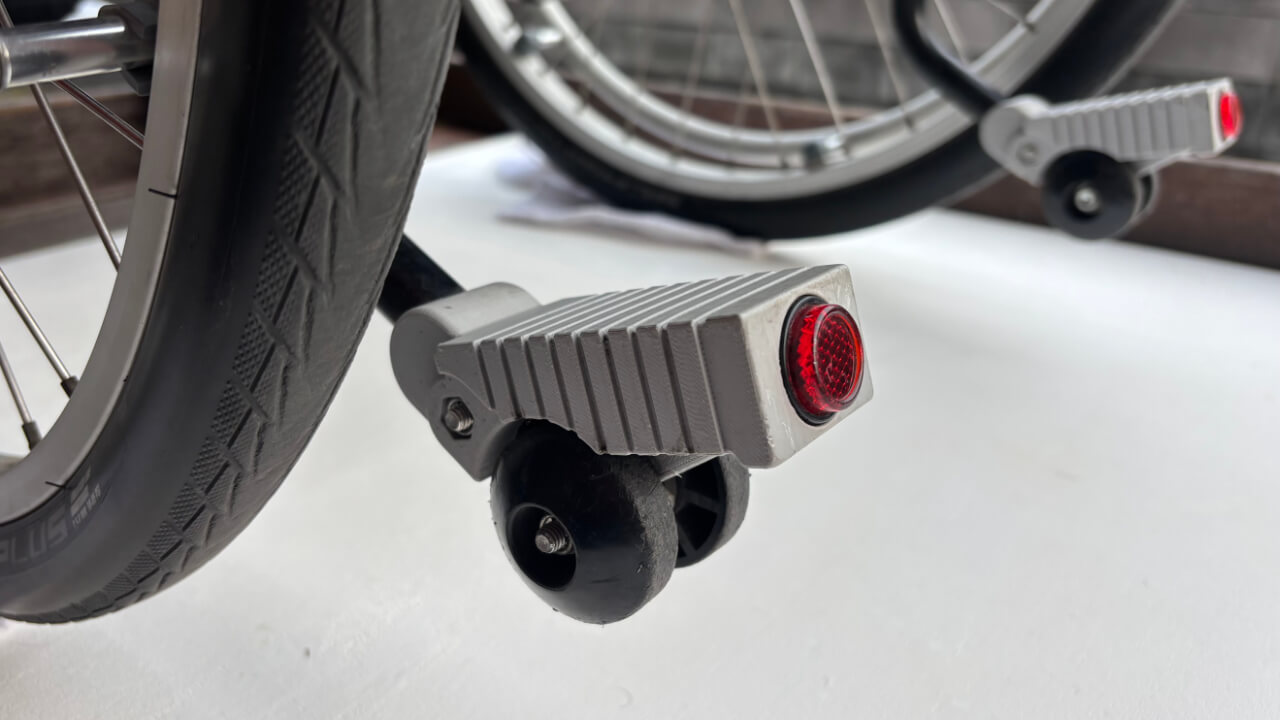
A tipping lever is what a caregiver steps on to lift the front wheels of a wheelchair when going over a curb or step.
On the YAMAHA power unit, the foot platform for this was narrow, and caregivers often slipped off it — so I decided to make my own.
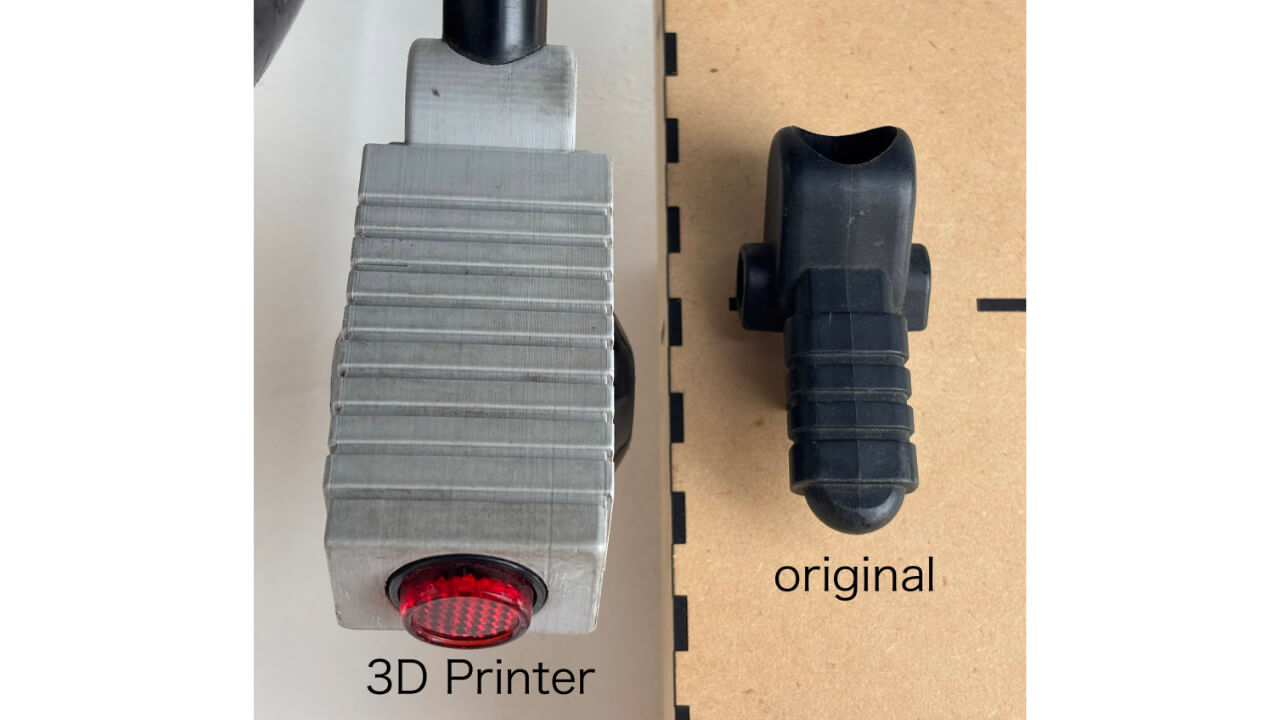
I added grooves to prevent slipping and attached a reflector as well. It wasn’t a part I used myself, but the fact that I had customized my own wheelchair made me genuinely happy. It was fun.
As a side note, these days it’s my son who operates this step. When we’re crossing at a traffic light or approaching a curb, he steps on it firmly to lift the front wheels for me.
A Life Where “If It Doesn’t Exist, Make It”
Prototyping parts, making jigs for DIY projects, adding small conveniences to everyday life. My life has truly changed. I have truly become someone who makes what doesn’t exist. (Though I also make things that already exist…)
That’s the story of how a 3D printer changed my life in a big way.
I’m still grateful to Psycho-san’s giveaway and to Bambu Lab for providing the prize. I’m also looking forward to JRRF2026. Finally — thank you to everyone who took the time to read something this long. I pray that your first layers adhere cleanly.
AM Insight Asia Perspective
This story is, at its heart, about encounters. An encounter with a 3D printer in Akihabara. An encounter with Psych0h3ad’s giveaway. An encounter with Bambu Lab. And I had my own encounter — with his words on X.
This is not a story about changing the AM industry, or about what a 3D printer can do. It is a small story. But it genuinely, really, changed one person’s life.
That’s what the Makers category is for at AM Insight Asia — not just to document what people build, but to carry these stories forward. Because somewhere out there, someone might read this and have their own encounter. With a machine. With an idea. With the simple, radical notion that if it doesn’t exist, you can make it.