How CF/PEEK Pultrusion and Laser Welding Could Make Automated Assembly in Space Possible
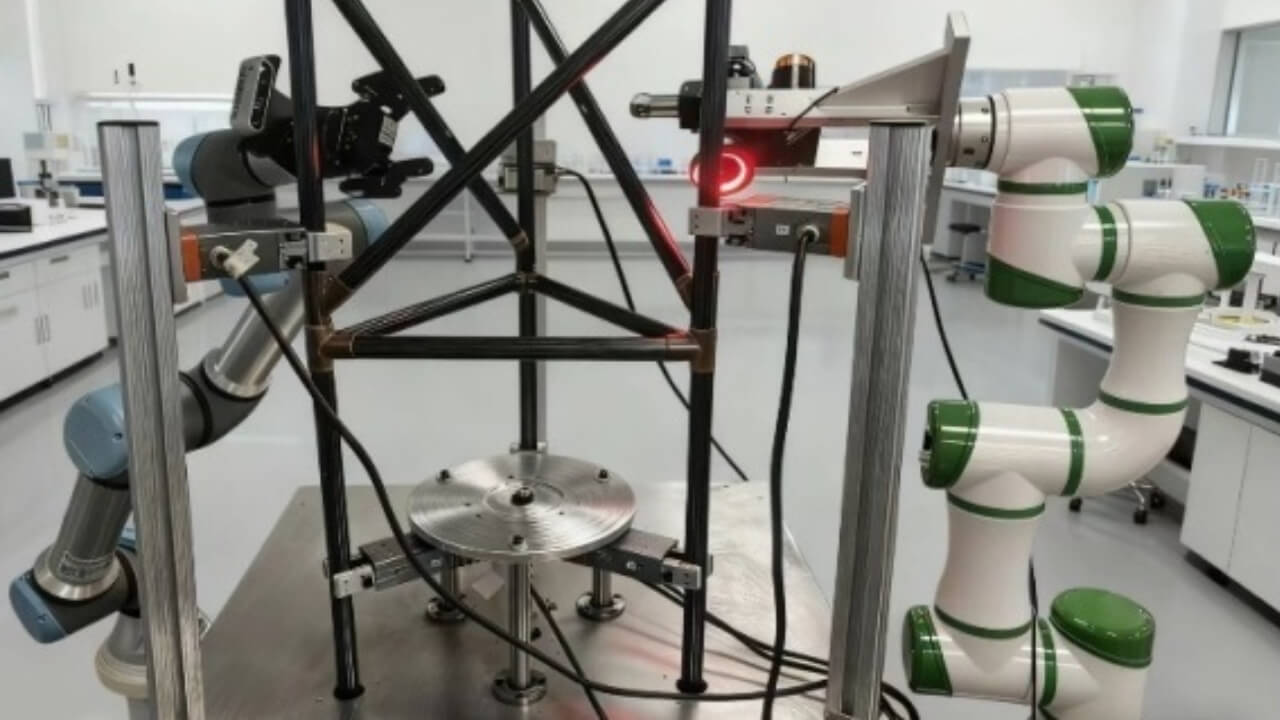
Everyone is working on how to manufacture structures in space. No one has fully solved how to join them. Adhesives do not cure without atmosphere. Bolts are heavy and require human hands. Metal welding is dangerous and difficult to inspect. The Shenyang Institute of Automation at the Chinese Academy of Sciences (SIA CAS) has proposed a system that addresses this gap directly: a continuous pultrusion process for CF/PEEK tubular members, joined by laser transmission welding through 3D-printed PEEK connectors. The approach was verified through a ground-based scaled prototype of a parabolic antenna truss, demonstrating the full process from raw material to structural assembly. The findings are published in Space: Science & Technology.
Why Joining Is the Core Problem in On-Orbit Construction
The logic behind on-orbit construction starts with a hard physical constraint. Launch vehicle fairings impose strict size limits. Structures on the scale needed for next-generation space systems — solar power satellites, ultra-large aperture antennas, lunar surface infrastructure — cannot be manufactured on the ground and launched whole. They have to be built in space.
The International Space Station is the most visible example of what this currently requires. It took more than 30 launches and extensive extravehicular activity by astronauts to assemble its truss structure. That approach worked, but it is expensive, slow, and dependent on human presence in orbit.
The alternatives each carry their own limitations. Adhesives cannot cure in the vacuum of space. Metal welding has been tested in orbit as far back as the Soyuz-6 mission in 1969 and the Skylab program in 1973, but defect detection is difficult, the process poses safety risks, and contamination of the surrounding environment remains a concern. Mechanical fastening with bolts adds mass and is difficult to automate reliably.
Other research groups are working on this problem. NASA and Agile Ultrasonics are developing ultrasonic welding for thermoplastic composites in space environments, but the program remains in the ground-test phase. NASA’s TDEA team has been studying robotic welding of CF/PEEK truss structures since 2021, with applications to large space observatories and lunar towers in mind. These efforts are advancing individual elements of the joining problem. What has not yet been demonstrated is a system that integrates manufacturing and joining end-to-end.
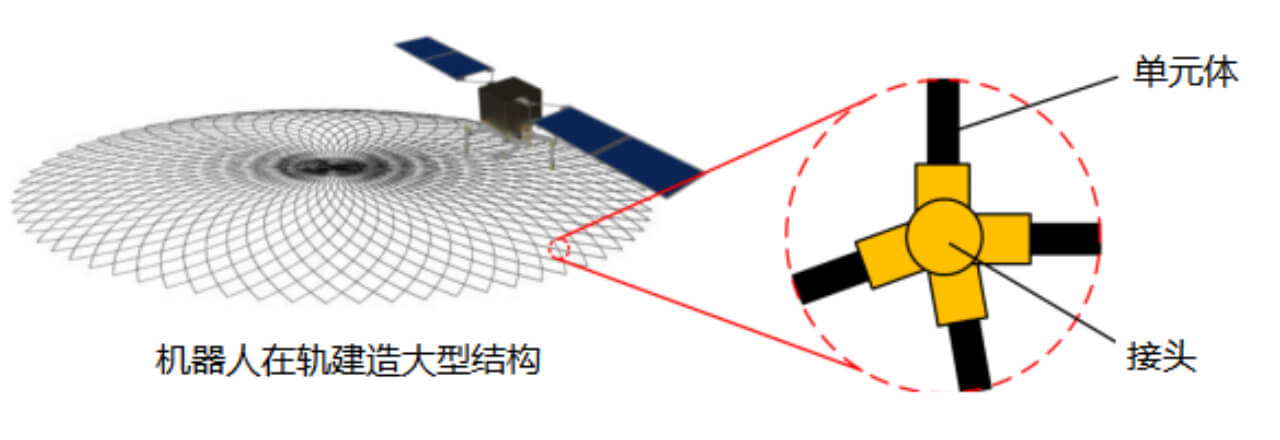
The SIA CAS Approach: CF/PEEK Pultrusion and Laser Transmission Welding
The system proposed by SIA CAS treats manufacturing and joining as a single designed process rather than two separate problems.
On the manufacturing side, CF/PEEK thermoplastic prepreg tape is fed into a continuous pultrusion process to produce hollow tubular members. The research team studied the effects of temperature and pultrusion speed on mechanical properties systematically, identifying optimal process parameters. The resulting composite tubes demonstrate high specific strength, high stiffness, and environmental resistance suited to long-term use in space.
On the joining side, 3D-printed high-transmittance PEEK connectors are used in combination with laser transmission welding. The laser passes through the PEEK connector and is absorbed at the interface with the tube, producing a weld without direct contact. This results in uniform stress distribution, high process efficiency, and avoidance of the degradation and mass penalties associated with adhesive bonding and mechanical fastening respectively.
This is worth distinguishing from conventional metal welding, which involves high heat, sparks, and gas generation — all hazardous in the space environment. Laser transmission welding works by exploiting the optical and thermal properties of PEEK as a thermoplastic: no open heat source, no combustion byproducts. The ability to be welded in this way is precisely why PEEK was chosen as the material system.
The design logic is coherent: both the tubes and the connectors are PEEK-based, meaning the same material system spans the full process. The joining step is non-contact and can in principle be executed by a robotic arm. This is the architecture that makes automated on-orbit construction plausible rather than merely theoretical.
What the Ground Prototype Confirmed, and What Remains to Be Tested
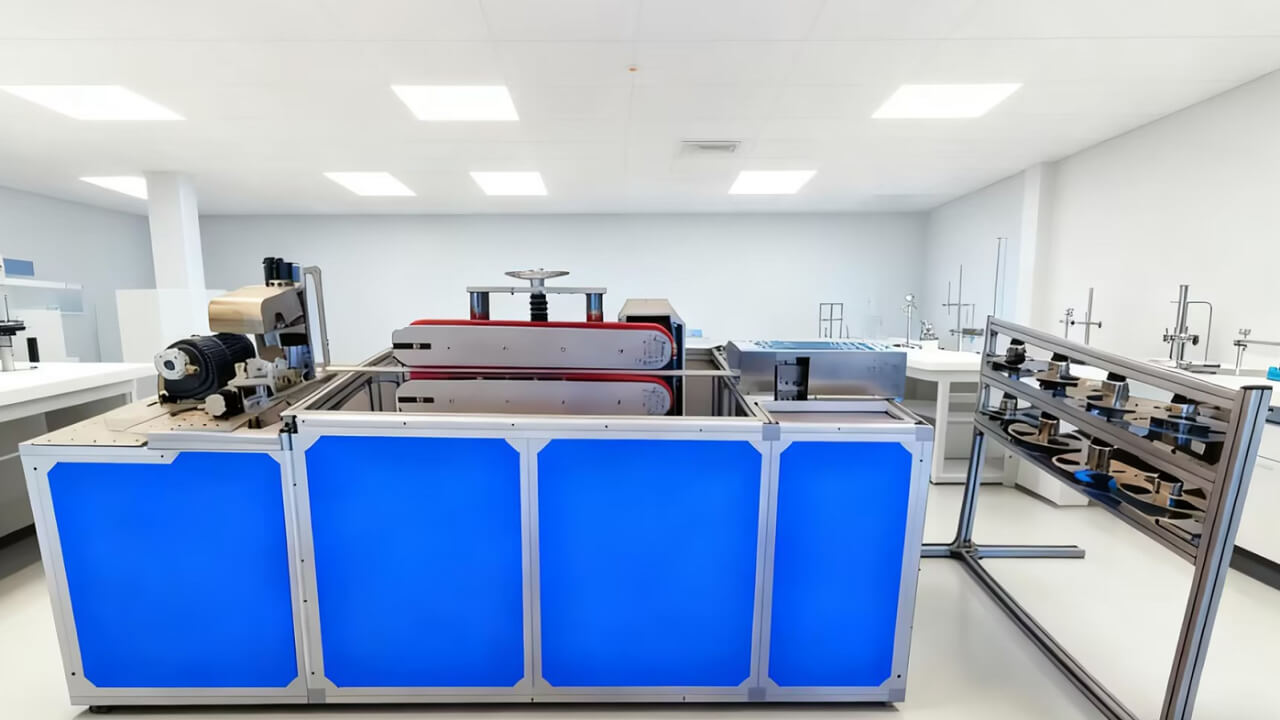
The research team used this system to manufacture a scaled-down prototype of a parabolic antenna truss. The full sequence was executed: material preparation, pultrusion of tubular members, laser transmission welding of joints, and final structural assembly. This confirmed the viability of the process and the validity of the identified parameters.
It is worth being precise about what this means. The prototype was ground-based and scaled down. Behavior under microgravity has not been tested. Long-term performance under the thermal cycling, radiation exposure, and atomic oxygen flux of the actual space environment has not been characterized. Full-scale structural performance has not been verified.
The paper’s own title uses the word “proposes.” This is a verified proposal, not a space demonstration. That distinction matters.
What it does represent is a system-level result. Other groups are refining individual techniques. SIA CAS has taken a complete process from material to assembled structure and made it work on the ground. In the progression toward on-orbit construction, that is a meaningful step.
AM Insight Asia Perspective
The technical choices in this research are worth examining closely, because they reflect a particular kind of engineering discipline.
PEEK is not the obvious material for space structures if you are optimizing for any single property. It is not the stiffest option. It is not the lightest. What it offers is a combination of radiation resistance, thermal stability across a wide range, chemical inertness, and crucially, the ability to be welded. It is a material that works across the full system: pultruded into tubes, printed into connectors, and joined by laser. The decision to build the entire process around one material system is a simplification that makes automation tractable.
That framing is where this research stands out in the current landscape. NASA and European programs are advancing the science of individual joining techniques with rigor. SIA CAS moved to demonstrate a working system. Neither approach is wrong. But the gap between “technique verified in isolation” and “system demonstrated end-to-end” is exactly where most space manufacturing proposals have stalled. That gap is what SIA CAS has moved to close, without waiting for each element to be fully characterized first. The pace at which a national research institute has pushed to a system-level result is worth noting separately from any judgment about the technology itself.
The applications named in the paper are not speculative. Space-based solar power, ultra-large antenna structures, and lunar base components are active development priorities in China’s national space program. This research is positioned within that context, not as an academic exercise. How quickly the next steps — microgravity testing, radiation qualification, robotic integration — follow will indicate how seriously this system is being pursued beyond the laboratory.