Discontinued Parts, Procurement Delays, Damage Repair. The Weight of Keeping Old Equipment Running.
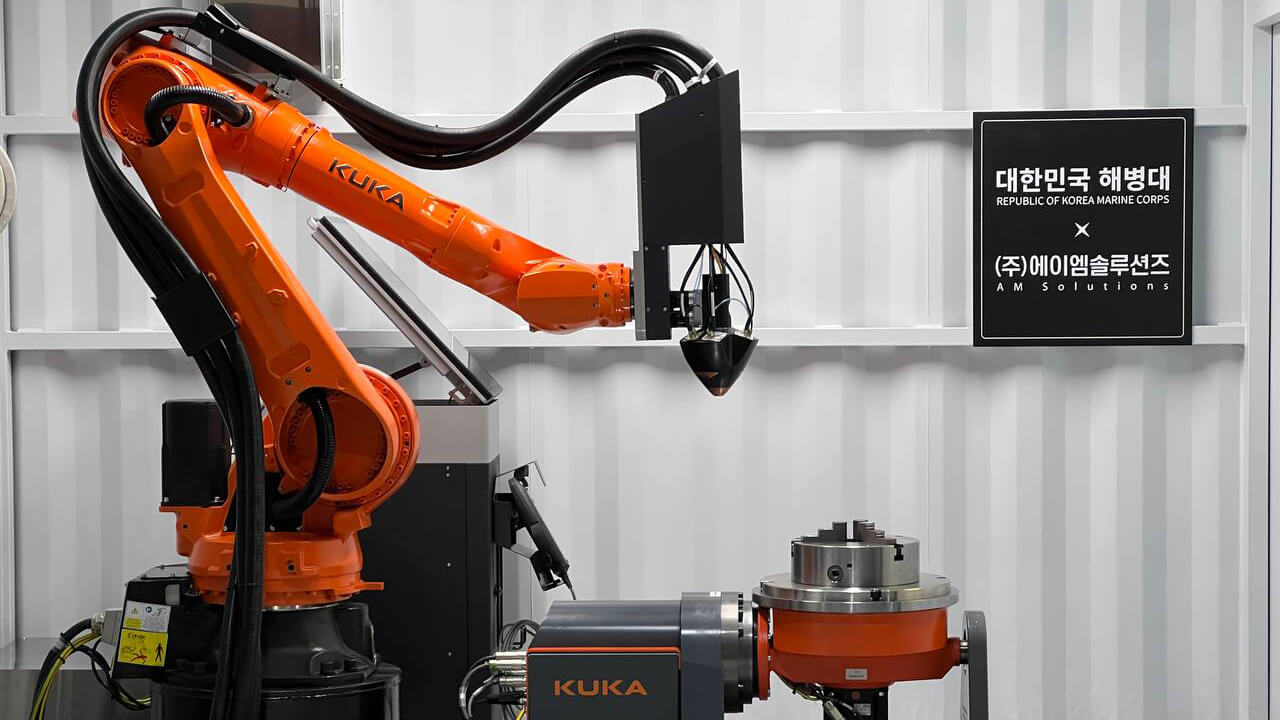
On February 19, 2025, the Republic of Korea Marine Corps Logistics Group announced the introduction of a containerized mobile metal 3D printer. Targeting Marine Corps-specific equipment including the KAAV (Korean Amphibious Assault Vehicle), this marks the first deployment of a robot-based military 3D printing system in the Korean armed forces. On March 26, Meltio and AM Solutions issued an official press release, drawing global attention as the first military adoption of the technology in Asia.
Military Equipment Cannot Simply Be Replaced When It Gets Old
Replacing military equipment is nothing like a company swapping out old computers for new ones. A single tank or armored vehicle can cost tens of millions of dollars. Procurement requires budget authorization and legislative approval, and transitioning to a new model demands crew retraining and a complete overhaul of maintenance infrastructure. It is not uncommon for older and newer models to operate side by side for years.
For armed forces, keeping aging equipment running reliably is not a choice — it is an obligation.
But this creates a serious problem. The longer equipment remains in service, the more its parts become scarce. Manufacturers may have already shut down production lines. Even when parts can be sourced, lead times of several months are not unusual. For specialized equipment like the KAAV, which is unique to the Marine Corps, the situation is even more acute. When a component breaks, the default is to replace the entire unit — discarding parts that still have life in them.
This combination of parts obsolescence, procurement difficulty, and inefficient repair has long dragged down equipment availability, disrupted maintenance schedules, and affected operational readiness. And there is a safety dimension that often goes unnoticed. When equipment must be operated despite unavailable parts, poor maintenance leads directly to accidents. Maintenance failures in military vehicles, aircraft, and vessels can mean loss of life outside of combat.
AM Solutions and Meltio’s LW-DED (Laser Wire Directed Energy Deposition) technology offers one answer to this problem. Given the right design data, discontinued parts can be reproduced. Damaged areas can be built up with deposited material rather than replacing the entire component. Procurement lead time drops to zero. Physical inventory is replaced by digital data.
Lieutenant Colonel Kim Seong-nam, commander of the Marine Corps maintenance battalion, stated: “The introduction of metal 3D printers is significant not only for reducing operation and maintenance costs, but also for preventing delays in maintenance schedules due to limited procurement of repair parts. We will maintain the best logistics support system to enable stable maintenance support.”
The Deployment Power That Containerized Military 3D Printing Enables
The system deployed is called with:Holonic — a mobile manufacturing system that integrates LW-DED robotic additive manufacturing technology within a container. Built around the Meltio Engine, it mounts a DED head on an industrial robotic arm and supports a wide range of metal alloys including stainless steel, titanium, copper, and Inconel. The deployment features a KUKA robotic arm, though the system is compatible with other major manufacturers including ABB, Fanuc, and Yaskawa.
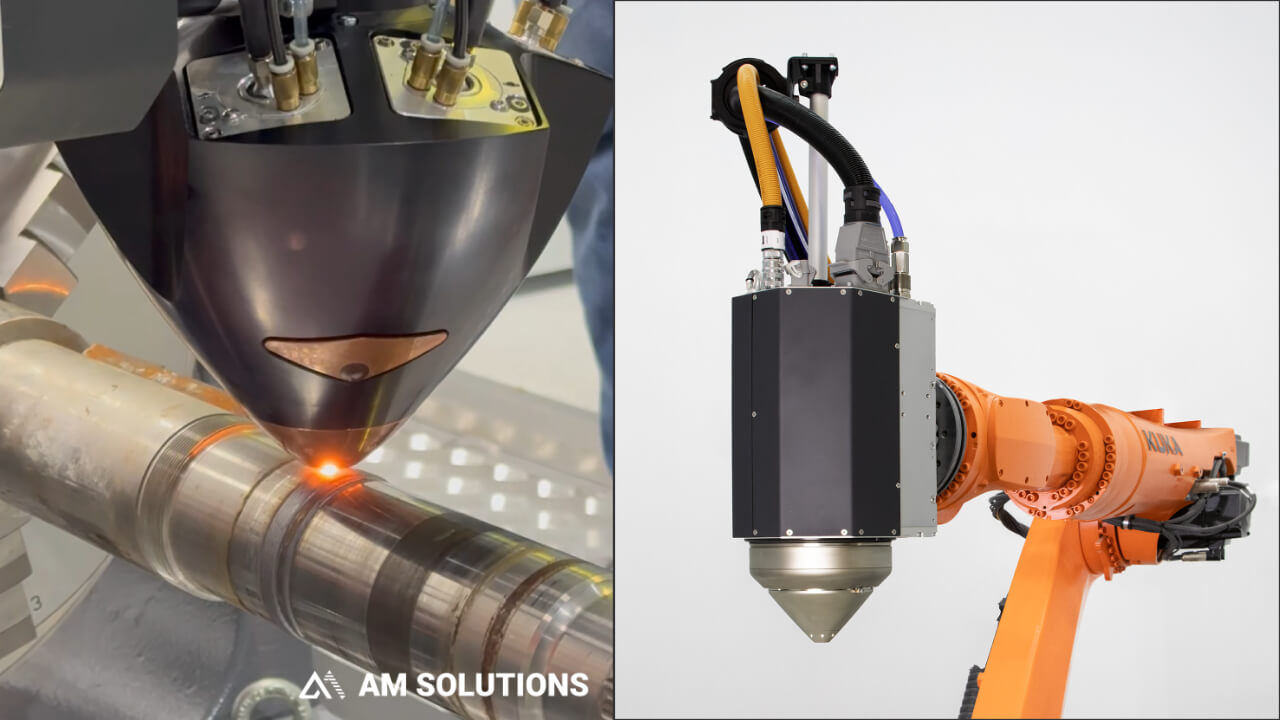
The core of this system is mobility. The container can be moved by crane or forklift, enabling deployment to forward bases and training sites, and even maintenance operations while mounted on a vehicle. A remote collaboration capability developed in partnership with the Korea Institute of Science and Technology (KIST) further allows technical support to be provided from a distance.
South Korea’s relatively compact geography means that supply line length is not, in itself, a pressing concern. But a mobile production base carries a different kind of strategic value. In a conflict scenario, fixed production and repair facilities become potential targets. A mobile system can be dispersed, concealed, and repositioned as the situation demands.
AM Solutions CEO Daejung Kim noted that “this entry into the defense sector is just the beginning.” The Marine Corps Logistics Group also plans to expand its field support capabilities over the next two years, adding mobile precision machining equipment and generators.
AM Insight Asia Perspective
The Republic of Korea Marine Corps initiative addresses a challenge that is universal to military logistics — but this challenge is by no means unique to Korea.
Across Asia, the problem is more acute in countries with tighter defense budgets. Where upgrading to newer equipment is not a realistic option, keeping aging systems safe and operational is a matter of survival. When parts are unavailable, maintenance cannot be performed. When maintenance cannot be performed, deteriorating equipment gets used anyway. That is a question of human lives. For such countries, DED-based on-demand parts production is not merely a cost-saving measure — it is a means of maintaining the safety of equipment that must keep running.
For countries with larger territories and longer supply lines, the containerized mobile production base carries even greater significance. Rather than shipping hundreds of parts from the rear, the manufacturing capability itself is brought forward. As the 19th-century Prussian military theorist Carl von Clausewitz understood, logistics is the foundation of strategy — and reducing dependence on supply lines fundamentally changes the freedom of operations. For some countries, containerized DED may prove to be an answer to the logistics problem itself.
That said, DED alone does not resolve all military logistics challenges. Parts produced by DED carry layer lines and face inherent limits in dimensional accuracy. Applications that demand tight tolerances will require post-processing. Many military components fall into exactly that category, and the knowledge needed to determine when DED alone suffices and when it must be combined with machining is itself a form of expertise that takes time to build. In the years ahead, hybrid approaches — using DED as the foundation and combining it with subtractive processes — may become increasingly necessary in military manufacturing contexts.
In environments where failure costs lives — extreme cold, salt corrosion, intense vibration, high heat, high pressure — the standards are uncompromising and the feedback can be direct and demanding. Bringing a new technology into that world and holding firm through it is what builds the kind of trust that no specification sheet or patent can capture.
Meltio has walked that path steadily. Parts manufactured aboard the USS Bataan for the U.S. Navy. Support for the French Navy’s Charles de Gaulle aircraft carrier. Armored vehicle maintenance for the Spanish Army. Jet engine repair for the Spanish Air Force. And now, the Korean Marine Corps. Across land, sea, and air — each in a different environment, each with its own unforgiving demands. That accumulated track record gives Meltio a depth that competitors using the same underlying technology cannot replicate overnight.
DED metal 3D printing will play an increasingly important role for armed forces around the world. When that moment fully arrives, the most trusted company in the room may well be the one that has faced the most demanding frontlines.