The EBAM System That Almost Nobody in AM Saw Coming
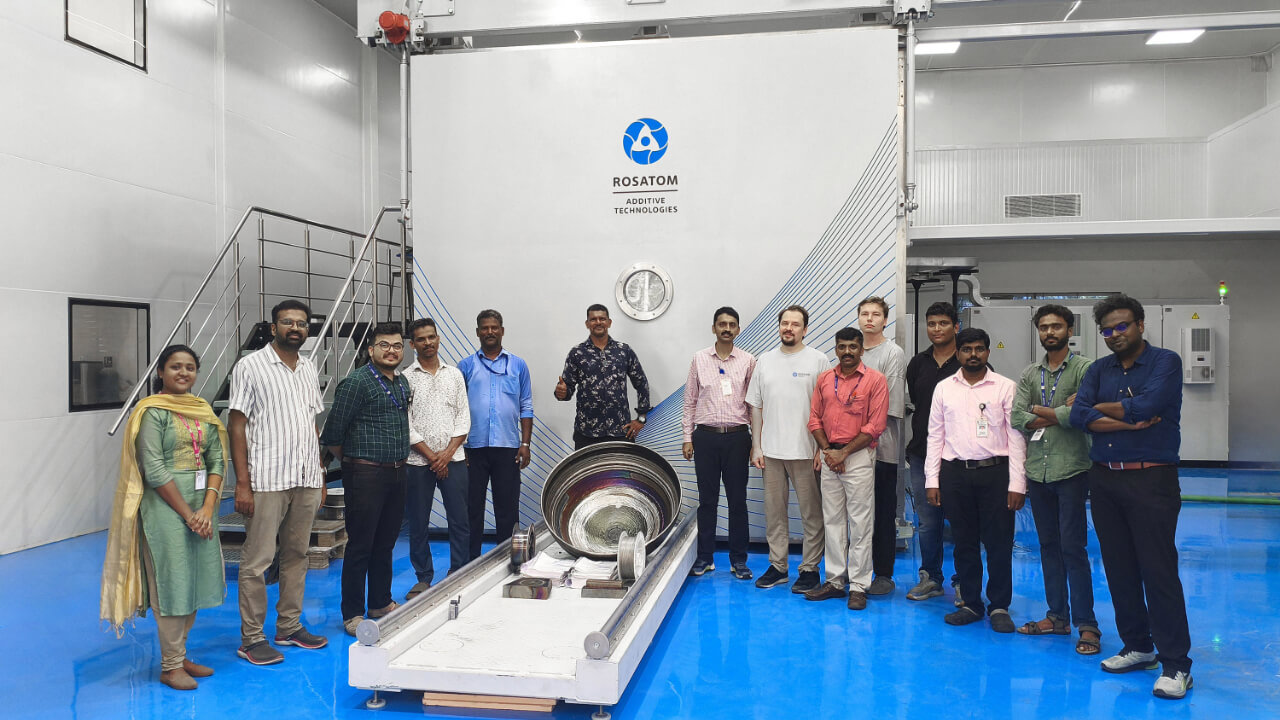
In April 2026, Rosatom’s Fuel Division delivered and commissioned its RusBeam 2800 industrial 3D printer in India — marking the Russian state corporation’s first-ever export of additive manufacturing equipment to a non-former-Soviet country. The system, based on Electron Beam Additive Manufacturing (EBAM) technology, is now operational at the Additive Manufacturing Research and Development Center of the Indian Space Research Organisation (ISRO)’s Vikram Sarabhai Space Centre. It will be used to fabricate large-scale metal components for India’s most ambitious space programs: the Gaganyaan crewed mission, the Bharatiya Antariksh Space Station, and Chandrayaan lunar missions.
The contract was awarded through a competitive international tender. For most observers in the global AM industry, this deal came out of nowhere. It shouldn’t have.
ISRO’s Additive Manufacturing Strategy and the Role of EBAM
ISRO’s commitment to additive manufacturing predates this procurement by years.
In May 2024, ISRO successfully conducted a 665-second hot-fire test of its PS4 rocket engine — the upper stage of the Polar Satellite Launch Vehicle (PSLV) — manufactured using Laser Powder Bed Fusion (LPBF) technology. The redesigned engine consolidated 14 components into a single piece, eliminating 19 weld joints and significantly reducing both material usage and production cost. Manufacturing was carried out by Wipro 3D, an Indian domestic company. At the national level, India’s AM strategy targets a 5% share of the global AM market and 100 new AM startups by fiscal year 2025-26.
The RusBeam 2800 fills a gap that domestic capability cannot yet close. The system fabricates parts up to 2.8 meters in height and four tonnes in weight from titanium alloys, superalloys, and refractory materials — under vacuum, using an electron beam wire deposition process. This is not a replacement for ISRO’s existing LPBF systems. It is a complement: large-scale, near-net-shape components in advanced materials that no available domestic system can produce.
Vessangi Anilkumar, Deputy General Manager of Vikram Sarabhai Space Centre and head of the Additive Manufacturing Research and Development Center, stated that the system represents a significant leap in ISRO’s capability to fabricate large-scale components while maintaining the material integrity required for the extreme conditions of space.
How India Actually Buys Technology
To understand this procurement, it helps to understand how India thinks about buying.
India has long operated under the principle of Strategic Autonomy: maintaining relationships with multiple major powers without subordinating its decisions to any one of them. This is not rhetoric — it is reflected directly in procurement. India operates Russian S-400 air defense systems, French Rafale fighters, American surveillance drones, and Israeli radar and missile technologies simultaneously. The selection criterion is not ideology or alliance. It is fitness for purpose.
The same logic applies in space and AM. ISRO knows precisely what it can and cannot do domestically. LPBF engine manufacturing is already within reach — Wipro 3D handles it. Large-scale EBAM is not. So ISRO ran an international tender and selected the best available solution, regardless of origin.
Critically, Rosatom has confirmed that discussions are already underway on further equipment supply, joint R&D in additive technologies, and the potential localization of equipment manufacturing in India. This is not simply a machine purchase. It is a deliberate strategy: acquire the technology, operate it, accumulate the know-how, and build toward domestic capability. That is Make in India in practice — not a slogan, but a sequenced industrial strategy.
What Rosatom Is, and Why It Entered AM
Rosatom is Russia’s state nuclear energy corporation, responsible for nuclear power plant construction and operation worldwide, the nuclear fuel cycle, and nuclear weapons management. It holds approximately 20% of the global nuclear power plant construction market.
Its entry into additive manufacturing was driven by two rationales. The first is internal application: reactor components involve complex geometries and difficult materials, making them a natural fit for AM. The second is diversification. In 2020, Rosatom set a target of tripling revenue to four trillion rubles by 2030, with 40% to come from non-nuclear businesses. AM was designated a strategic pillar. In 2018, Rosatom established RusAT — Rusatom Additive Technologies — as its AM subsidiary, building an integrated offering of printers, metal powders, software, and services under one structure.
The Three Phases That Built Russia’s Additive Manufacturing Capability
To the global AM media, Russian industrial 3D printing has been almost invisible. That invisibility was never the same as absence.
Phase 1: Strategic investment (2014-2021) Rosatom began AM development in 2014 and unveiled its first metal 3D printer in 2016. RusAT was established in 2018. In 2020, Rosatom opened its first Additive Technologies Center in Moscow, developing proprietary printers, metal powders, and software — positioning itself simultaneously as manufacturer and customer.
Phase 2: Forced acceleration (2022-present) Following the 2022 sanctions, most major Western AM manufacturers suspended operations in Russia. Access to foreign equipment, components, and software was cut off. What had been a chosen path of domestic development became a necessary one. The result: by end of 2023, Russia’s AM market had already exceeded the scale originally targeted for 2030, with aerospace, space, and defense accounting for approximately 50% of the total. In January 2026, the United States formally prohibited the procurement of Russian AM systems for defense use under Section 849 of the FY2026 National Defense Authorization Act (NDAA). Read one way, this is a sanctions measure. Read another, it is Washington’s acknowledgment that Russian AM has reached a level of capability worth treating as a strategic concern.
Phase 3: A new export industry (2026) Domestic capability matured. Russia now has AM as a new industrial asset — and the first deployment of that asset outside the former Soviet sphere is the RusBeam 2800 at ISRO.
Progress does not emerge from comfort. The friction of constraint produced something that open access to foreign technology might never have forced Rosatom to build: a self-contained, full-stack AM ecosystem capable of competing internationally.
AM Insight Asia Perspective
This deal illustrates two distinct models of AM maturity — and both carry implications beyond this transaction.
The first is Russia’s model. Progress is born from constraint, not comfort. When access to foreign technology was removed, the only option was to build everything from scratch: machines, materials, software, service infrastructure, and localization capability. That necessity produced an ecosystem capable of winning an open international tender against established competitors.
The second is India’s model. ISRO entered this procurement knowing exactly what it could and could not do domestically. It uses Indian suppliers where Indian capability exists. It goes to the international market — without ideological preference — where it does not. And it structures its foreign procurement to accumulate know-how, not just hardware, with localization discussions beginning before the machine is even fully operational. Make in India is not a protectionist stance. It is a sequenced strategy built on an honest assessment of current capability and a clear view of where domestic industry needs to go.
As Asia’s aerospace and space sectors expand their AM programs, the map of viable suppliers is being redrawn — quietly, through tenders rather than announcements. Japan’s aerospace and space supply chain faces the same question ISRO answered with this procurement: do we know, with the same clarity, what we can build today, what we cannot, and what that means for how we buy?