Custom Parts, Low Volumes, Discontinued Components: Tackling What Casting Cannot
Daidore Corporation, an Osaka-based manufacturer of drainage fittings, manholes, and water-related equipment, has adopted a wire DED system from Spanish metal 3D printer maker Meltio. Founded over 100 years ago, the company’s manufacturing foundation is casting. But Daidore did not abandon that foundation. Instead, it added wire DED as a new manufacturing capability for the areas where casting falls short.
Where Casting Could Not Reach
Most of the drainage fittings and pipe components Daidore produces are made by casting. Casting excels at high-volume production. But it has its limitations. Once a mold is made, any change to the geometry requires designing and manufacturing a new one — an expensive, time-consuming process that makes rapid prototyping and low-volume runs impractical.
As a result, casting was simply not a viable option for the following:
Single-unit and low-volume custom parts. Non-standard components for complex pipe layouts. Discontinued parts where molds and drawings no longer exist. Prototype verification during the design phase.
Recognizing additive manufacturing (AM) as the solution to these challenges, Daidore committed to the Meltio Robot Cell.
Why Daidore Chose Wire DED
After evaluating multiple AM technologies — including powder bed fusion (PBF) and binder jetting — Daidore selected Meltio’s wire DED process. The deciding factors were as follows.
Significant reduction in material costs According to Meltio, wire DED reduces material costs by up to 80–90% compared to powder-based systems. Standard welding wire can be used directly, keeping procurement costs low.
Minimal infrastructure requirements No explosion-proof facilities, sintering equipment, or degreasing systems are required — unlike powder-based AM. The system integrates easily into an existing factory environment.
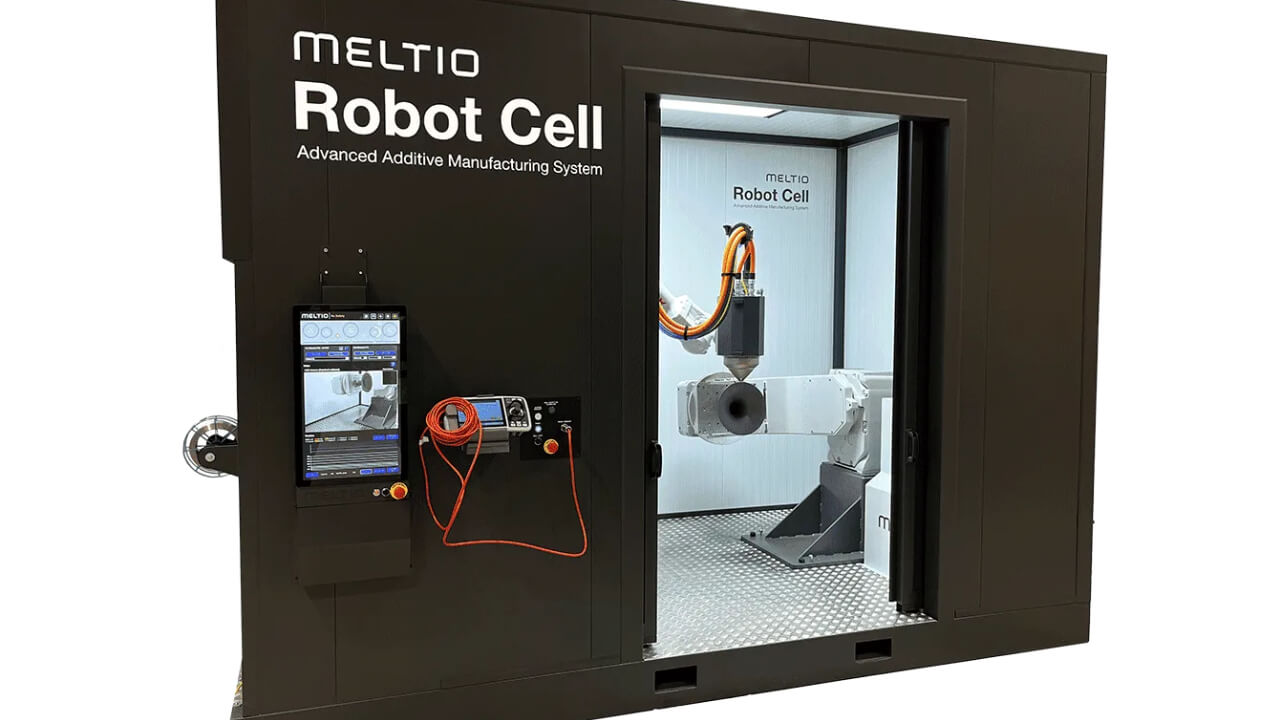
Large build volume The Meltio Robot Cell provides a build area of 2m × 1m × 1m, enabling the production of large parts or multiple components in a single run.
Complex geometry without supports The combination of a 6-axis robotic arm and a 2-axis rotating build table allows complex geometries to be produced without support structures.
Multi-material capability Up to two different metal materials can be deposited within the same part, enabling functional hybrid components.
Wire DED in Action: An SS316L Flange Printed Without a Single Support
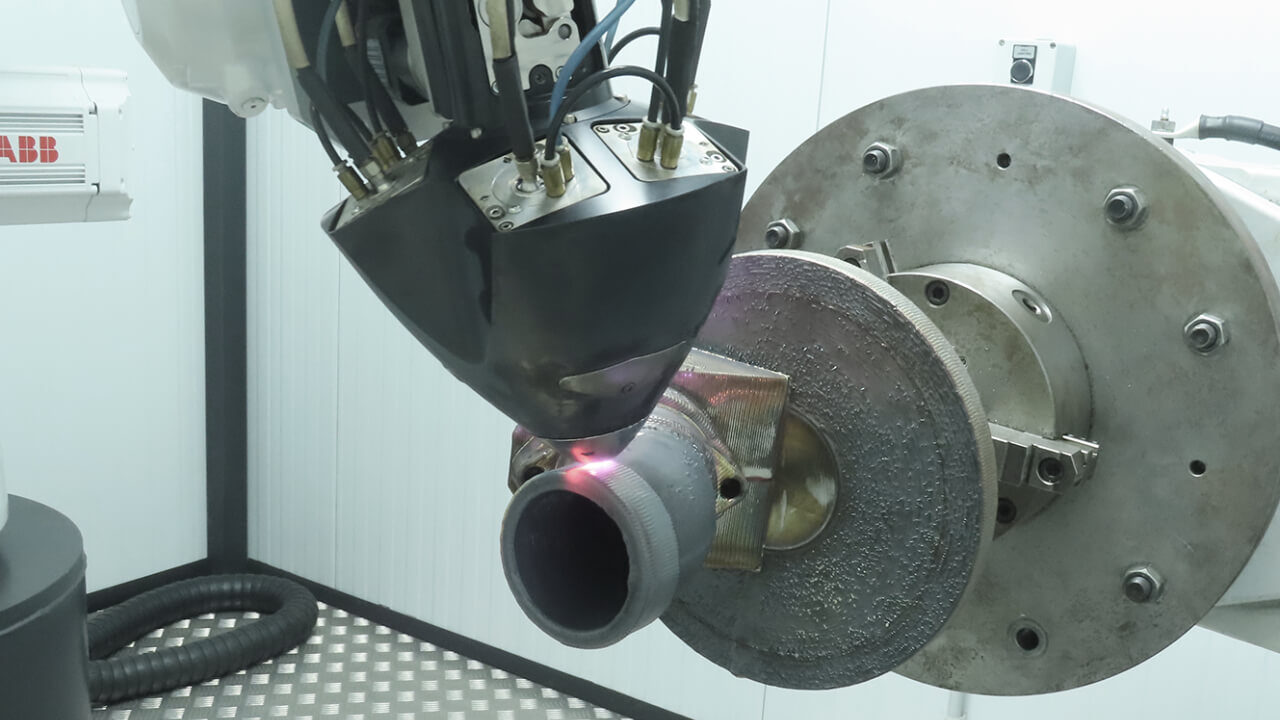
For its technical validation, Daidore produced an industrial flange component in SS316L — a stainless steel known for its corrosion resistance. The part was a custom geometry designed to fit a complex pipe layout while maintaining a precise fluid flow path.
The production details were as follows.
- Part dimensions: 165.7 × 107 × 174.7 mm
- Weight: 3.3 kg
- Print time: Under 16 hours
- Layer height: 1 mm
- Material: SS316L stainless steel
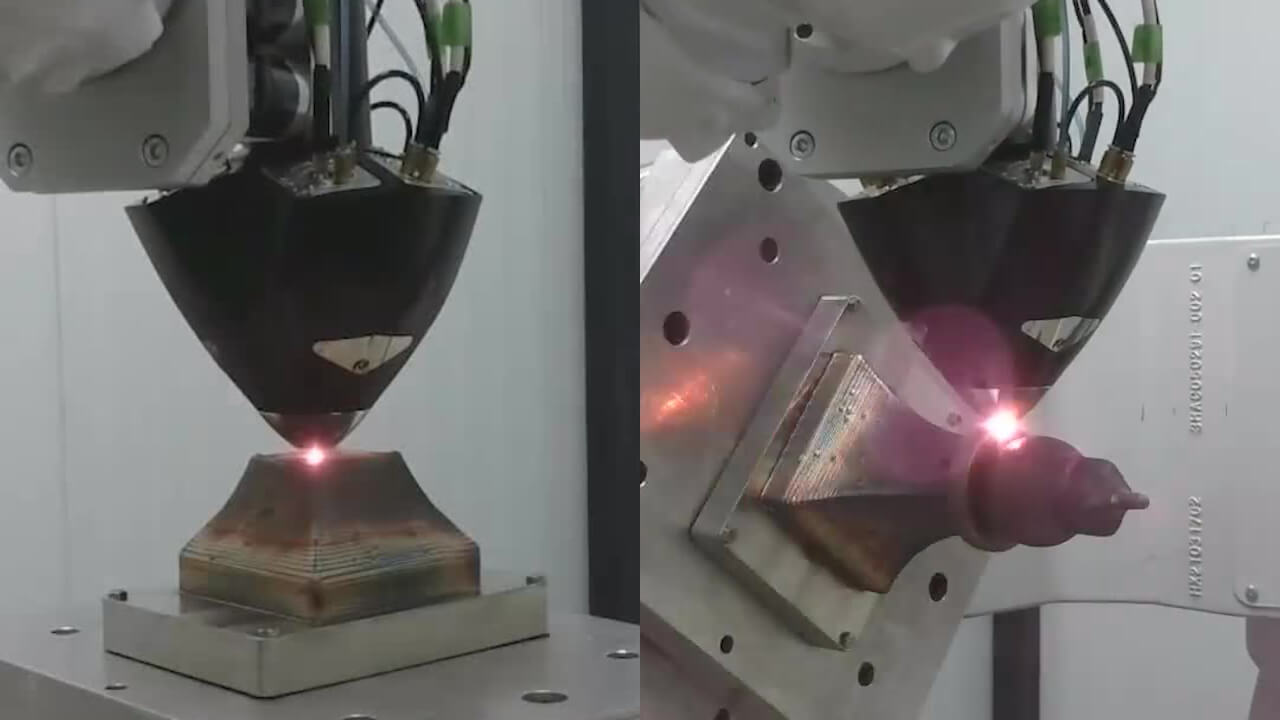
The key to the result was a radial deposition strategy. By combining the 6-axis robotic arm with custom tooling, Meltio’s system achieved optimal flange orientation without requiring any traditional support structures. The part was manufactured lights-out through robotic automation, significantly reducing labor dependency.
From Technical Validation to Commercial Service: 10 Months
On June 3, 2025, Meltio published a case study on its website documenting Daidore’s successful technical validation. At that stage, the application was still internal.
Approximately 10 months later, on April 16, 2026, Daidore formally announced the launch of a contract manufacturing and custom prototyping service on a Japanese industrial platform — its public declaration that the technology was ready for customers.
In those 10 months, Daidore had completed the following steps.
Maturing the technology. Starting from the successful production of the 3.3 kg flange component, Daidore refined its process until it could consistently produce customer-ready quality.
Building the service infrastructure. The system moved from an in-house experimental tool to a fully operational contract service — accepting customer 3D data and producing parts from a single unit upward.
The service offerings Daidore now promotes include mold-free custom production from a single unit, large-format builds up to 2000 × 1000 × 1000 mm, reproduction of discontinued parts, and support for SS316L and other high-corrosion-resistance alloys. The material knowledge accumulated through decades of drainage fitting production now extends into a new domain.
AM Insight Asia Perspective
A company with over a century of history did not discard its casting expertise. It built on top of it — adding wire DED as a new layer of manufacturing capability. This was not a response to pressure. It was a deliberate choice made in pursuit of what customers need. That is what makes this case worth attention.
In Japan, wire DED has largely been discussed in the context of repair and cladding. Daidore’s case points in a different direction: producing parts from scratch, without molds or drawings, on demand. A 3.3 kg custom component delivered in under 16 hours. If this kind of result continues to accumulate, the conversation around wire DED in Japanese manufacturing may be about to shift — from repair to production.
Source:
・Agile metal production by replacing molds and casts — Meltio (June 3, 2025)
・Mold-free production of tailored metal parts — Meltio (July 22, 2025)
・Meltio Use Case Study by Daidore — HDC
・ダイドレ、金属3Dプリンターはじめました。 — Daidore Corporation via Ipros (April 16, 2026)