The 29% Satisfaction Rate Was a Sign of an Absent Education System
In 2018, a JICA survey revealed that only 29% of Japanese companies operating in Thailand were satisfied with their Thai engineers. The number traveled fast. It was cited in policy documents, used to justify new education initiatives, and repeated across business media as evidence of a skills gap. But the 29% figure has been widely misread. It was not a verdict on Thai engineers. It was a reflection of the fact that Thailand’s education system had never once taught the process of identifying a problem, forming a solution through design, and bringing it to life. The classroom at KOSEN-KMITL, the KOSEN Institute at King Mongkut’s Institute of Technology Ladkrabang, established in 2019 to fill that gap, is now asking new questions of engineering education in Thailand through 3D printing education.
What Is KOSEN? Neither High School, University, nor Vocational School
To understand KOSEN-KMITL, one must first understand what KOSEN is. KOSEN is a uniquely Japanese higher education institution with no equivalent anywhere in the world.
In Japan, students enter at the age of 15 after completing junior high school and spend five years in an integrated program that brings them to the level of a university engineering graduate. It is not a high school, not a university, and not a vocational school. The OECD has described KOSEN as a distinctive model combining cross-curricular and project-based learning, and researchers at Georgetown University have stated plainly that there is nothing comparable to KOSEN in the United States, adding that it is exceedingly unlikely one will emerge in the near future.
The distinction from vocational schools is important. Vocational schools take students after high school and train them in specific occupational skills over a short period. The goal is to fit people into existing job categories. KOSEN works differently. Experiments and hands-on practice make up 30 to 40 percent of the curriculum. Students spend five years cycling through forming hypotheses, building things, testing them, and thinking again. Graduates are not workers who can execute defined tasks. They are engineers who can respond to problems that have not yet been defined.
Germany’s dual system is another common point of comparison, and here too the difference is significant. The dual system pairs company-based apprenticeships with vocational school instruction and produces highly skilled specialists. But its structure follows existing occupational categories. Students learn to execute within defined roles. The capacity to design beyond those roles, which is what KOSEN aims to build, comes from a different starting point entirely.
Today, 57 KOSEN institutions exist across Japan with approximately 60,000 students enrolled. Graduates receive an average of 20 job offers, and around 40% choose to transfer into the third year of a university program.
Why Thailand Chose KOSEN
Thailand’s existing education system was not built to produce engineers who think independently. Vocational schools focused on transmitting specific workplace skills. Universities leaned toward theory. There was no institutional space in Thailand for the process of finding a problem, forming a hypothesis, building something, testing it, and revising. That process had no home.
This absence showed up as a number in the JICA survey. Thai engineers performed reliably on defined tasks in factory settings. But responding to unexpected problems, understanding why a design was made the way it was, proposing improvements without being asked: these things could not be done because they had never been taught. This was not a ceiling on ability. It was the absence of an environment.
The industrial context made the gap urgent. Japan’s Thailand Plus One strategy was shifting labor-intensive production to Cambodia, Laos, Myanmar, and Vietnam. For Thailand to survive the shift, moving from assembly-based manufacturing toward research, development, and high-value production was not optional. The national policy known as Thailand 4.0 made that direction explicit. But the human infrastructure to carry it out did not exist.
The turning point came in October 2017, when Isao Taniguchi, then President of the National Institute of Technology, addressed the Thai parliament. When he mentioned that the then-president of Hitachi was a KOSEN graduate, the mood in the room changed. What caught the attention of Thai legislators was not a pedagogical argument. It was a fact: a KOSEN graduate had risen to lead one of Japan’s largest corporations. Thailand was not looking for workers who follow instructions. It was looking for people who could drive an industry.
In May 2018, the governments of Japan and Thailand signed a memorandum of cooperation. The Thai government committed to covering full tuition and dormitory costs through scholarships. KOSEN-KMITL opened in May 2019. The first cohort had 24 places. 309 students applied. Since then, the number of applicants has grown to over 5,000 competing for fewer than 200 places. The ambition and potential were there from the beginning. What had been missing was the environment.
Why 3D Printing Belongs in This Classroom
It is worth pausing on what 3D printing actually is as a tool, because the way KOSEN-KMITL uses it is not the way most institutions do.
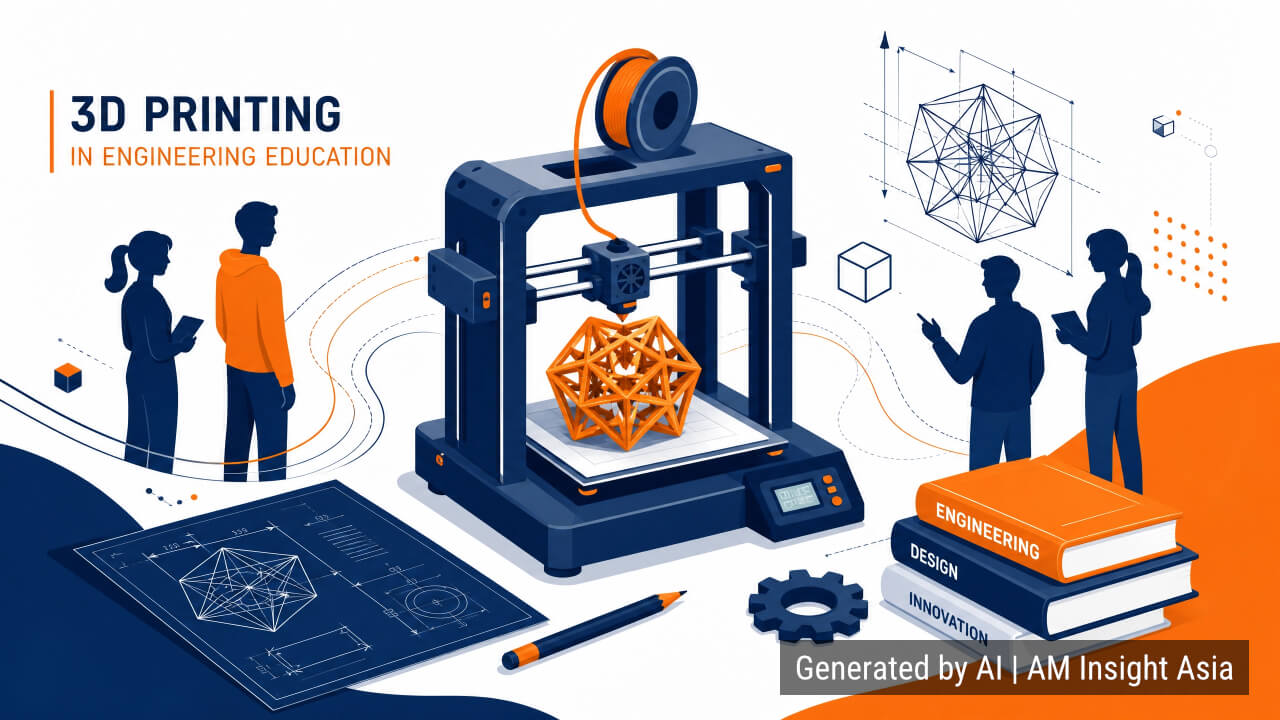
3D printing is often described as a technology that can make anything. In practice, it is more accurate to say it makes exactly what its user imagines, and nothing more. Unlike machining or molding, which involve working within constraints toward an optimal outcome, 3D printing offers few inherent constraints. The imagination of the person operating it determines what emerges. This is why the complaint heard so often from companies that have purchased 3D printers, that they do not know what to use them for, points to something deeper than a training problem. The issue is not that people cannot operate the machine. The issue is that they have not developed the thinking that comes before the machine: identifying a problem, forming a solution through design, and then bringing it into physical form.
These three steps, finding the problem, designing the solution, and using 3D printing to realize it, must work together for 3D printing to have meaning. What KOSEN develops is precisely this thinking.
KOSEN-KMITL introduced the Flashforge Creator Pro in 2020, early in its operation. In much of Western higher education, 3D printers are placed in FabLabs and makerspaces and used primarily to produce prototypes quickly. In Germany, a 3.5-year dual vocational training program called Ausbildung includes a specialization in additive manufacturing, centered on operating and maintaining the machines. In both cases, the education is about using 3D printing.
What happens in KOSEN-KMITL’s classrooms starts from a different place. For a national rocket competition, students used 3D printers to repeatedly prototype the nose cone of a rocket, cycling through material selection, shape hypotheses, printing, testing, and revision. In a first-year class, students disassemble digital cameras and work with 3D data to reverse-engineer the design, asking why each component takes the form it does, and learning design thinking by reading it backwards from an existing object.
The 3D printer in this context is not an output device. It is a medium for internalizing design thinking. The cycle of failing, reconsidering, and trying again is the education itself. This connects directly to the problem that companies face when they buy a 3D printer and find they cannot use it. The tool is not the issue. The thinking that should precede it is.
A 2024 academic study on the challenges of integrating 3D printing education in developing countries identified curriculum misalignment, insufficient faculty training, equipment costs, language barriers, and limited student exposure to the technology as the primary obstacles. KOSEN-KMITL addresses each of these structurally: through dispatched Japanese faculty, a coherent curriculum grounded in NIT’s Model Core Curriculum, and full government scholarships that remove financial barriers entirely.
PBL: Bringing Design Thinking to the Factory Floor
The question that follows is how design thinking developed in the classroom functions outside it. The answer is visible in the structure of the internship program.
Every October, all KOSEN-KMITL students participate in a one-month internship during the semester break. In the 2025 academic year, 58 companies offered placements and 40 were matched with students. The majority were Japanese-affiliated companies. Unlike the short-term internships common in Japan, students use the placement to identify a research theme grounded in a real company problem, and carry that theme forward into their graduation research. The structure runs as a three-way PBL between the company, the student, and the supervising faculty member. In some cases, the internship company has become the student’s employer.
The Mechatronics Department places particular emphasis on practical CAD and PLC training, and company evaluations of KOSEN-KMITL students have been rising. The first cohort of 20 graduates completed their studies in spring 2024, and every one of them secured a placement, either with a Japanese-affiliated company or through admission to a Japanese university. Third-year students also participate in a one-month training program at a Japanese KOSEN institution, where they work on lathe-based fabrication and real company problems, gaining hands-on engineering experience in both Thailand and Japan.
KOSEN-KMITL now operates three departments: Mechatronics Engineering, Computer Engineering, and Electrical and Electronic Engineering. A new building opened in 2025. A second Thai KOSEN, KOSEN-KMUTT, opened in June 2020, and enrollment across both institutions continues to grow.
AM Insight Asia Perspective
What is happening at KOSEN-KMITL carries implications well beyond Thailand’s own education reform.
The KOSEN model has already expanded to Mongolia and Vietnam, and inquiries have arrived from Uzbekistan and countries across Africa. The structural problem it addresses, the gap between assembly capability and design capability, is not specific to Asia. It is a challenge shared by emerging economies around the world. Thailand is becoming the first working proof of concept.
In Japan, the default path after high school runs in two directions: vocational school for immediate employability, or university for theoretical grounding. Technical skills can be acquired through vocational school. Theory can be learned at university. But the capacity to define what the problem actually is, to ask why a design should take a particular form, and to generate answers independently, has no clear home in Japan’s mainstream education. KOSEN was built to fill exactly that role, yet only 57 KOSEN institutions exist across Japan. Set against approximately 800 universities and around 3,000 vocational schools, the scale of KOSEN’s presence in Japanese education is strikingly small.
Japan is exporting KOSEN to the world while leaving its domestic potential largely unrealized. Thailand entered this process without design skills and without design thinking, and needed to build both simultaneously. That is why importing KOSEN as a complete system made sense: it addresses both at once. Japan’s manufacturing sector faces a different version of the same problem. The technical skills exist. The design thinking is often weaker. And the evidence shows up in a familiar place: companies that purchase 3D printers and find, once the machine arrives, that they do not know what to make with it.
What KOSEN is proving in Thailand, and beginning to prove across the world, is something that Japan’s own manufacturing and education sectors would benefit from asking again. Identifying the problem. Forming the solution through design. Realizing it through 3D printing. That sequence of thinking is what the next stage of manufacturing requires.