The world has moved past talking about machines. Practitioners from aerospace, rail and healthcare were discussing what AM should look like on the industrial floor.
Mention an AM event and most people picture a trade show, with aisles of machine and material booths to walk past. Global AM Summit 2026 in Singapore, held on October 22 and my first time attending, was something else entirely. The focus was not on exhibits but on people meeting people, and the talks were designed as a way in.
Speakers were given ten minutes as a rule. Representatives from Airbus, Alstom and Siemens laid out their key points and handed the stage to the next speaker. Whatever the talks left out was picked up during the breaks between sessions, over lunch, and at a dinner that ran for three and a half hours after the program ended. When a panel ran out of time for audience questions, the emcee simply told the room to catch the speakers once they stepped off stage.
The message that kept coming back throughout the day was that the next phase of AM will be decided not by printer performance but by certification, data, and who you choose to work with.
I wrote this report especially for those who have not attended yet.
For me, the day was a mix of excitement and disappointment. Why the two at once? I will come to that in the AM Insight Asia Perspective at the end.
Global AM Summit 2026 at a Glance
Global AM Summit is organized by NAMIC (National Additive Manufacturing Innovation Cluster), an organization hosted by Singapore’s Agency for Science, Technology and Research (ASTAR), the government agency that leads the country’s public-sector R&D. NAMIC connects research institutions, companies and government to drive AM industrialization, standards development, workforce training and collaboration between companies. I plan to cover what ASTAR and NAMIC each are, and why Singapore’s AM strategy draws attention worldwide, in separate articles.
Global AM Summit is NAMIC’s flagship in-person AM business event in Singapore. This year’s 15th edition, themed “Building Resilient Industries with Additive Manufacturing and AI,” ran for one day at the Suntec Singapore Convention & Exhibition Centre across four tracks.
It was held alongside ITAP (Industrial Transformation Asia-Pacific), an industrial technology show that ran on October 21 and 22, with the summit falling on the second day. This year marked ITAP’s relaunch under a new pairing of organizers: Hannover Fairs Asia-Pacific, a subsidiary of Deutsche Messe, and the Singapore Manufacturing Federation (SMF). As a transition year, the show was a smaller, conference-led edition, and it moved from Singapore Expo near Changi Airport, its venue in 2024 and 2025, to Suntec in the city center. Next year it is set to return at full scale, at Marina Bay Sands from July 20 to 22, 2027.
Short Talks, Panel Debates and a Three-and-a-Half-Hour Conversation
The program combined three elements: short talks, panel discussions with several speakers, and time for networking. The brevity of the talks struck me as a design choice rather than a scheduling constraint. Speakers skipped the company pitch and presented only what the problem is and what can be changed.
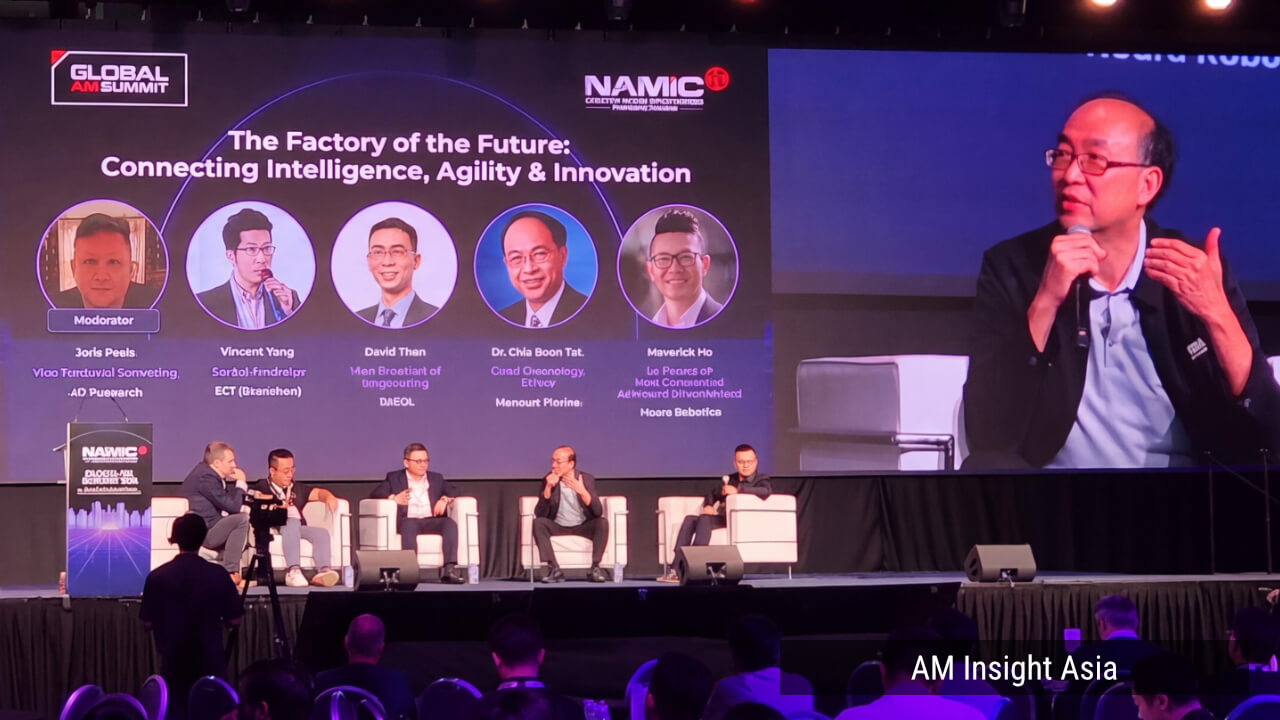
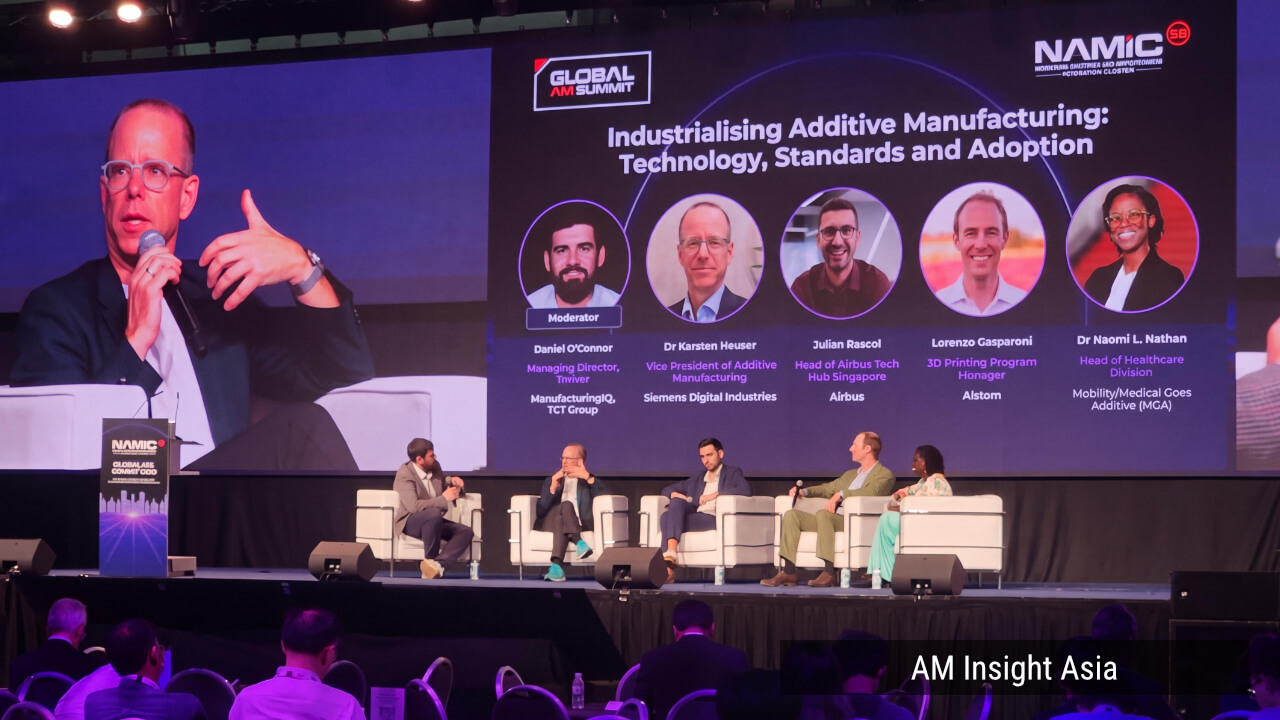
After the talks, the speakers lined up on stage for a panel. In the track on industrialization, four speakers from Siemens, Airbus, Alstom and the healthcare field each spoke for ten minutes, then the same group debated certification, standards and how to handle AI. The panel following the keynote was built the same way, picking up the keynote’s question of who should be working with whom and digging into it. Putting speakers with different vantage points side by side on the same points brought out both the challenges shared across industries and where they diverge.
Design, quality assurance, procurement, management, policy, materials, service providers: each of these looks to AM for a different answer, and even a 30-minute talk could not address everyone’s questions. That gap is what the conversation time is for. Breaks between sessions were fairly long, and lunch offered another chance to talk. The dinner afterwards lasted three and a half hours, and while there were some announcements, most of it was networking over food. Anyone you wanted to follow up with, you could keep talking to again and again, from the break right after a talk until late in the evening.
The organizers make no secret of this design. In his welcome address, NAMIC CEO Dr. Ho Chaw Sing encouraged attendees to approach the speakers and fellow participants during the breaks and to visit the booths. In the same address, he announced that a directory called AM Industry Connect 2026-2027, covering several hundred AM companies, research institutions and public-sector organizations, would be launched that evening. Arno Held, founder and managing director of Held Holding GmbH, opened his keynote by saying that in how it looks after its speakers and in the quality of its organization, this conference is almost unmatched anywhere in the world.
The room itself was different from the typical lecture setup in Japan, where chairs are simply lined up facing the stage. It was set up more like a banquet hall, with round tables, so attendees could listen to the talks in comfort. By my own estimate, it seated around 200 to 300 people. Because this is not a giant trade show, attendees get to recognize each other’s faces and can speak several times in one day with someone whose talk caught their attention. At Global AM Summit, the talk is the opening to a conversation, and the conversation is the main event. In a field like AM, where applications, certification, data and supply chains are all tangled together, that design makes sense.
What Resilience Means Here
Resilient, in the sense of the theme, refers to the ability to keep production and supply going, or to restore them, in the face of supply chain disruption, disaster, geopolitical turmoil or a halt in parts supply. Guest of honor Shawn Huang, Senior Parliamentary Secretary for Finance and Manpower, looked back on how, when nasopharyngeal swabs ran short during COVID-19, Singapore worked with NAMIC to build domestic manufacturing capability. For a small country, he said, technological capability is about more than competitiveness. At critical moments, it is a matter of survival.
Within this theme, AI and AM split the work. AI links equipment sensor data, in-process quality data, inventory, orders, logistics and supplier information, and makes the call early on what is about to stop and which alternative is fastest. AM provides the means to make the replacement part where it is needed. Only with both in place does manufacturing become robust against supply chain disruption.
Keynote: AI Will Not Save AM. It Will Sort It
The foundation for the day’s discussion was laid by Held’s keynote. He spent 11 years investing in AM startups and screened around 3,000 companies.
In February this year in New York, Held had argued that AM is not short of investment money but crowded with too many companies. This time he looked back on the industry shakeout since then, without naming companies, and framed it not as a failure of the technology but as a market growing up. The more hardware commoditizes, the more applications decide who wins. Indeed, many of the companies succeeding with AM have a core business in sporting goods, toys or dentistry, and do not describe themselves as AM companies.
His answer on AI was short: AI will not save additive. AI will sort it. The most expensive thing in this industry is not the machine but proving that the process works, through parameter development, qualification and certification. Machine learning is shortening that cycle, and qualification know-how turns into data. Data can be owned, transferred and scaled. At the same time, AI does not fix a missing customer. It makes a good application better and makes a bad application fail faster.
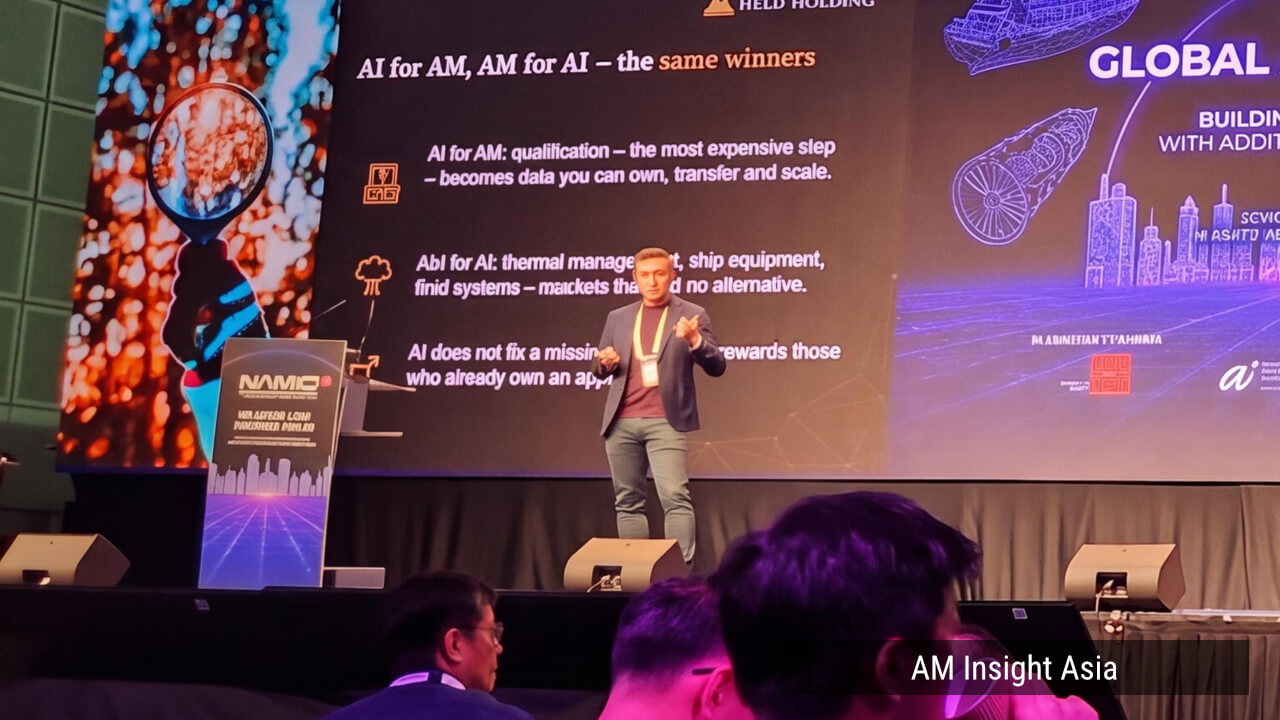
Held then widened the lens to geopolitics. With tariffs, export controls that now reach into data, and buyers asking where things were made, machines and production are moving closer to customers and to borders. What travels across borders is knowledge: which application, which materials and parameters, which qualification rules. That is why the question of who owns qualified process data, whether the OEM, the machine builder, the service provider or the state, will be at the center of the next round of alliance negotiations.
Asia, with its scale and speed, and Europe, with more than 20 years of experience qualifying parts, cannot win alone. Held said Singapore has quietly built a neutral ground where that cooperation can happen, and closed his keynote with three lines: applications decide who survives, borders decide where things are made, and alliances decide who wins.
What Holds Back Industrialization Is Everything Around the Printer
The track on industrialization told the same story from four industries. The printing itself works. What is stuck is everything around it.
Dr. Karsten Heuser of Siemens Digital Industries said AM has been talked about for a decade as something that would disrupt supply chains, and that it did not. As Heuser put it, Airbus sells aircraft, Adidas sells shoes and Apple sells iPhones. They do not own AM machines, and they do not buy powder. What actually worked was existing suppliers that already served those industries through casting or injection molding adding AM to their own processes. Just as Foxconn is Apple’s biggest manufacturing contractor, he saw no reason for that structure to change with AM.
Julian Rascol, head of the Airbus Tech Hub Singapore, said Airbus has around 10,000 metal AM parts flying and produces about 5,000 a year. It wants to reach about 20,000 a year within five years, but printer capacity is not the obstacle. A certified part needs a business case, which means it has to be either high volume or critical, and the critical parts are exactly where the technology is least mature. On top of that, machines are not standardized against each other, so the same build on a different machine does not necessarily produce the same part.
Lorenzo Gasparoni of Alstom said the company has printed around 250,000 parts, saved 46 million euros mainly through inventory reduction via its digital warehouse, and cut lead times by more than 250,000 days. The goal is to make 20% of the bill of materials printable. But rail has no standard for certifying printed parts. Alstom controls its process to ISO/ASTM 52920, then certifies each part against its own rules and prints test specimens with every batch. A single metal validation specimen costs around 1,000 euros.
Dr. Naomi L. Nathan of Mobility Goes Additive, who covers healthcare, put technology at the bottom of her list of barriers. At the top were regulatory approval, reimbursement, business models, and quality and skills. However mature the technology, adoption stalls until it is settled whom to invoice and who pays.
AI as a Tool That Brings Human Judgment Forward
Kitty Wang, CEO of SynaCore, described a customer that prints blades. The customer had sensors, design data, measurement data and three years of failed prints sitting on shelves, but collecting the data alone did not solve its distortion problem. Once the data was connected to a closed-loop digital twin, distortion was brought within 200 microns in three iterations, without anyone touching the printer. Data that is not connected to software, she pointed out, is not an asset but simply a cost.
Heuser described AI as a co-worker rather than a replacement. It cuts a four-day root-cause investigation down to an hour and predicts failures by looking across data that companies usually keep in separate silos. But a human still signs off the part.
Rascol drew a firmer line. Airbus has used AI in one form or another for about 40 years, he said, but large language models are a different matter and will not go near production in safety-critical processes. His remark that there is no pathway to certifying that kind of AI showed the practical wall facing anyone trying to build AI into AM.
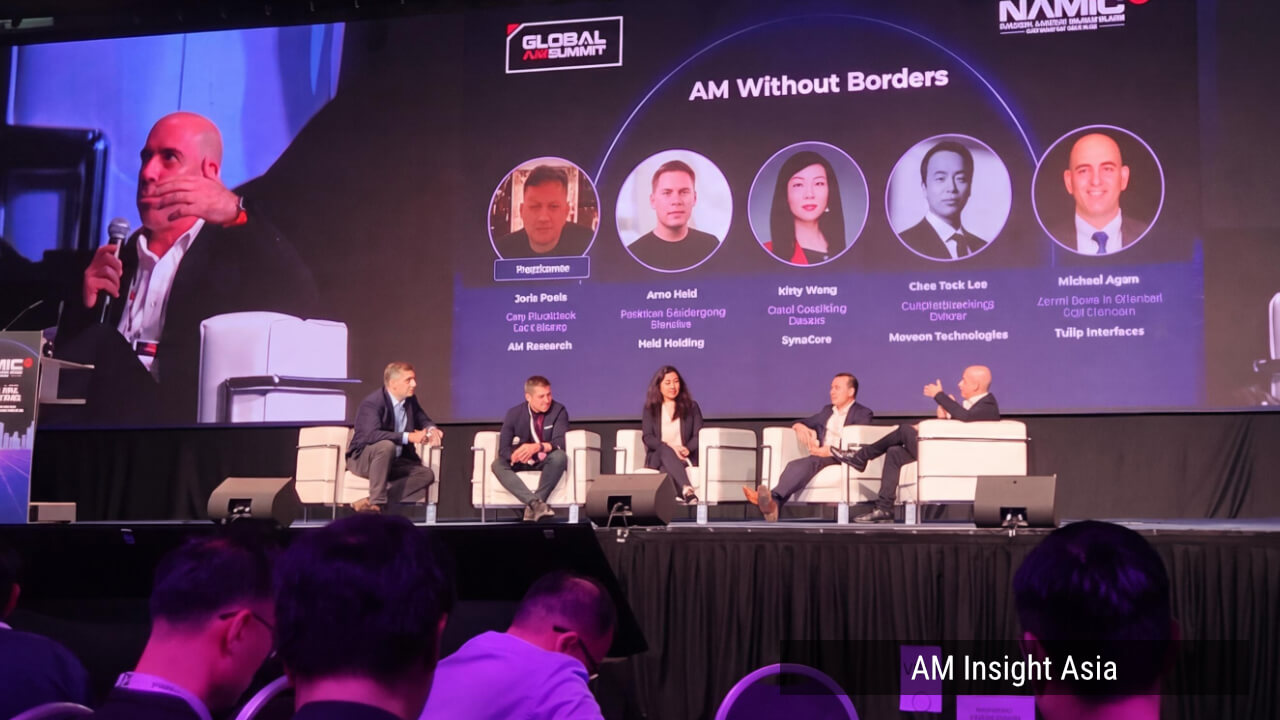
The question of dependence on AI itself also came up. In the Track 1 panel, moderator Joris Peels of AM Research asked what happens to a business if it loses access to the AI it relies on. Michael Agam of Tulip Interfaces answered that more than 80% of AI use runs on open models, which limits the risk (he did not give a source). Held said that while the scale of the dependency has grown, building redundant systems to manage that risk has always been an entrepreneur’s job.
AM Is One Step in the Chain, Not the Center
The day’s most uncomfortable line also came from Heuser: don’t be arrogant and put yourself at the center of the universe, because AM is just one step in a bigger production chain. Every AM part connects to other processes such as machining, casting, injection molding or surface treatment. What to offer customers, he said, is not a disruptive new technology but what they already buy on: cost, price, quality and lead time.
Agam likewise said additive and subtractive will always live alongside each other and neither will replace the other. The injection mold example presented by the CTO of Moveon Technologies made that concrete. The bulk of the mold is made by precision machining, while porous inserts produced by metal AM are fitted where conventional vents tend to clog. For cooling, instead of machined channels that can only run in straight lines, AM is used to make conformal cooling channels that follow the shape of the part. He also described printing a stack of tiny endoscope lenses as a single piece to solve an assembly yield problem, and said the premise of any partnership is that each side brings value to the table.
Three Partnerships Signed, and an Investment in People
Over the course of the event, NAMIC announced three partnerships. None of them is about buying machines. All of them concern qualification, supply chains, standards and people.
- Bavaria Makes: a memorandum of understanding with a nonprofit association driving AM industrialization in Bavaria, Germany, signed on October 21, the first day of ITAP. Its founding members include Siemens, EOS, Oerlikon and the Technical University of Munich, and the partnership will support knowledge and talent exchange between the two regions.
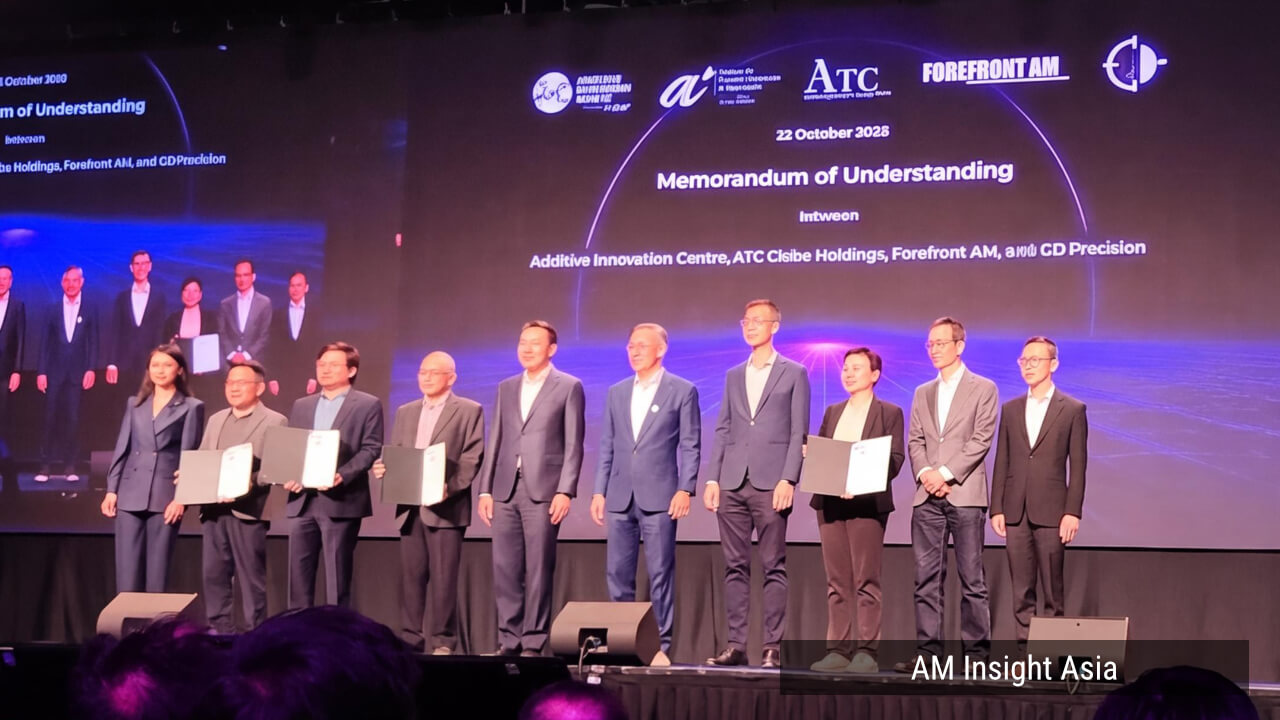
- A*STAR Additive Innovation Centre (AIC) and three local companies: a collaboration between AIC, ATC Globe Holdings, Forefront Additive Manufacturing and GD Precision. It links the capabilities of a public research institution with the operational strengths of local companies, covering everything from research and materials development to printing, precision machining, qualification and production in one environment.
- ASTM International: a deepening of a strategic partnership that began in 2018, aimed at advancing standards, qualifications and trusted digital data frameworks. The introductory video described the partnership as using standards to support the adoption of next-generation manufacturing powered by AM, robotics and AI. It has so far delivered four international standards and three accredited training programs, with more than 120 people trained.
On the workforce side, Senior Parliamentary Secretary Huang noted that NAMIC has trained more than 1,000 professionals since 2022. NAMIC has also put in place a national accreditation scheme linking the skills needed for AM roles with training, the National Additive Manufacturing Jobs-Skills Accreditation Framework (NAAF). The Singapore Armed Forces, as it builds its in-house AM capabilities, has chosen NAAF-recognized courses to upskill its engineers. The training programs developed with ASTM are now recognized under NAAF as well.
How to Get the Most Out of Global AM Summit
If you only listen to the talks, you get half of what Global AM Summit has to offer. On site, I found that approaching it in the following ways makes a big difference.
- Plan who you want to meet, but leave room for chance: The program is posted on the official website down to the speakers and time slots, so deciding in advance who you want to talk to is efficient. Rather than leaving a ten-minute talk with unanswered questions, go in planning to ask the speaker directly during the break, and you will listen differently. At the same time, a conversation with someone you happen to sit next to during a break or at dinner can turn into an unexpected connection. Being able to enjoy both the planned and the unplanned is part of what a conference this size offers.
- Note who to ask what during the talks: Panel Q&A can run out of time. This year too, attendees were encouraged to take their remaining questions directly to the speakers after they left the stage.
- Stay for the dinner: The three and a half hours of networking are the time to sit down properly with people you could not finish talking to during the day. Given the size of the venue, my impression is that you get far more chances to speak directly with the speakers you are interested in than at a large trade show.
- Use LinkedIn before and after: LinkedIn is essential. You meet in person for the first time people you were already connected with on LinkedIn, and you connect on the spot with people you meet at the venue. Moving back and forth between online and in person is the key to relationships that last beyond the event.
The dates for Global AM Summit 2027 had not been announced at the time of writing.
Who Should Attend
Global AM Summit is less a technical training session for designers and printing engineers than a conference for people building the systems that bring AM into an organization’s or a region’s manufacturing base. The question was less how to print a given part than which operations, products and supply chains to bring AM into, who manages the data and certification, and how to turn it into a business.
- Government officials, public agencies and local governments: those who want to design policy on AM-driven industrial development, workforce, regional manufacturing bases and supply chain resilience
- Corporate AM strategy and technology management leads: those weighing adoption decisions, application areas, return on investment, and certification and data strategy
- Machine makers: those who want to understand end-user requirements, application trends and needs for integration with AI and software
- Material makers: those who want to learn about material requirements by application, certification and the barriers to volume production
- Distributors and resellers: those looking to articulate customer challenges, sharpen their proposals and find ecosystem partners
- Service bureaus: those exploring the direction of quality assurance, digital inventory and spare parts businesses
- Research institutions and universities: those looking for connections to industrial challenges and partners for joint research and workforce development
On the other hand, if your only goal is operator training on a specific machine, detailed material data or printing know-how, Global AM Summit on its own may fall short. That kind of deep dive needs to be supplemented through conversations after the talks, one-on-one meetings or separate technical training.
AM Insight Asia Perspective
The value of Global AM Summit lies less in what was said than in the way the conference itself is shaped around where competitiveness in AM actually flows.
Following Held’s framing, what will carry value across borders in AM from here on is not the machine but qualified process data and application knowledge. The lack of standardization between machines that Airbus described, the specimen costs Alstom pays part by part, and the reimbursement wall Nathan pointed to are all problems whose solutions cannot be found in papers or exhibition booths. Who got which certification route through, and how they dealt with which regulator: this kind of knowledge only flows through relationships between people. Things that cannot be said openly on stage can sometimes be heard off the record over a break or at dinner.
Singapore has designed that flow as national policy. It keeps the talks to ten minutes, makes time for breaks and dinner, and signs partnerships with Bavaria and ASTM during the event. The way the conference is run and the country’s industrial policy point in the same direction. That being so, this should also be a place to lay the groundwork for policies, joint projects and initiatives that cross national borders. Most AM events in Japan are built around talks, and they end once the talks are over. There is no place to discuss.
Singapore’s design extends to people as well. Look at the AM industry as a whole, and its energy is weighted toward selling machines, with far too little effort put into education and spreading knowledge. Japan is no exception. With few educators who can teach AM systematically, the number of students learning it does not grow, and neither does the number of engineers entering the field. True, operating a machine can be learned inside the company that bought it. But that engineer will one day be in a position to think strategically about how to use AM in the business and the organization. When that day comes, can strategy be taught and discussed as a mere extension of machine operation? At this rate, even if machines spread for a time, AM will not become an industry that is properly understood and takes root. Talk of its usefulness will remain confined to a small circle of specialists. Singapore linking training to job roles through a national accreditation scheme, to the point that even its armed forces use that scheme to train engineers, is one answer to this problem facing the industry.
The gap showed in who was in the room. I had expected that a fair number of government officials, public agencies, local governments and corporate AM strategy leads would be there from Japan. As it turned out, I was the only Japanese person at the venue. To be honest, I was disappointed. Here was a conference where practitioners from aerospace, rail and healthcare spoke frankly about certification and data, and where policymakers and companies signed partnerships on the spot, and Japan’s stakeholders were absent. That absence can translate directly into a gap in access to information on certification and data.
So the reason for Japanese companies to attend Global AM Summit is not to see the latest machines or materials. The question to ask is not what to go and see but who to go and talk to, and about what. For a material maker, that could be aerospace and rail engineers stuck on certification. For a service bureau, the people running digital warehouses. For local governments and policymakers, the people who designed workforce schemes like NAAF. Go in having decided who to talk to and what to ask, and a ten-minute talk works perfectly well as a way in. What is more, the connections do not end on the day. As the emcee noted at the opening, there were many familiar faces in the room, and plenty of attendees come back every year. Rather than a single exchange of business cards, you can meet again year after year and deepen the relationship. The real value of this conference lies in that chance to build lasting relationships.
The next thing to watch is how Global AM Summit will be held alongside ITAP when the show moves to full scale at Marina Bay Sands in July 2027. And Held’s question applies just as much to Japanese companies: in 2031, who will you be building your AM business with?
About the Company
A*STAR (Agency for Science, Technology and Research) The Singapore government agency that leads the country’s public-sector R&D. Its Additive Innovation Centre (AIC), supported by NAMIC, works on AM process development and training. At Global AM Summit 2026, AIC announced a collaboration with three local companies.
NAMIC (National Additive Manufacturing Innovation Cluster) An AM promotion organization hosted by ASTAR. It drives AM industrialization, standards development, workforce training and collaboration between companies. Its establishment was announced in September 2015. CEO Dr. Ho Chaw Sing also serves as Executive Director of ASTAR’s Science and Engineering Research Council (SERC). Besides Global AM Summit, NAMIC organizes the NAMIC Start-up Innovation Forum, a pitching event for AM startups.
Source
- Back Downtown: Takeaways from GAMS 2026 and the Relaunched ITAP in Singapore (via TCT Magazine, Oct 24, 2026)
- Speech at 15th Global Additives Manufacturing Summit 2026 (via Ministry of Manpower Singapore, Oct 22, 2026)
- Deutsche Messe and Singapore Manufacturing Federation Relaunch ITAP 2026 (via PR Newswire, Aug 18, 2026)