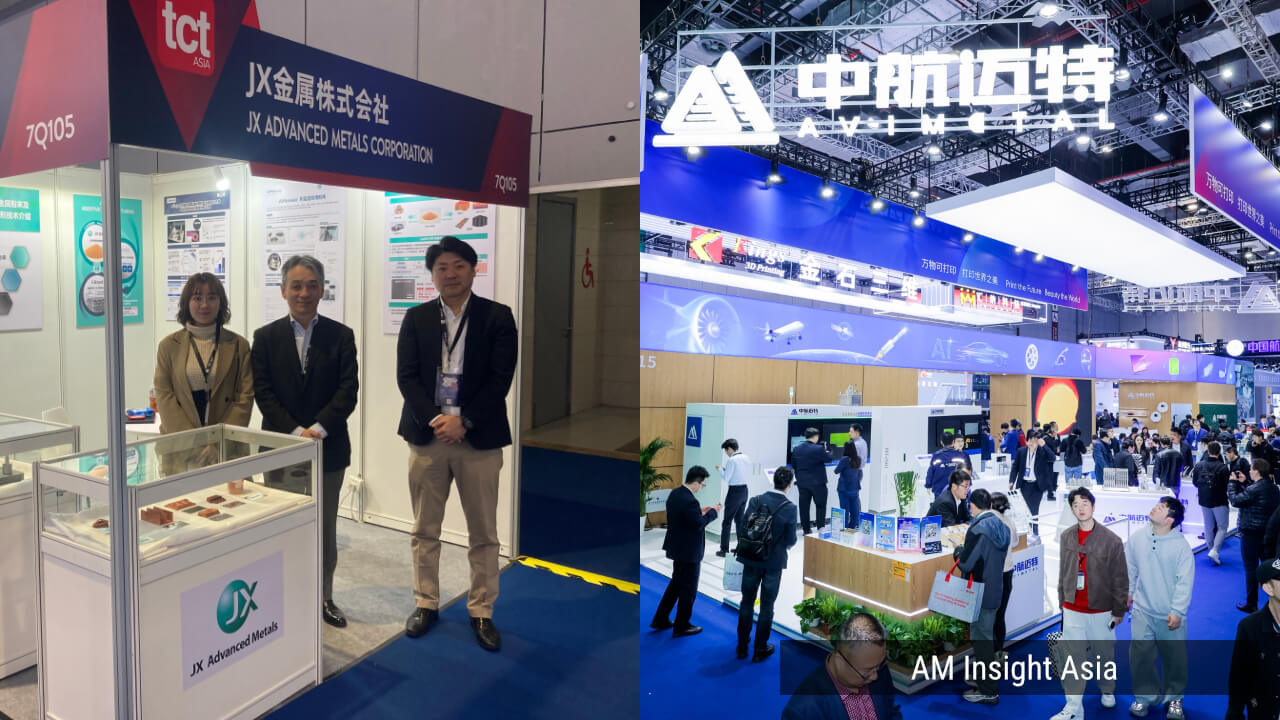
Walking the floor of TCT Asia 2026 — 55,000 square meters of additive manufacturing spread across two halls at Shanghai’s National Exhibition and Convention Center — it is easy to miss things. Over three days, I walked that space until my feet gave up on me. Avimetal’s booth was impossible to miss: large, well-staffed, packed with printed parts and live machine demonstrations, drawing a steady crowd of engineers and procurement managers. A little further along, I almost walked past a much smaller booth without a second glance. That was JX Metals. First time at TCT Asia, modest in scale, easy to overlook if you weren’t paying attention. Yet both companies are doing essentially the same thing: making copper powder that can be processed without a green laser. Same goal. Completely different worlds.
Why “Copper Powder Additive Manufacturing Without a Green Laser” Matters
Pure copper has long been one of the most stubborn materials in laser powder bed fusion. The near-infrared lasers used in most commercial L-PBF systems — operating around 1064 nm — are largely reflected by copper’s surface rather than absorbed. Combined with copper’s exceptional thermal conductivity, which rapidly dissipates any heat that does get in, the result is a material that resists the stable melt pools that reliable AM depends on.
The conventional fix has been a hardware upgrade. Germany’s Trumpf commercialized green-laser systems operating at 515–532 nm around 2020, offering dramatically higher absorption efficiency for copper. In China, Shenzhen-based Addireen has built its entire business around green-laser copper AM, developing its laser source, optical system, and printer in-house — a clear signal of how seriously the industry is taking this challenge. But green-laser machines carry a significant price premium that puts them out of reach for much of the manufacturing world. What both Avimetal and JX Metals are betting on is whether powder engineering alone can make that hardware investment unnecessary. Both say yes — but what they mean by that, and who they are saying it to, could not be more different.
JX Metals’ Small Booth — A Purist’s Answer to Copper Powder Additive Manufacturing
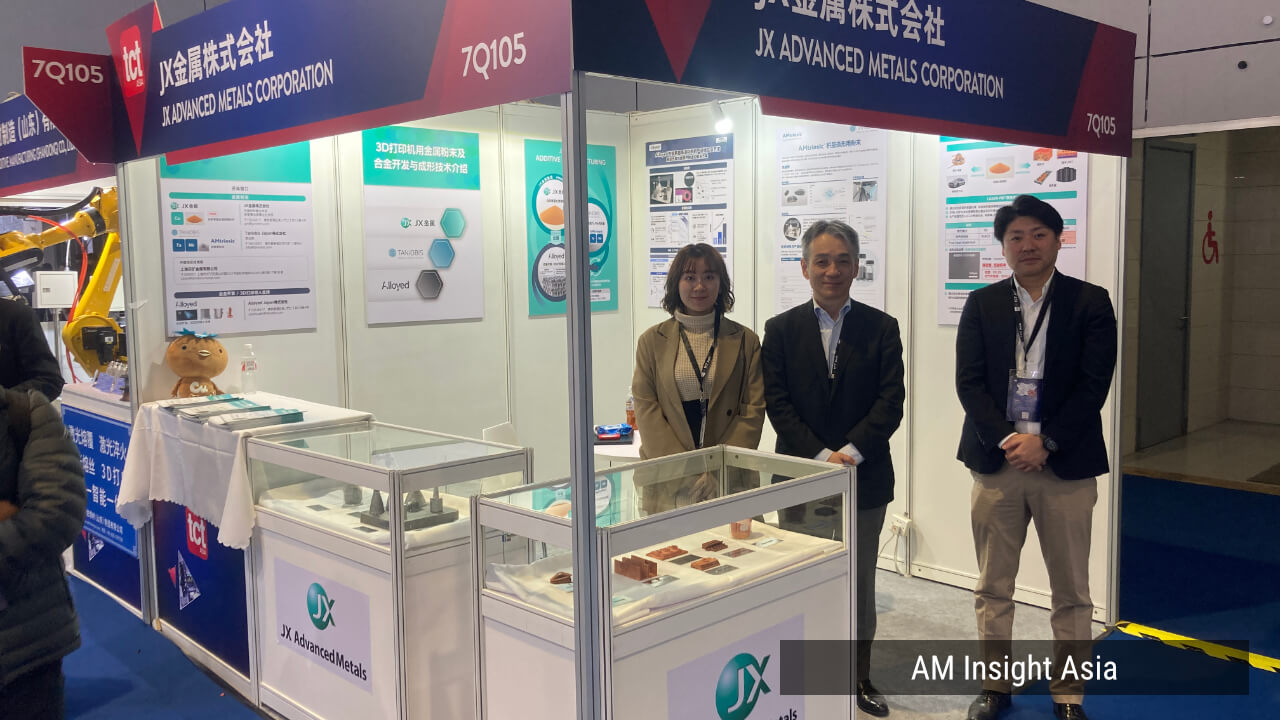
JX Metals made its TCT Asia debut without making any statement about scale. Small, quiet, almost theatrical in its contrast with Avimetal. Yet the technology on display was the product of years of co-development with UK-based Alloyed, and it represents a fundamentally different bet on where the value in copper AM lies.
The concept behind JX Metals’ surface-treated copper powder is simple and bold. By applying a proprietary nano-scale surface treatment to high-purity copper powder, the company has engineered particles that dramatically improve laser absorptivity — without sacrificing the electrical and thermal properties that make pure copper worth printing in the first place. The powder enables high-density builds using standard near-infrared L-PBF systems at 400W to 500W, achieving electrical conductivity of 99% IACS or above — equivalent to pure copper. Crucially, the powder requires no post-build heat treatment, a step that copper alloy powders typically demand and that adds cost, time, and process complexity.
What sets JX Metals’ strategy apart is the business model: the company sells powder as a standalone material, designed to work with machines from any manufacturer. The message is straightforward — whatever L-PBF system you already own, JX Metals’ powder can make it capable of producing copper parts that rival the output of far more expensive green-laser platforms. Target applications reflect that premium positioning: next-generation EV inverter cooling, high-density heat sinks for AI server infrastructure, and bespoke components where a fraction of a percentage point in conductivity determines product performance and longevity. This is the territory where Japanese manufacturing has always been strongest.
Avimetal’s Booth — Copper AM as an Industrial Tool
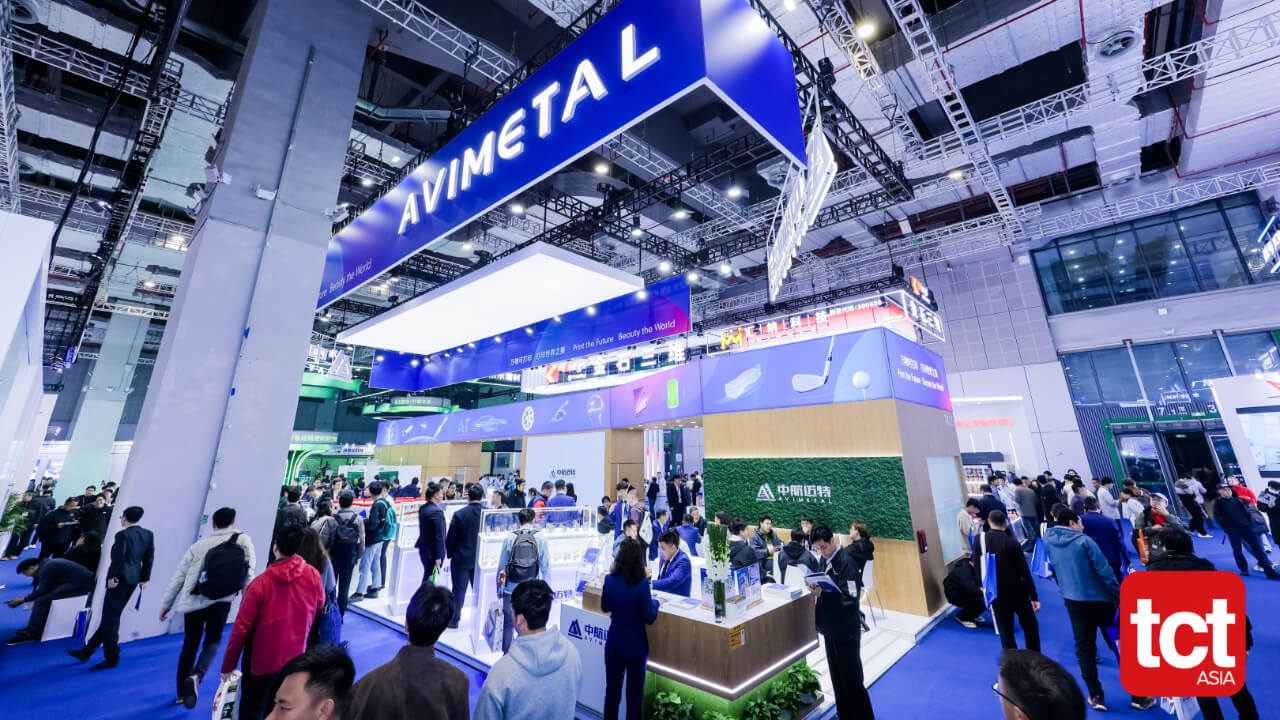
Avimetal is not a company feeling its way into the market. Established in 2015 as a subsidiary of Beijing-based state-owned enterprise Jingcheng Electromechanical, the company entered the L-PBF machine market in 2021 and now operates three facilities in China with a portfolio of over 200 metal powder grades. The scale of the TCT Asia 2026 booth matched that footprint exactly.
The centrepiece of Avimetal’s copper story is MT-CuCrZr — a copper-chromium-zirconium alloy powder engineered with full-chain optimisation from composition to process parameters. The powder is purpose-matched to Avimetal’s own MT-series printers, a lineup running from the compact MT170H up to the large-format MT1300. The pitch is not “here is a material.” It is “here is a system.”
What made the booth compelling was not the technical specifications but the evidence of real production. MT-CuCrZr is now manufactured at 300 tonnes per year, and the parts on display — rocket engine combustion chambers, EV connectors, precision electrodes — were unambiguously production-grade components, not showcase prototypes. The engineers browsing the booth were running the same mental calculation: can this system replace the expensive green-laser machine I was about to buy?
Same Technology, Worlds Apart — What Two Booths Revealed About the Power of Diversity
The contrast between these two companies is about more than strategy. It shows how the environment a company operates in can transform the same technology into something entirely different.
In China, metal AM is already a mature industry. Large-format printers are running on production lines, cost competition has begun, and the question has shifted from “can it work?” to “how many, and at what cost?” In that environment, what Avimetal has perfected is the ability to lower barriers and guarantee results through vertical integration. No matter how good a technology is, if the cost is too high, it simply won’t be adopted. Delivering something that works at scale is where Chinese manufacturers excel. Avimetal’s target is the dedicated copper parts manufacturer — the facility that prints copper components every day, in volume. At that frequency, cost hits the bottom line directly. Running a purpose-built system at lower cost than a green-laser machine is not a compromise; it is the rational choice.
In Japan, metal AM is still in its early stages. Prototyping over mass production, quality over cost, performance over scale — these are the priorities that define the market. In that environment, JX Metals is targeting a different kind of customer entirely: the job shop or research institution that prints titanium today, aluminium tomorrow, and occasionally needs to print copper too. For that customer, a dedicated copper machine makes no sense. What makes sense is putting JX Metals’ powder into the machine they already own, and getting the best possible result when the job calls for it. Japan’s commitment to doing things properly has never wavered.
Same goal — copper AM without a green laser — but one company is speaking to manufacturers who print copper every day, and the other is speaking to those who print copper when the job demands it. Both booths were on the same floor at TCT Asia 2026. The technology that connects them could not be taking more different paths.
AM Insight Asia Perspective
There is no single correct AM strategy. That was the clearest lesson from these two booths at TCT Asia 2026. Avimetal and JX Metals share the same challenge and the same general approach — overcoming the green-laser barrier through powder engineering. But what they are building toward is entirely different.
If Avimetal’s system gains traction, the cost of entry into copper AM drops, and volume manufacturers who never considered the process before will start to enter the market. If JX Metals’ surface-treated powder spreads, the existing installed base of L-PBF machines becomes copper-capable overnight. Both scenarios point to the same conclusion: it is materials innovation, not hardware, that is rewriting the rules of copper AM.
TCT Asia covers 55,000 square meters, and walking it is exhausting. But when you move through that space with a question in mind — why are these two companies doing the same thing so differently? — what looks like a crowded trade show floor starts to reveal itself as something else. Small booths and large ones, Japan and China, the pursuit of perfection and the drive for scale — the dramatic stories are there, scattered across every hall. That is what makes TCT Asia worth the walk.
- TCT Asia 2026 Field Report [Part 1]: The Energy Of The 3D Printing Industry As Felt In Shanghai
- TCT Asia 2026 Field Report [Part 2]: Two Worlds Born From Diversity — Diverging Strategies In Copper Powder Additive Manufacturing
- TCT Asia 2026 Field Report [Part 3]: 7 Companies Worth Watching In TCT Asia 2026 Metal AM
- TCT Asia 2026 Field Report [Part 4]: My First TCT Asia Experience