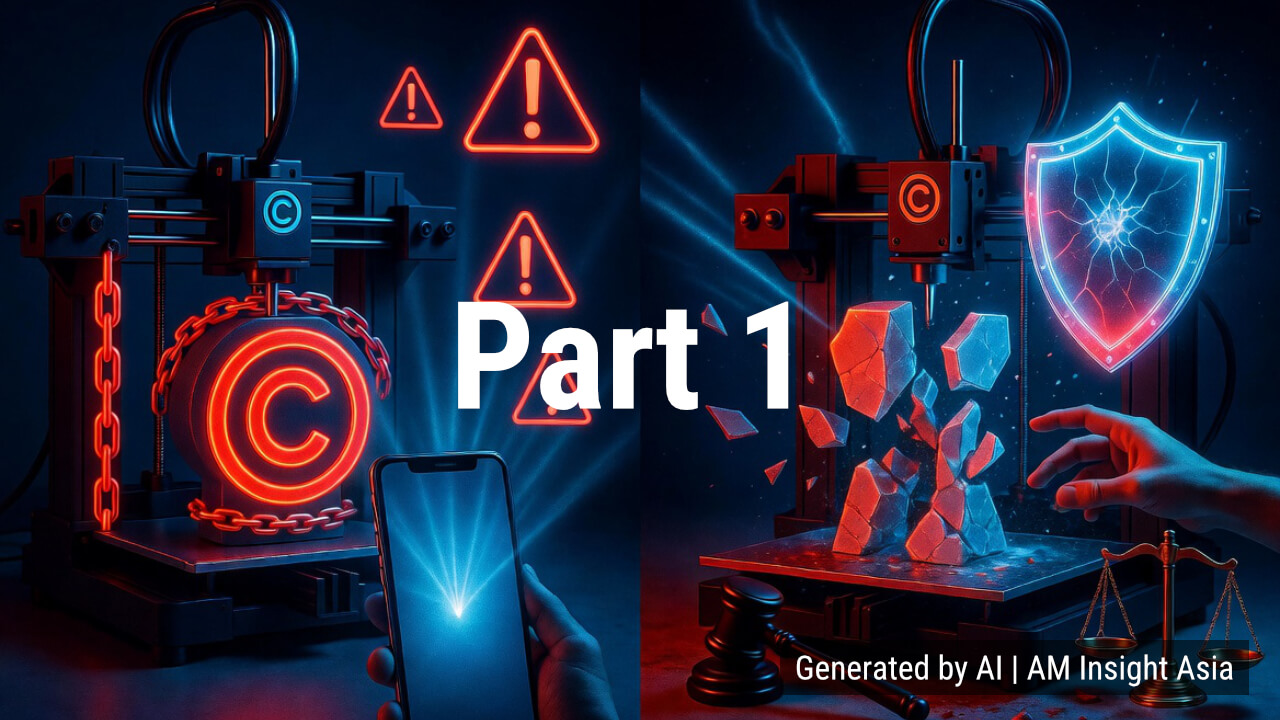
The Age of Democratized Copying Has Also Democratized Infringement
Anyone can now digitize their ideas and bring them to life with ease. 3D printers, AI, social media, and online selling platforms have come together, making it possible to deliver something you thought of yesterday to the world tomorrow. The spread of AI has accelerated this further. Even without design knowledge, AI generates the data. Even without CAD skills, a smartphone scan app turns reality into data. It is a truly remarkable era.
But wait.
What you are doing, or what you are about to do, may be quietly turning into a serious problem. There is no malicious intent. You are not trying to break any rules. You simply do not know. And that not knowing is spreading rapidly in this day and age.
This article is not written to blame anyone. It is written to raise awareness by sharing knowledge that is taken for granted in the manufacturing industry but has not reached individual makers, through concrete examples.
One thing to note in advance: the author is not a legal professional. This article does not provide legal judgments. Its purpose is solely to raise awareness that these issues exist. For judgment and action on individual cases, please consult a qualified professional such as a lawyer or patent attorney. Knowledge is only the entrance to awareness. Beyond that, always seek the help of professionals.
Additionally, while the issues covered in this article are globally relevant, all legal and regulatory references are based on Japanese law. Readers outside Japan are encouraged to verify the applicable laws in their own jurisdiction.
For issues related to product liability, safety management, and the Product Liability Act, please refer to the companion article “What You Need to Know Before Starting 3D Printing (2/2): Responsibility Edition.”
How Far Does “Personal Use” Go? The Basics of 3D Printing and Copyright
Let us start with the basics.
If you make something and enjoy it entirely by yourself, there is generally no problem. Article 30 of the Copyright Act permits reproduction for private use. Printing a figurine of your favorite game character at home and displaying it on a shelf, or scanning a character to create data for personal enjoyment, are legally permissible within the scope of private use.
However, the scope of “personal use” is far narrower than most people assume.
The line is crossed the moment something leaves your hands.
Posting a photo on social media. Sending data to a friend. Posting in a community. Displaying at an exhibition. The moment a copyrighted work leaves your control, legal issues begin.
Posting on social media falls under “public transmission” as defined in Article 23 of the Copyright Act. According to the Agency for Cultural Affairs, sharing information online, including via social media, constitutes providing information to people around the world. In most cases, any transmission without permission constitutes an infringement, regardless of intent or motivation.
“I am not doing it for profit” does not hold up. “I did not receive any money” is irrelevant. “I had good intentions” does not provide immunity. The act of letting something leave your hands is itself the issue.
There are also situations that require attention even when you are not selling, not posting on social media, and simply keeping something in your possession. That situation is exhibition.
Consider placing a 3D-printed character in a booth at a trade show. Displaying a legitimately purchased figurine in a booth is fine. However, placing an unauthorized 3D-printed character in a booth creates a dual problem: infringement of the reproduction right at the point of printing, and public display at the point of placement. “I printed a popular character and displayed it in my booth to demonstrate technical capability.” This is not uncommon in the industry, but legally it is a violation.
The same applies when companies place 3D-printed objects bearing other companies’ logos or popular characters in their own social media or trade show booths. The addition of business intent, such as “we used it for marketing” or “we used it for social media appeal,” increases the risk further.
Links and Files Are Different. But Links Also Have Pitfalls
Data sharing is commonplace in the 3D printing community. People download data from MakerWorld or Thingiverse, send it to friends, and post it in groups. Much of this activity constitutes unconscious infringement under the law.
Let us start with a basic clarification.
Sharing a link is, in principle, not considered copyright infringement. Sharing a MakerWorld URL on social media or posting a Thingiverse page link in Discord does not place data on your own server. Since the data is sent directly from the linked source, this is not considered an infringement of reproduction or public transmission rights under current Japanese law (Rocket News 24 case, Osaka District Court, 2013).
However, the qualifier “in principle” should not be forgotten.
Posting a URL to content that is clearly illegal, or continuing to keep such a link posted after being warned, may result in legal liability as aiding and abetting copyright infringement. The structure is similar to spreading defamatory content online. Even if you did not post the original content yourself, actively directing others to illegal content can make you liable.
Moving the file itself is more clearly a violation.
Sending an STL file via LINE. Uploading data to a Discord server. Distributing an STL via a Dropbox link. Attaching a file to a message with a note saying “check this out.” All of these involve reproduction plus transmission and may constitute infringement even with good intentions.
“But the data is freely available” is a common objection. However, free data always comes with a license. When uploading data to MakerWorld or Thingiverse, creators can set licenses such as “personal use only,” “no modifications,” “no redistribution,” and “no commercial use.” Free does not mean freely usable. Forwarding or redistributing data without checking the license may constitute a violation of that license.
Why “I Just Received It” and “I Just Passed It Along” Can Still Create Liability
This is the most widely misunderstood area.
Someone received an STL file from an acquaintance, thinking it was for personal use. That person then forwarded the data to someone else, or posted it in a community group. What happens in this case?
First, the person who forwarded the data becomes an independent infringer. The origin of the data does not eliminate responsibility. “I just received it” and “I just passed it along” do not provide immunity in civil law. Under copyright law, even intent or negligence is not required for an injunction request. Liability arises from the act itself.
Second, the person who originally passed the data may also face liability. A verbal restriction stating “this is for personal use only” has no legal binding force. If the recipient spreads the data further, the original sender may be held responsible as the starting point of the chain of infringement.
The chain can be visualized as follows.
The copyright holder can independently file for damages and injunctions against the person who created the data, the person who passed it along, the person who received it and forwarded it further, and the person who spread it on social media. “I was just in the middle of the chain” does not hold up.
Is a Closed Space Safe? The Discord 50-Person Threshold
“Discord is invite-only, so it is fine.” “It is just among friends, so there is no problem.” These assumptions are mistaken.
Under copyright law, “the public” includes not only unspecified individuals but also a large number of specific individuals. According to the Agency for Cultural Affairs, more than 50 people constitutes “many.”
Applying this to Discord:
Uploading data to a private server shared among five close friends is closer to a safe judgment. They are specific and few in number.
However, uploading data to a 3D printing community server with 100 members is likely to be considered public transmission. Even though they are specific individuals, the number is large.
Furthermore, servers with publicly shared invitation links, or servers that anyone can join by applying, may be treated as “unspecified” regardless of how few members there currently are. Unspecified individuals are considered the public regardless of number.
“Right now there are only 10 people, so it is fine” is also risky. If the server grows beyond 50 members, data uploaded in the past may retroactively become a problem.
Acts That Are a Violation Even Without Selling
The belief that “there is no problem if I am not receiving money” is deeply entrenched. Copyright infringement can occur independently of any sales activity.
This is not only a problem for individual makers. Major 3D printer manufacturers, material manufacturers, and retailers have also been observed casually using popular characters or well-known IP in trade show displays and social media posts. Even companies that are strict about copyright and licensing in other contexts tend to let their guard down when it comes to 3D printing. There is an unconscious industry-wide assumption that “3D printing is somehow exempt.” It is not. The rules apply equally to everyone in manufacturing.
Here is a typical example.
Someone 3D prints a popular character, posts aesthetic photos on Instagram, and grows their follower count and impressions. No transaction takes place. However, those followers and impressions can lead to advertising revenue, PR deals, branding benefits, and customer acquisition. This constitutes public transmission of a copyrighted work without permission and may be judged as infringing on the rights holder’s interests through indirect gain. The argument that “I did not receive money directly” or “this was not for business purposes” is unlikely to hold up.
Official repost and share functions on social media platforms are generally not considered copyright infringement. However, this too is conditional. Intentionally reposting or sharing content that is clearly published without authorization may constitute aiding and abetting infringement. The fact that an official platform function was used does not guarantee immunity. Saving a screenshot and reposting it, or downloading data and re-uploading it to another service, may constitute dual infringement of reproduction rights and public transmission rights.
“I shared it with good intentions” does not provide immunity. In October 2025, the Tokyo District Court recognized a post on X as a copyrighted work and ordered approximately ¥40,000 (approx. $250) in damages for an unauthorized screenshot repost.
The criminal penalties are worth stating explicitly. For individuals, copyright infringement carries up to 10 years in prison or a fine of up to ¥10,000,000 (approx. $62,500), or both. For corporations, the fine can reach ¥300,000,000 (approx. $1,875,000). Civil damages claims arise separately. In actual cases, ¥270,000 (approx. $1,688) in damages was recognized for the unauthorized reposting of three illustrations, and a claim of ¥1,200,000 (approx. $7,500) was sent for the unauthorized use of a single blog thumbnail image. The assumption that “a small infringement is fine” is dangerous. Note: USD equivalents are approximate, based on a rate of ¥160 per dollar as of June 2026.
The Chain of Infringement That Begins the Moment You Scan
The proliferation of 3D scanners has further accelerated this problem.
What once required expensive dedicated equipment and skilled technique can now be completed in minutes using a smartphone LiDAR app. Photogrammetry apps can automatically generate 3D data from multiple photographs. The act of “seeing” has become “copying,” available to anyone, for free, instantly.
AI has pushed this problem to a new dimension. AI tools capable of automatically generating 3D data from two-dimensional images and photographs have now reached practical maturity. Input an anime character illustration, a product photograph, or a game screenshot, and 3D-printable data is generated in minutes. A scanner is no longer even needed. The distance between “seeing” and “copying” has shrunk even further.
However, this convenience comes with legal problems.
Scanning a copyrighted work or generating 3D data from it using AI may be permissible as private reproduction when kept entirely for personal enjoyment. However, the moment it leaves your hands, problems begin. Sending the data to someone may infringe reproduction rights. Handing over a printed object may infringe distribution rights. Posting a photo on social media may infringe public transmission rights. At each step of the process, different rights violations may occur. Whether the method is scanning or AI conversion, what matters is what was reproduced, not how it was reproduced.
At Wonder Festival 2022, exhibitors raised alarm after observing attendees pointing their smartphones, which appeared to be running scanning apps, at booth displays. In today’s environment, exhibitors must consider not only the risk of being seen but also the risk of being scanned and the risk of being 3D-converted by AI.
Scanning itself and AI conversion itself are legal acts. However, if the subject is a copyrighted work, subsequent use can quickly turn illegal. The assumption that “I only scanned it” or “I only converted it with AI” is extremely risky.
Additionally, scanning or AI-converting a person’s likeness to create a figurine raises issues beyond copyright, including portrait rights and publicity rights. Creating 3D data from images of celebrities or public figures carries risks even without selling the result.
The Chain of “People Who Don’t Know Teaching People Who Don’t Know”
Why are so many of these problems occurring so widely and so unconsciously?
In manufacturing, “I didn’t know” does not hold up. People who enter the manufacturing industry are placed within a structure that conveys necessary knowledge through industry customs, training programs, senior colleagues, and contractual relationships with business partners. Channels for transmitting knowledge exist.
Furthermore, in professional manufacturing, roles are divided. There are people who make things, legal and intellectual property teams who verify copyright and licensing, and quality assurance departments who manage safety. Each specialist exists separately and checks the others. Individual makers must handle all of this alone. Without knowledge, no one will stop them.
For people who begin making things with a 3D printer, however, that channel does not exist. The entry point is “a hobby.”
They watch how-to videos on YouTube, ask about settings in communities, download data from MakerWorld, and list on BOOTH. Nowhere in this flow does copyright, public transmission rights, or license verification appear.
What makes this more serious is the structure in which experienced community members teach beginners. Those experienced members also lack systematic knowledge. Customs such as “it’s a gray area, so it’s fine” and “everyone does it, so it’s fine” are passed on as if they were correct. A chain of people without knowledge teaching other people without knowledge is underway.
In February 2026, MakerWorld launched a beta version of a copyright protection program. Triggered by a case in which a prominent creator’s work was being sold without permission on another service, a system was established to support removal requests in partnership with legal partners. Platforms are beginning to take rights protection seriously. The era of “free data means anything goes” is coming to an end.
What to Do. Concrete Actions You Can Take Today
Knowing about these problems does not mean you need to stop enjoying 3D printing. Enjoy it with knowledge.
Create originals Printing and selling from data you designed yourself from scratch carries the lowest risk. Learning CAD or using AI design tools to generate original data, starting from your own creative work, is the fundamental solution.
Always check the license When using data from MakerWorld or Thingiverse, always check the license. Data without clear indications such as “commercial use permitted” or “redistribution permitted” should be kept for personal enjoyment only.
Share via link, not file When you want to share interesting data with a community, post the URL rather than the data file. This alone avoids many risks.
Obtain permission from rights holders If you absolutely want to use a character or existing design, contact the rights holder directly and obtain written permission. It may seem like extra work, but it is the only reliable approach.
Consult a professional when uncertain If something feels like a gray area, consult a lawyer or patent attorney. A single consultation can clarify many risks.
AM Insight Asia Perspective
The democratization of 3D printing manufacturing and sales is spreading rapidly across the world. In Asia and beyond, major 3D printer manufacturers, material manufacturers, and retailers in Europe and North America have also been observed casually using legally questionable models in trade show displays and on social media. This is not a problem specific to any region or culture. The same thing is happening in every market where 3D printing has taken hold.
Education has not kept pace at all. To put it bluntly, it is as if Formula 1 cars have become affordable and beginners without a driver’s license are now driving them on public roads. Access to the technology has been democratized. But the knowledge and responsibility required to handle that technology have not been taught to anyone.
What AM Insight Asia wants to emphasize in addressing this issue is not stricter regulation or enforcement. It is the development of educational infrastructure across the industry, and the protection of individuals from being unwittingly caught up in serious problems. People becoming infringers without knowing it, people bearing responsibility without knowing it: knowledge is necessary to protect individuals from that kind of injustice.
The knowledge that professional manufacturers acquire systematically, covering copyright, trademark rights, design rights, and license management, is not reaching individual makers who come from outside the manufacturing industry. There is an urgent need for platforms, industry associations, and media to work together to create mechanisms for delivering this knowledge.
MakerWorld’s launch of a copyright protection program in February 2026 can be evaluated as a signal that platforms are beginning to take responsibility seriously. However, platforms cracking down on infringement alone is not enough. Reducing “I didn’t know” before infringement occurs is what will nurture a sustainable 3D printing culture.
Writing this article brought a renewed appreciation for something. Copyright, trademark rights, design rights, licenses. These are the rights that protect creators and what they make. The spread of 3D printing has made the meaning of those rights more immediate than ever before, for both those who create and those who use.
That is an opportunity to cultivate a new maker culture built on genuine respect for the act of making things.
The democratization of manufacturing will not stop. That is precisely why the democratization of knowledge is urgent.
For issues related to product liability, safety management, and the Product Liability Act, please refer to the companion article “What You Need to Know Before Starting 3D Printing (2/2): Responsibility Edition.”