Eco-conscious materials will only spread as far as the consumer products willing to tell their story
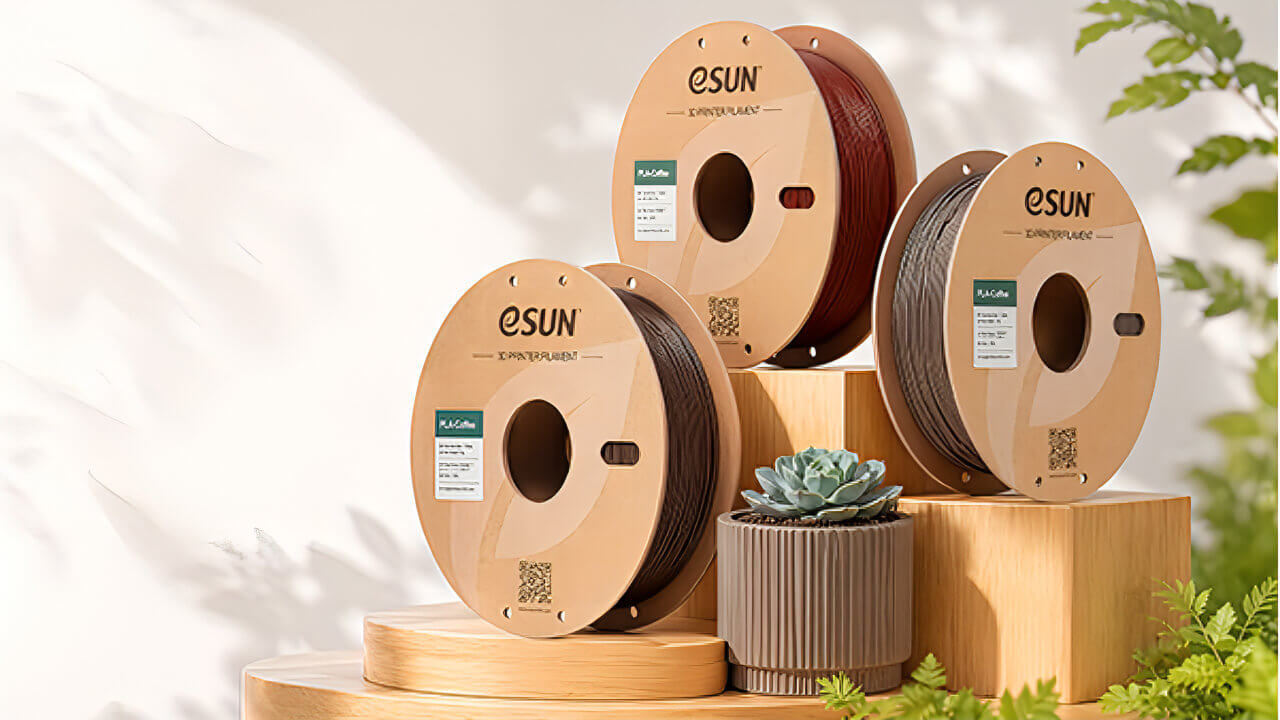
Shenzhen-based eSUN (Shenzhen Esun Industrial Co., Ltd.) launched a bio-based filament called PLA-Coffee worldwide on July 30, developed jointly with Yum China, the operator of KFC and Pizza Hut in China, among other chains. Waste coffee grounds are dried, ground, and modified before being compounded into PLA, producing a matte finish that hides the layer lines typical of FDM printing. eSUN has not published quantified environmental data, but the launch also extends nearly two decades of PLA recycling work the company has carried out.
Compounding Coffee Grounds Into PLA to Hide Layer Lines
eSUN announced the global commercial launch of PLA-Coffee, a bio-based filament made from recycled coffee grounds, on July 30. The material had already been previewed on June 24 at Yum China’s booth in the sustainability exhibit area of the China International Supply Chain Expo (CISCE) in Beijing.
The production process dehydrates, grinds, and modifies daily coffee waste before compounding it with biodegradable PLA. The organic coffee particles change how light reflects off the surface, producing a diffuse rather than glossy finish. That, in turn, makes the layer lines characteristic of FDM printing less visible. The material also achieves a natural earth tone without artificial dyes, aimed at planters, desktop objects, and other pieces suited to warm, wood-toned interiors. eSUN says printability and reliability remain on par with standard PLA, and the filament works with ordinary FDM printers. According to eSUN, the material also releases a mild coffee aroma during printing, turning the print process itself into a bit of a sensory experience. The press release itself also lists food-contact items such as pour-over coffee equipment as a potential use, but it makes no mention of food safety compliance, so this article does not address that application.
The launch is a joint development between eSUN and Yum China. Yum China contributes its collection and supply network for coffee grounds across its restaurant footprint, while eSUN handles the materials science behind the compounding process. Turning waste-derived material into a composite is not new territory for eSUN; the company has pursued this direction since its founding in 2002 under Kevin Yang, its founder (more on this below).
Yum China, for its part, has run its own sustainability programs for years. It introduced a “no cutlery” option for KFC China app orders in 2017, rolled out reusable equipment in 2019 that cut paper packaging by more than 2,000 tons, and has targeted an annual reduction of roughly 8,000 tons of non-degradable plastic since 2021.
The Technical Challenge of the Composite, and the Data eSUN Hasn’t Disclosed
Compounding coffee grounds into PLA is not trivial. The material’s high moisture and oil content, combined with poor compatibility with the PLA matrix, are known obstacles. eSUN’s press release touches on this, suggesting the work involved more than simply blending powder into resin. The company has prior experience in bio-composite modification, including its wood-fiber composite PLA-Wood, and PLA-Coffee sits on that same technical line.
At the same time, eSUN has not disclosed how much coffee waste the product actually processes, or what carbon reduction it might achieve. What it emphasizes instead is the visual effect, texture and tone, and the broader idea of a circular economy. Global coffee grounds waste is estimated at 18 to 23 million tons a year; whatever volume a niche market like FDM filament can absorb is likely a small fraction of that total.
AM Insight Asia Perspective
Products like PLA-Coffee tend to get filed into one of two boxes: either they meaningfully cut environmental impact, or they’re little more than a talking point. AMIA thinks that framing is too crude. The question is worth splitting into at least three layers.
The first is the direct effect on the waste problem itself. Here, honestly, the impact is limited. Given the scale of the FDM filament market against the volume of coffee grounds generated across Yum China’s restaurant network, whatever PLA-Coffee absorbs is likely close to a rounding error. Calling that a major environmental contribution would be an overstatement.
The second is whether the technology itself is real, and here there’s more to credit. Overcoming coffee grounds’ moisture content, oil content, and poor compatibility with PLA while keeping the material printable is the kind of work that only makes sense for a company with chemical recycling infrastructure and patents behind it. eSUN has pursued PLA recycling and upcycling research since 2006, built its own 5,000-ton-per-year lactide synthesis facility in Xiaogan, Hubei in 2013, and acquired a fiber manufacturer in 2023 to close the loop on biodegradable fiber production. In his own company’s interviews, Kevin Yang has said eSUN plans to expand its PLA chemical recycling capacity overseas, framing waste-derived materials not as a one-off campaign but as part of a long-term strategy articulated by the company’s own leadership. Seen against that nearly twenty-year track record, PLA-Coffee reads as one more step rather than a standalone stunt.
The third layer is about where a material needs a story to sell at all. 3D printing applications broadly split into functional parts, chosen for cost, strength, and precision, such as jigs and prototypes, and consumer or design products, chosen for how they look and what they signify. Nobody picks a coffee-ground filament to print a jig. Which means a “waste-derived” or “sustainable” narrative only really finds a buyer in the market for finished, consumer-facing products. That PLA-Coffee has narrowed its use cases to planters and desktop objects looks less like a limitation and more like a design choice built around that distinction. Whether eco-conscious materials actually take hold across the AM industry depends less on the underlying material science than on how far the industry’s use cases shift from functional parts toward consumer-facing finished products.
Taken together, PLA-Coffee is neither a large-scale fix for an environmental problem nor an empty gesture. It looks more like a technically capable company choosing, deliberately, the corner of the market where a circular material’s story actually matters, and using it to demonstrate what’s possible.
About the Company
eSUN (Shenzhen Esun Industrial Co., Ltd.) is a bio-based materials manufacturer founded in Shenzhen in 2002. It committed to polylactic acid (PLA) bioplastics in 2003 and released what it says was the world’s first commercial PLA 3D printing filament in 2007, since becoming one of the material’s global brands. The company operates across four areas, biomedical materials, 3D printing, eco-fiber, and sustainable packaging, and holds PLA chemical recycling technology and patents. It listed on China’s NEEQ (New Third Board) in 2016 under the ticker 836514. Its founder, chairman, and general manager is Kevin Yang (Yang Yihu).
Yum China is a major restaurant operator running KFC, Pizza Hut, and other chains in mainland China. Spun off from Yum! Brands, it listed independently on the New York Stock Exchange in 2016, added a Hong Kong Stock Exchange listing in 2020, and became dual-primary listed on both exchanges in 2022. Since introducing a “no cutlery” option for KFC China in 2017, it has continued running waste-reduction programs, including reusable equipment and targets for cutting non-degradable plastic use.
Source:
- eSUN Launches PLA-Coffee, a Sustainable 3D Printing Filament Made from Recycled Coffee Grounds (via GLOBE NEWSWIRE, July 30, 2026)
- Rebirth of Waste! eSUN PLA-Coffee 3D Printing Material Debuts at Beijing CISCE (via eSUN, June 24, 2026)
- eSUN’s Kevin Yang: The Technical Pathway, Advantages, and Future Market of PLA Chemical Recycling (via ESUN GROUP)