Having let a big catch slip through fixed thinking, industrial printer makers are starting to move into the low-cost market
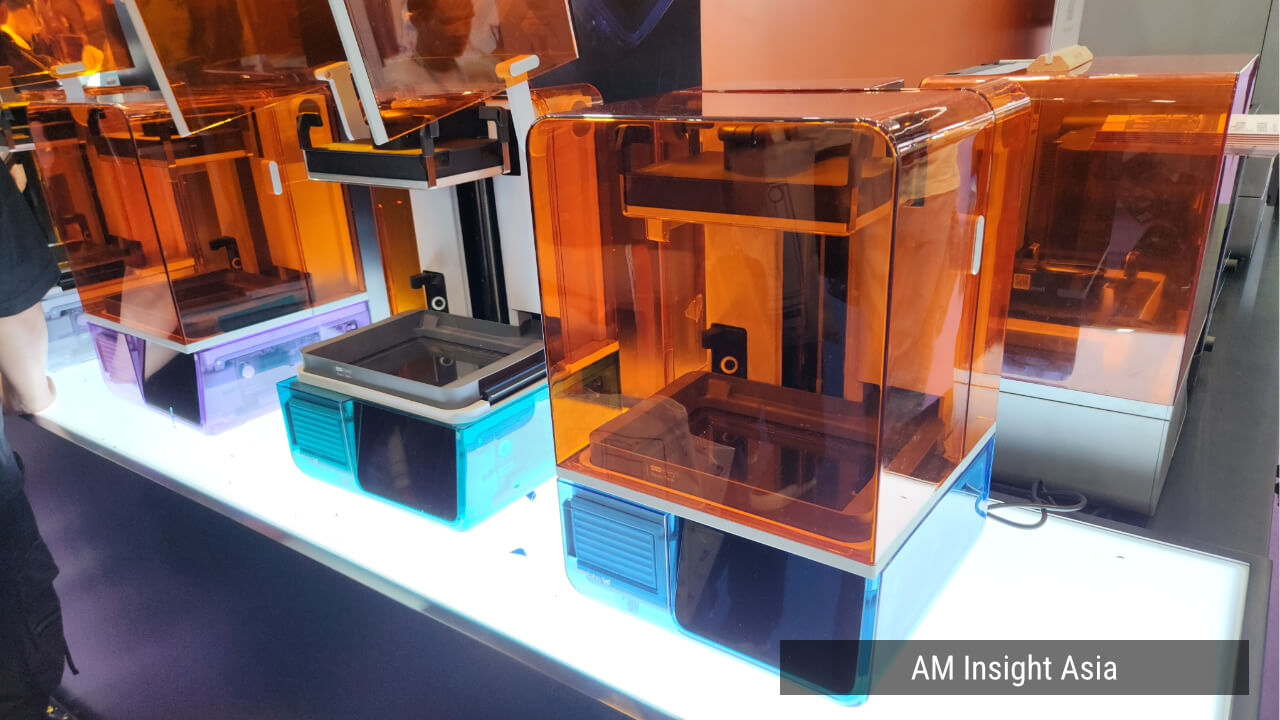
AM Insight Asia (AMIA) covered TCT Shenzhen 2026, the 3D printing show held in Shenzhen, China, from October 14 to 16. On October 15, the second day of the show, Formlabs unveiled its new resin 3D printer, Form Studio 1, at its booth. The company had announced the printer the day before, calling it the world’s most affordable professional resin 3D printer, and opened orders the same day. Prices start at $699, with shipping set to begin on November 16. At roughly a quarter of the price of the flagship Form 4, Form Studio 1 brings technology and software developed for higher-end machines into the low-cost segment, showing Formlabs’ intent to move past the traditional split between consumer and industrial printers.
Unveiled on October 15 in Shenzhen
On the opening day, October 14, the printers at the Formlabs booth were covered with cloth. The cloth came off at the company’s product launch event on October 15, revealing Form Studio 1.
“We started Formlabs to build the Form 1 and make professional resin printing accessible to more people,” said Maxim Lobovsky, co-founder and CEO of Formlabs. “Form Studio 1 takes that ambition to the next level.”
A new print engine built on Form 4 technology
Form Studio 1 runs on a new print engine based on Low Force Display (LFD), a technology Formlabs developed in-house. Twenty-eight LEDs and a lens array deliver a uniform 6 mW/cm² of light to the print plane. The pixels of the exposure liquid crystal display (LCD) measure 35 µm, and anti-aliasing renders features finer than a single pixel. According to the company, most prints finish in under two hours. The build volume is 20.0 × 12.5 × 23.5 cm, 2.5 cm taller than the Form 4.
Resin is dispensed and heated automatically from a cartridge, so there is no need to pour it by hand. With Build Platform Flex, a flexible build platform, parts come off without tools. At launch, nine Formlabs resins come with dedicated print settings, and the optional Resin Tank Pro lets users print with third-party resins.
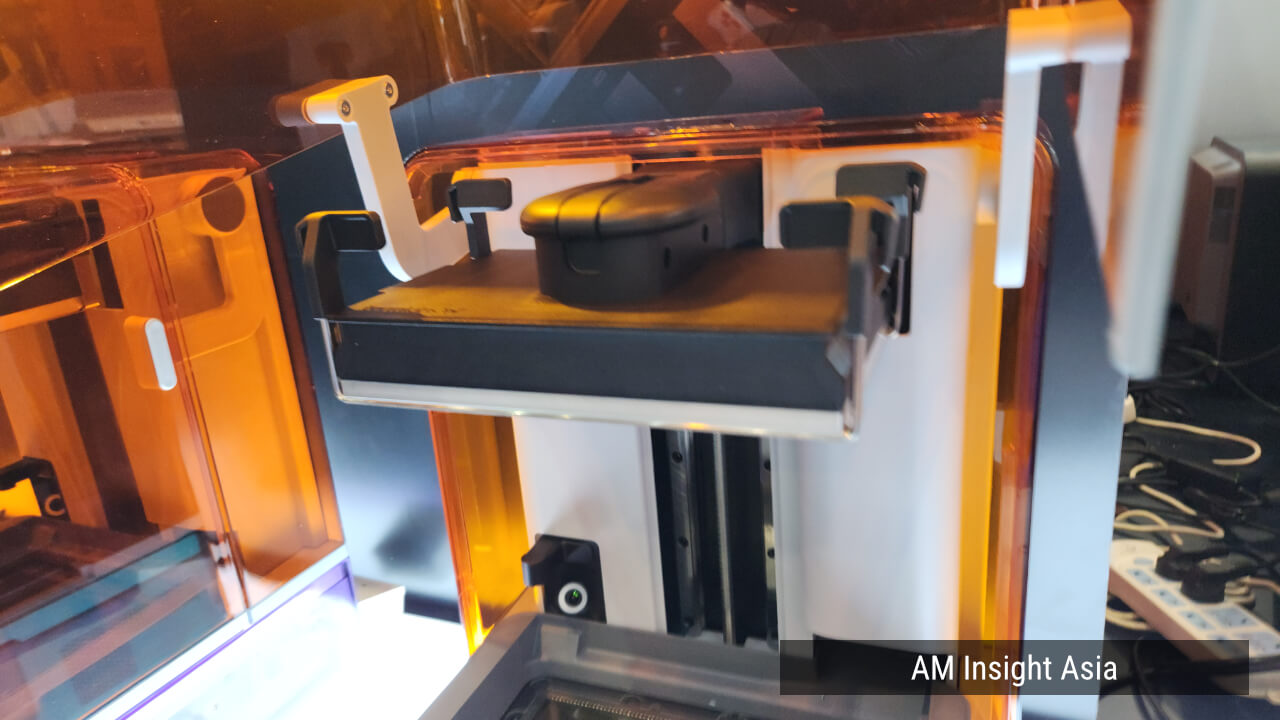
The press release cites a 98% print success rate. A footnote, however, explains that this means a rate comparable to the Form 4, which scored 98.7% in third-party testing, and that reliability testing of Form Studio 1 itself is still under way.
Formlabs also launched Form Studio Wash+Cure ($199), a single unit that both washes and post-cures parts, the VOC Extractor, which captures the volatile organic compounds (VOCs) released during printing, and Form Mobile, a smartphone app for checking on prints remotely through the built-in camera.
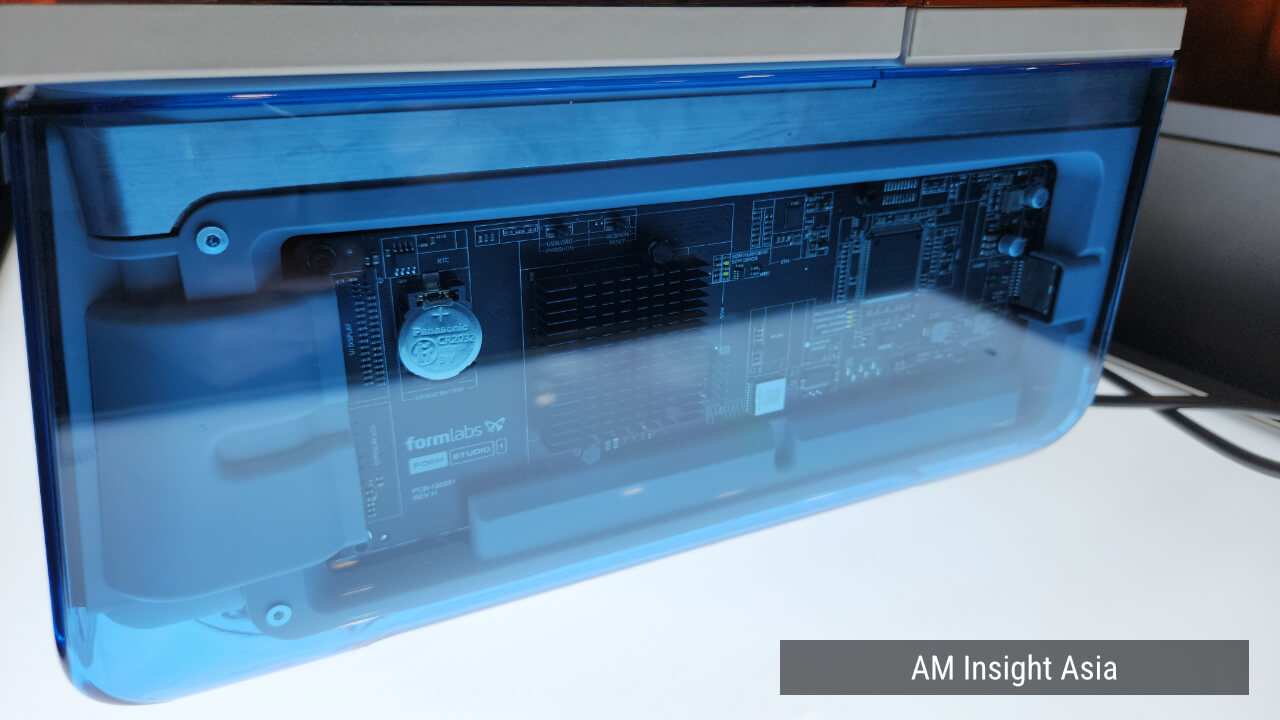
The lower part of the printer is a translucent case. On the launch Founder’s Edition, buyers can choose its color from graphite and three limited colors: aqua, teal and violet. The Founder’s Edition is on sale through November 30 or while supplies last. The main board shows through the right side, a touch that dedicated fans are likely to enjoy.
The entry configuration at $699 includes only the printer, a resin tank and a standard build platform. Because resin parts must be washed and post-cured, the bundle at $948, which adds Build Platform Flex and Form Studio Wash+Cure, is the realistic setup for getting started (all US prices, excluding tax).
Safety backed by third-party certification
Resin 3D printers deliver fine detail, but they have long come with concerns about the smell of liquid resin and the inhalation of VOCs. Formlabs itself describes today’s resin printing as something close to a Wild West on safety.
Against that backdrop, Formlabs says Form Studio 1 is the first resin 3D printer to earn UL GREENGUARD Gold Certification. The certification, issued by the US certification body UL, assesses the chemicals a product emits into indoor air, and Gold is its stricter tier, designed for places where children and older adults spend long hours, such as schools, daycare centers and hospitals. With the VOC Extractor, total emissions stay below 220 µg/m³ under the UL 2819 standard.
The certification applies only to the combination of Alpha Resins and the VOC Extractor ($179). The print chamber is fully enclosed, and the company says the printer can be used in homes, small offices and classrooms without dedicated ventilation or a tent. What gives this weight is that a third-party test, not just the manufacturer’s own claim, backs up the safety.
The six Alpha Resins launched alongside the printer, Grey, White, Black, Clear, Model and Fast, start at $29 per liter. Parts post-processed as recommended are suitable for long-term skin contact of more than 30 days under ISO 10993. According to Formlabs, all Alpha Resins are made and tested at its own factory in Ohio.
Fine detail is not the same as accurate dimensions
The price gap with the Form 4 (from $2,625) shows up in the specifications. The light source drops from 60 LEDs at 16 mW/cm² to 28 LEDs at 6 mW/cm², the mixer for filled materials and the resin tank debris detection are gone, and the number of control systems falls from six to five. Formlabs resins with dedicated settings number nine, against 23 for the Form 4.
The pixels, on the other hand, are finer than the Form 4’s 50 µm. The point to keep in mind here is that resolution and dimensional accuracy are different things. Resolution describes how finely light can be applied, and in masked stereolithography (MSLA) it is set by the pixel size of the exposure LCD. Dimensional accuracy describes how close a finished part comes to the dimensions in the design data. Resin shrinks as it cures, and the forces acting on a part during printing can also change its shape slightly, so a printer that draws fine detail does not necessarily produce parts at their designed dimensions.
For features of 1 to 30 mm, the dimensional tolerance is ±0.5% (lower limit ±0.08 mm) on Form Studio 1 and ±0.15% (lower limit ±0.02 mm) on the Form 4. Based on these published figures, a 20 mm feature comes out at ±0.1 mm on Form Studio 1 and ±0.03 mm on the Form 4. Form Studio 1 suits uses where fine detail and surface texture are the value, such as figures, while the Form 4 suits parts that are useless unless the dimensions are right, such as mating parts and jigs. Formlabs itself draws the same line, rating Form Studio 1 best for figurines and models and the Form 4 best for functional prototypes and end-use parts.
AM Insight Asia Perspective
Industrial 3D printer makers have long stayed away from the consumer market. Margins per unit are thin, and supporting individual users takes effort. In December 2015, 3D Systems announced it would stop producing the Cube, its home printer priced at $999, and concentrate its resources on the more profitable professional and industrial markets. Stratasys merged MakerBot, the desktop printer maker it acquired in 2013, with Ultimaker in 2022 and removed it from its consolidated accounts.
That was a miscalculation by the industrial makers. With the industrial side offering bigger markets and more revenue, they likely saw little reason to bother with a low-cost market that demanded so much effort. Yet once the lid came off, low-cost printers were improving quickly, their market was spreading quickly, and it proved to be the bigger business. Founded in 2020, Bambu Lab passed RMB 10 billion (about $1.5 billion) in revenue in 2025, according to Chinese media. That is more than the combined 2025 revenue of Stratasys (about $551 million) and 3D Systems (about $387 million). Stratasys posted a net loss of about $104 million that year. Bambu Lab’s 2026 sales target has been reported at RMB 24 billion (about $3.6 billion).
Bambu Lab itself did not initially plan for business use, yet its printers have been adopted by companies around the world for jigs and prototypes, and in 2025 it launched the business-oriented H2D Pro. The split between consumer and industrial printers, defined by who uses them, has already broken down. What divides the market now is what a machine does and at what price, in other words whether it is a low-cost or a high-end printer. For a company, a low-cost printer is the first machine and an entry point for stepping up to higher-end models. For the manufacturer, it is also a sales channel.
The heart of this news is that Formlabs, an industrial printer maker, has moved early on this shift. By making a low-cost printer itself, it has started building a new ecosystem. The PreForm print preparation software, the Dashboard remote management tool and the Form Mobile app are shared with its higher-end printers, and the Form Wash and Form Cure post-processing units and the VOC Extractor work with them as well. What users learn on a printer costing $699 carries straight over to the Form 4 at $2,625 and the Form 4L at $7,125. In an industry where low-cost and high-end printers have lived in separate ecosystems, one company is trying to join the two into a single path, and this is why AMIA rates the product highly.
Users of low-cost printers can now get a machine that partly inherits the know-how built up on high-end systems. Beyond a print engine based on Form 4 technology, every material comes with print settings validated by Formlabs engineers, and each unit goes through a 28-point calibration and a test print before it leaves the factory. Light output and some functions have been cut, but the quality systems refined on high-end machines have come to a printer costing $699.
Materials are handled through cartridges, just as on the higher-end models. SnowPod, the desktop metal 3D printer from SnowX that AMIA has covered, also handles metal powder in sealed cartridges. Packaging hard-to-handle materials so they can be used without getting your hands dirty is becoming a trend. It makes materials more expensive. In Formlabs’ own comparison table, Alpha Resins cost $29 to $39 per liter, against $12 to $20 for budget third-party resins. Even so, people stop using machines that are a hassle. Cutting the hassle is what keeps a low-cost printer in use long after the purchase.
Formlabs has also addressed the thin margins and support burden behind the earlier exits. The setup that meets the GREENGUARD Gold conditions costs $1,127, the $948 bundle plus the VOC Extractor, and assumes continued purchases of Alpha Resins. A service plan that extends coverage and covers repairs after accidents costs a flat fee of $9.99 per month ($99 per year). The model is designed to earn steadily from accessories, consumables and services rather than from the printer itself.
What to watch next is whether users who start with Form Studio 1 actually move up to the Form 4, and how far players coming from the low-cost side, such as Bambu Lab, climb into higher price ranges. Pricing and launch timing in Asia, including Japan, have yet to be announced.
About the Company
Formlabs is a 3D printer maker headquartered in Somerville, Massachusetts. It makes stereolithography (SLA) and selective laser sintering (SLS) 3D printers, post-processing equipment, software and more than 45 materials. According to the company, it is the largest professional 3D printing company founded since the 1980s, with annual revenue of more than $250 million, and its customers have printed more than 500 million parts. In China, it operates under the name Xinglang Technology (形朗科技).