The scale of drone threats demonstrated on separate battlefields in Iran and Ukraine has sharpened Japan’s sense of urgency.
Japan’s Acquisition, Technology & Logistics Agency (ATLA) announced on August 25, 2026 that it had signed a mass-production procurement contract with Terra Drone Corporation (Shibuya, Tokyo) for a domestically made interceptor drone, the Terra B1. The contract came roughly three months after the call for proposals began, an unusually fast timeline for defense procurement, which normally takes years or even more than a decade in Japan. The quantity to be procured, the contract value, and the aircraft’s detailed specifications have not been disclosed.
Why the Rush
Behind the urgency lie two distant battlefields where the scale of the drone threat has become impossible to ignore. Iranian-designed Shahed-type drones have been used in attacks across the Middle East and, as the Russian-built “Geran-2,” in large numbers during Russia’s invasion of Ukraine. Terra Drone made strategic investments in two Ukrainian companies in quick succession: Amazing Drones in March 2026, developer of the vertically launched Terra A1, and WinnyLab in April, developer of the horizontally launched fixed-wing Terra A2. Both companies say they succeeded in intercepting Shahed-type UAVs in spring 2026. Terra Drone describes the combination of the two aircraft as a “layered defense.”
The threat is also becoming concrete closer to home. According to Japan’s Ministry of Defense white paper for fiscal 2025, Chinese reconnaissance-and-attack drones, the WL-10 and GJ-2, were confirmed for the first time during Japan’s air defense identification measures in fiscal 2024. China is believed to be producing “Sunflower” self-destructing drones by the tens of thousands, while Russia and North Korea are each building up their own mass-production capacity for drones.
The other driver is cost. A conventional anti-air missile costs tens of millions to hundreds of millions of yen per unit, while an attack drone typically costs a few million yen. Shooting down cheap drones with expensive missiles is not fiscally sustainable at scale, which is why low-cost interceptor drones have gained attention as a new layer of air defense.
Three and a Half Months, From Tender to Delivery
The path to the contract unfolded as follows:
- Late May 2026: The Ministry of Defense issues a tender for the rapid acquisition of interceptor drones
- June 5: ATLA announces the “Interceptor Drone Early Acquisition Program”
- June 29: Deadline for company proposals (38 companies submit)
- July 15: ATLA selects one model in each of four categories to proceed to demonstration
- July 15–August 6: The Japan Maritime Self-Defense Force (JMSDF) conducts demonstration trials
- August 25: Terra B1 clears the trial as the sole finalist in its category and the mass-production contract is signed
- Around September 2026 (planned): Delivery to the JMSDF
The 38 proposals were submitted under one of four pre-defined categories. According to the tender requirements published by the JMSDF Supply Depot, the criteria for each category were as follows.
| Category | Requirement |
|---|---|
| Type 1 | Ability to simultaneously manage and assign targets to multiple aircraft from a single control unit, with no added functionality |
| Type 2 | Maximum range of at least 25 miles (about 40 km) |
| Type 3 | Domestically made, with domestic production infrastructure in place |
| Type 4 | Top speed of at least 400 km/h |
Lined up this way, Type 3 stands out. Types 1, 2, and 4 are all functional requirements built around what the aircraft can do: simultaneous control, range, and speed. Type 3 alone is not a functional requirement at all. It is an attribute requirement based on where, and by whom, the aircraft is made.
On July 15, ATLA announced it had selected one model for each category, four in total, to proceed to demonstration trials.
| Category | Model | Manufacturer | Contracting Partner (Domestic) |
|---|---|---|---|
| Type 1 | BVQ404 | Beyond Vision (Portugal) | AirMobility Inc. |
| Type 2 | QS INTERCEPTOR | Quantum Systems (Germany) | ANA Trading Co., Ltd. |
| Type 3 | Terra B1 | Terra Drone (Japan) | Terra Drone Corporation |
| Type 4 | IonStrike | DZYNE Technologies (US) | Nippon Kaiyo Co., Ltd. |
The four categories represent different evaluation axes, so the 38 proposals were not simply ranked and narrowed down; instead, one company was chosen for each axis in a parallel selection process. How many of the 38 companies applied under each category has not been disclosed.
The proposal guidelines ATLA issued on June 5 also asked companies to structure their quantity proposals in increments of 10, 20, 30, 40, or 50 units. This was only a benchmark for the proposal stage; how many units will ultimately be procured for the Terra B1 remains undisclosed even now, after the contract has been signed.
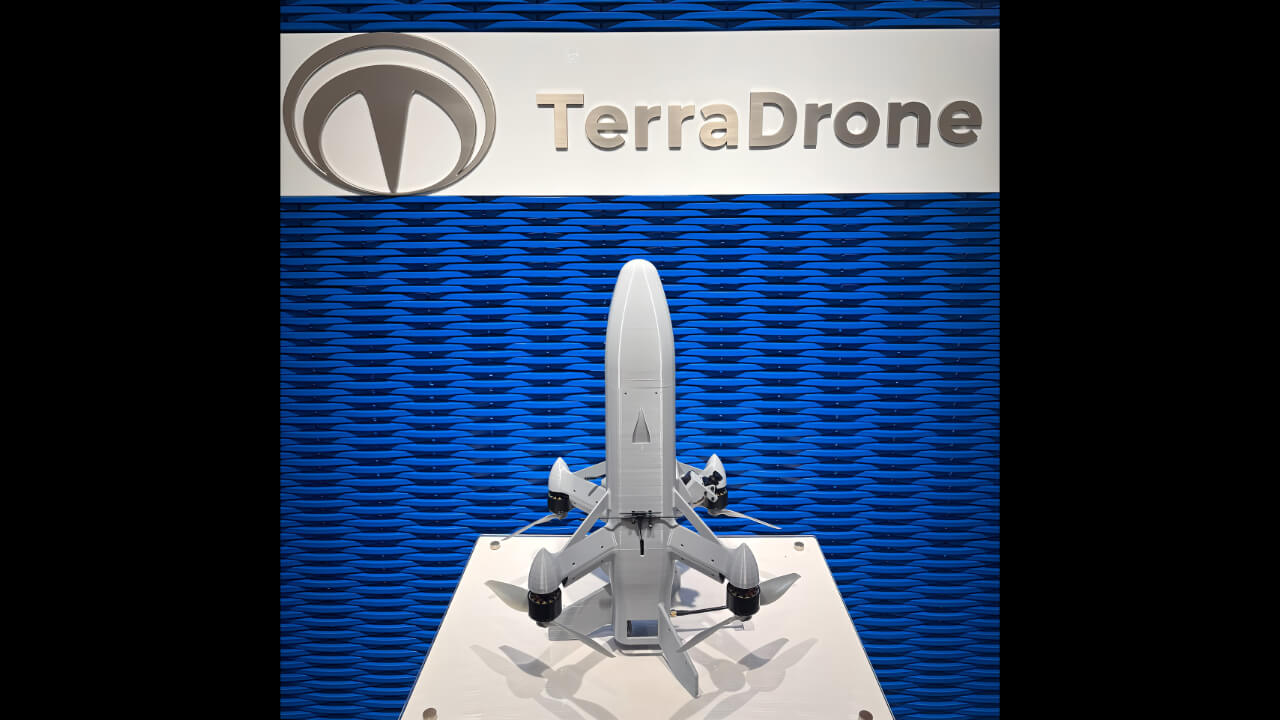
The Terra B1 is described as the Japan-market derivative of the Terra A1, an interceptor drone developed by Ukraine’s Amazing Drones, in which Terra Drone holds a stake, and one already deployed with Ukrainian forces. Defense News describes it as a rocket-launched interceptor drone. The “domestic” requirement under Type 3 does not mean the design itself originated in Japan; it refers to having production infrastructure inside the country. The aircraft’s design lineage traces back to real-world combat in Ukraine, and what Japan primarily contributes is the manufacturing base for mass production.
What “Missile-Type” Actually Means
The Terra A1 is often called a “missile-type” drone because it homes in on and rams its target, but it is in fact an electrically powered propeller UAV. Unlike a missile, which burns through its fuel in a single rapid burst from a rocket or jet engine, an electric UAV flies slower but for much longer. The Terra A1 covers a 32 km range at up to 300 km/h and has 15 minutes of flight endurance; its electric propulsion also gives it a low-noise, low-heat-signature profile. According to reporting by RBC Ukraine and UAS Vision, it is priced from around $3,000.
Weapons that can both loiter and search before ramming a target like this fall into an established category in the industry known as “loitering munitions.” The anti-radar Harpy is a well-known example, occupying a middle ground between missiles and drones.
How 3D Printing Underpins the Fast Delivery
Only about a month separates the contract signing on August 25 from the planned delivery around September. Terra Drone CEO Toru Tokushige told Defense News that using 3D printers simplifies and shortens the design and prototyping stage, which forms the basis for meeting the short post-contract delivery timeline. He said the technology brings more than lower costs and faster production; it also leaves room to modify the aircraft as threats and technology evolve without delaying deployment.
Terra Drone plans to spread production across multiple sites and eventually expand into local printing farms. Tokushige said this distributed model would significantly reduce the risk of the entire supply chain being disrupted even if one production site were attacked by a Shahed-type drone.
Two Kinds of Speed: What the System Did and What the Technology Did
The schedule behind this contract is really made up of two different kinds of speed.
The first is the roughly three-month pace from tender to contract, a matter of institutional design that has nothing to do with 3D printing. ATLA itself compressed the procurement process, and the defense minister personally called for proposals on X with the words “please share,” a form of outreach not normally seen in defense procurement.
The second is the roughly one-month pace from contract to delivery, a matter of production speed. Injection molding that requires cutting a new mold typically takes weeks to months from design to fabrication, making that timeline difficult to hit. 3D printing, which requires no mold, can compress the ramp-up to mass production considerably, so it appears likely that the characteristics Terra Drone describes contributed to meeting this one-month delivery window. That said, since the procurement quantity is undisclosed, it remains possible that other manufacturing methods could have handled a small initial delivery just as well.
Where the Terra B1 sits in the broader landscape is also worth noting. The line between missiles and drones is blurring from both directions. Loitering munitions like the Harpy have brought loiter-and-search capability to what is fundamentally a missile, while Russia’s jet-engine Shahed derivatives, the Geran-3 and Geran-4, have pushed speeds up to roughly 350–500 km/h, closing the gap from the drone side. The Terra B1, an electric UAV known for being slow, cheap, and long-endurance yet still called “missile-type,” sits within this same convergence.
AM Insight Asia Perspective
Even a domestically made aircraft could plausibly have been selected under a functional category like Type 1, 2, or 4. The fact that ATLA nonetheless set up a dedicated category that requires nothing but domestic origin, with no functional bar to clear, shows that this procurement prioritized the fact of domestic production over functional superiority. This institutional design also speaks to the government’s seriousness about localizing production. Compressing a procurement process that normally takes years into three months, combined with the defense minister’s own unusual call to action, reflects a real sense of alarm following the first confirmed sightings of Chinese aircraft during Japan’s air defense identification measures. The scale of the drone threat made visible on the separate battlefields of Iran and Ukraine appears to have forced Japan to stop treating this as someone else’s problem and start treating it as a fact of its own air defense.
That same sense of urgency is reshaping who gets to build Japan’s defense equipment. Terra Drone, which makes the Terra B1, was founded in 2016 and built its business on survey, inspection, and agricultural drones along with UTM (unmanned traffic management) systems, an outsider to a defense-equipment sector long dominated by heavy-industry conglomerates. A procurement framework built around speed and flexibility, contingent on domestic production infrastructure, opened a path to mass production for companies without the capital to build large manufacturing plants of their own. Terra Drone’s plans for distributed production and local printing farms go beyond cost-cutting; they are bringing to Japanese defense procurement the idea of a production network that keeps running even under attack. Whether the urgency driving this push toward domestic production ends up reshaping who is allowed to build defense equipment in Japan is worth watching closely.
Still, there is a gap between securing something domestically in small numbers and handling it at scale. What this contract demonstrates is only the former. The moment the numbers grow, two capabilities become necessary, and Japan does not yet have either: a system to control large numbers of drones at once, and a system to produce large numbers of drones.
The first is the control problem. “Controlling large numbers of aircraft” here does not mean the kind of choreography seen in drone shows, where a preset flight path is uploaded from the ground. Interception is a distributed-processing problem: each aircraft must detect an incoming threat on its own sensors and decide autonomously how to respond, without knowing in advance how many attackers are coming, at what speed, or along what trajectory, while also coordinating with other interceptors so that no target is engaged twice or missed altogether. ATLA itself made this an independent evaluation axis under Type 1, yet the contract went to the Terra B1 under Type 3, selected for its domestic origin, and how far this aircraft’s distributed-processing capability actually extends is not something the published materials confirm. Terra Drone describes its combination of two Ukrainian investees, Amazing Drones and WinnyLab, as a “layered defense,” but that layering refers to combining aircraft with different ranges and launch methods; whether it refers to this kind of distributed-processing capability cannot be determined from what has been announced so far.
The second is the production problem. In Shenzhen, Winner Technology had 5,000 3D printers running as of November 2025 and plans to scale up to 15,000 by March 2026. Japan’s leading example of a distributed 3D-printer farm, by contrast, is on the order of 100 units and has only just begun operating. At a scale of about 100 units, checking for quality variation between machines by eye is still workable. Once the count climbs into the thousands or tens of thousands, manual inspection stops being realistic, and managing machine-to-machine variation statistically and automatically becomes essential. This kind of know-how, maintaining uniform quality at a scale of thousands of units, can only be built up by actually running production at that scale, and Japan does not appear to have that track record yet.
In other words, building the drone itself is not actually the hard part. What is genuinely difficult is controlling large numbers of them and continuing to manufacture them at scale. Measured against those two capabilities, this contract, however impressive it looks on the surface, is really only a first step. How Terra Drone’s distributed-production plans and the distributed-processing capability ATLA laid out under Type 1 end up getting filled in will be the thing to watch in this space going forward.
About the Company
Terra Drone Corporation was founded in February 2016 and is headquartered in Shibuya, Tokyo; its president and CEO is Toru Tokushige. The company is listed on the Tokyo Stock Exchange (ticker: 278A). It provides drone services in survey, inspection, and agriculture, with a track record of more than 3,000 projects, and its UTM (unmanned traffic management) systems have been deployed in ten countries. It has ranked in the top three in the Global Drone Services Company Ranking published by Drone Industry Insights every year since 2020. In 2026, it entered the defense business in earnest through strategic investments in the Ukrainian interceptor-drone companies Amazing Drones and WinnyLab.
Source
- Interceptor Drone Early Acquisition Program: program announcement / selection of demonstration models / mass-production contract announcement (via ATLA, June 5, July 15, and August 25, 2026)
- FY2026 Interceptor Drone Early Acquisition Program Demonstration Trial Services: Tender Requirements (via JMSDF Supply Depot, June 30, 2026)
- Japan approves mass production of 3D-printed interceptor drones (via Defense News / C4ISRNet, August 27, 2026)
- Terra Drone selected for ATLA’s “Interceptor Drone Early Acquisition Program” (via Terra Drone Corporation, July 15, 2026)