What Is Formnext Asia Shenzhen? And What Is Happening in the Greater Bay Area Right Now?
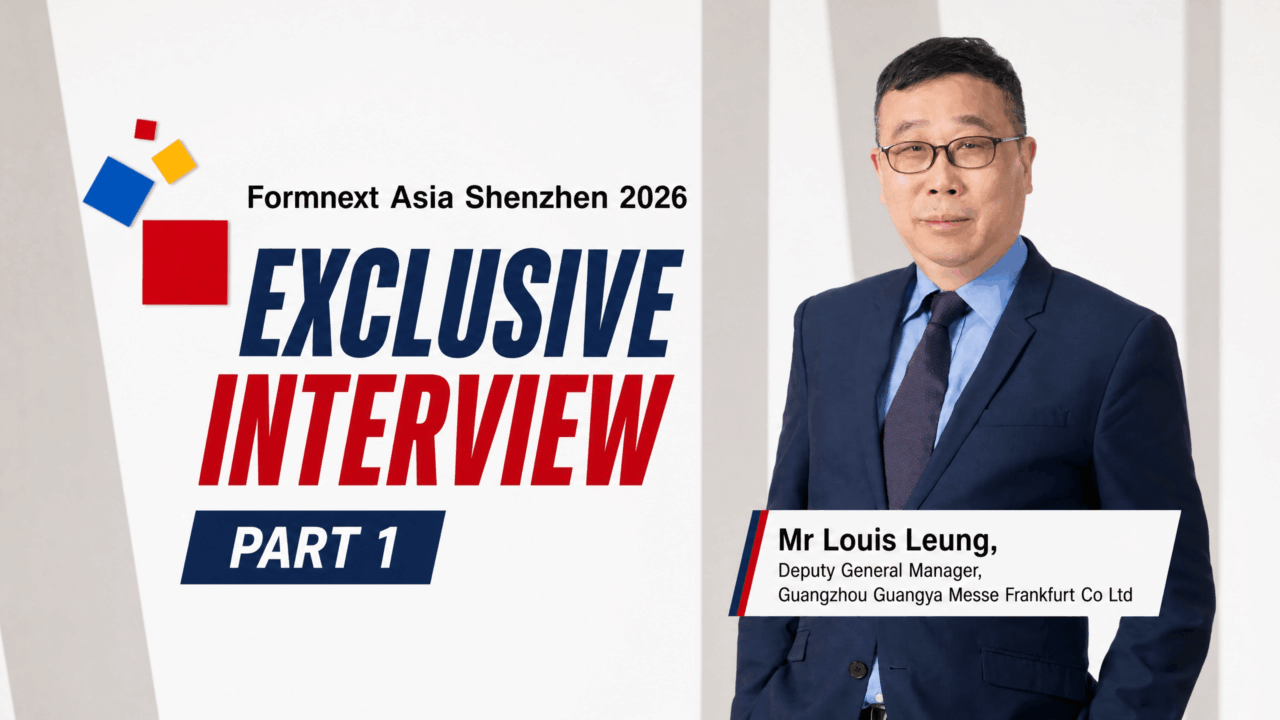
Ahead of the opening of Formnext Asia Shenzhen 2026, AM Insight Asia sat down for an exclusive interview with Louis Leung, Deputy General Manager of organiser Guangzhou Guangya Messe Frankfurt Co Ltd. In this first instalment, we asked how Formnext Asia Shenzhen divides its role with its Frankfurt counterpart, and why Shenzhen and the Greater Bay Area have become such an essential foundation for the show. The answers below are presented as Louis Leung’s own words, without interpretive editing.
Q. How would you describe the role that Formnext Asia Shenzhen plays within the Asian AM industry? How does it differ from, or complement, Formnext in Frankfurt?
Formnext Asia Shenzhen is part of the Formnext event family, so our foundational approach is the same as Frankfurt. We present additive manufacturing as a complete process, across the full value chain. That means materials, equipment and software, but also post-processing, inspection and services, because together, these are the factors that make AM viable as a production technology.
Most people in this community know Formnext in Frankfurt well. It is the global flagship and the industry’s largest international meeting point. It gives companies a global stage, as well as a broad view of where AM technology and the market around it are heading.
At Formnext Asia Shenzhen, we take that same full process-chain approach and apply it within a very different market context. Here in South China, for example, we are surrounded by major industries in electronics, moulds and dies, footwear, consumer products, hardware, automotive components and robotics. Having these important user industries for AM on our doorstep naturally shapes the visitor profile and application focus.
Shenzhen has also become a major supplier base in certain areas of AM, particularly on the desktop and consumer end, where local companies account for 94% of the global entry-level desktop 3D printer market, supporting applications in print farms and prototyping. This gives the show a strong base of suppliers, user industries and application topics to draw from.
In that sense, Frankfurt gives the industry its forward-looking global reference point, while Shenzhen gives companies a more immediate connection to the AM markets and applications developing here in Asia. We also see the show as a sort of industrial incubator, giving regional companies room to grow their position in the domestic market, and from there, begin looking toward international opportunities. So the two shows approach the industry from different contexts, but both contribute to the development of the industry globally.
Q. What makes Shenzhen the right location for this show? What does the South China region offer that other cities or regions in Asia cannot?
As I mentioned, the industrial base around Shenzhen is one of the main reasons. The city already has a strong international reputation for advanced technology and hardware manufacturing. When visitors think of Shenzhen, many will think of companies such as DJI, Huawei and BYD, or, on the AM side, Creality, Elegoo and Bambu Lab. There is already some understanding of the kind of technology environment that has developed here.
The city’s industries are also closely matched with some of the major areas where AM applications are developing. Medical devices are one of the clearer examples of this: Shenzhen’s medical-device exports rank first nationally at RMB 29.86 billion, which is equivalent to approximately USD 4.41 billion. In the low-altitude economy, Shenzhen-produced drones account for nearly 70% of the global consumer market, and the city also has a very strong new-energy vehicle industry through companies such as BYD.
What these industries share is that they are all high-technology sectors with fast product cycles and a continuous need for the kinds of engineering work where AM has advantages, through lightweighting, specialised parts, or shorter development runs. These are the kinds of questions that naturally bring AM into the conversation.
But when we discuss Shenzhen, we typically do so in the context of the Guangdong-Hong Kong-Macao Greater Bay Area, because the city’s advantages are much stronger when you consider the wider regional system around it. The GBA generates roughly one-ninth of China’s GDP, so it is already one of the most economically significant parts of the country.
Beyond this, it also means that Shenzhen is closely integrated, via infrastructure, supply chains, and policy coordination, with several other major manufacturing cities in Southern China.
Shenzhen brings its specialties in technology and R&D, but around it you also have Guangzhou in automotive, biomedicine and trade, Dongguan in electronics manufacturing, components and tooling, Foshan in robotics and equipment manufacturing, and Hong Kong as an international gateway for trade, finance and professional services.
For the show, that gives us a particularly dense and highly developed industrial ecosystem to draw from. Around Shenzhen, we have the manufacturing users that can benefit from AM, the materials and equipment suppliers that can support its application, tooling partners, research centres, and the international connectivity that links the region to global markets, with much of this sitting within the two-hour supply circle of the Greater Bay Area.
Q. The 2025 edition saw visitor attendance grow by 78% and international attendance more than double for the second consecutive year. How do you explain that growth, and in what ways are you looking to build on it in 2026?
I would explain the growth as the result of several factors coming together, some of which go back quite a long way.
In fact, our involvement in the additive manufacturing industry goes back further than Formnext Asia Shenzhen to when we first featured AM as a product category at our mould-making trade show, Asiamold, now Asiamold Select – Guangzhou, back in 2015.
This gave us early connections with AM companies and industry associations, but also with manufacturing visitors who were beginning to look at additive manufacturing in mould-making, tooling and other industrial applications. So when we launched Formnext Asia Shenzhen, we already had a strong foundation to build from.
At that stage, the regional market here still needed more opportunities to learn about AM and understand its industrial applications. A great deal of work went into raising awareness among local manufacturers through our fringe programme, giving the industry a regular platform close to its home market, and using our position within the Formnext event family to bring international AM resources into South China. And over time, that built a strong local following for the show.
From there, we continued to build the audience outward through cooperation with influential industry organisations, global AM media and professional networks. As part of Messe Frankfurt’s global network and the Formnext event family, we have also been able to reach international AM professionals through channels and relationships that are already well established around Formnext, so by 2025, Formnext Asia Shenzhen was benefiting from an AM audience and industry network that we had been developing for nearly a decade.
The market around us has changed a lot as well. Today, the international perception of Chinese AM companies is very different from even a few years ago. Many Chinese AM companies are now recognised as technologically competitive at an international level, so overseas visitors are looking at this market with much more interest.
For 2026, we intend to build on that interest more deliberately. This includes new participation formats for overseas audiences, additional language support in the fringe programme, and more structured opportunities to connect with exhibitors and industry partners during the fair. At the same time, we will continue updating the programme around the applications, opportunities and business needs that matter most to our visitors.
Q. There are several well-established AM trade fairs globally, including RAPID+TCT in the US and TCT Asia in Shanghai. What does Formnext Asia Shenzhen offer that sets it apart?
Every trade show is shaped by the market it serves.
What makes Formnext Asia Shenzhen unique is that it inherits the Formnext event family’s focus on advancing industrial AM adoption, but translates this approach to a region that is both one of the world’s most significant for manufacturing and one of Asia’s most important centres for technology, research and innovation.
From here in the Greater Bay Area, we serve an audience that includes manufacturers from sectors such as 3C electronics, new energy and robotics, industries whose scale, concentration and the particular combination in which they are found is quite distinctive to this region. This means we attract a very unique audience profile made up of industries with a very strong case for AM adoption.
Being part of Messe Frankfurt’s global Manufacturing Technologies & Components portfolio means that we can draw on the group’s industry knowledge, international relationships and sales network, which covers more than 180 countries and regions worldwide. Through our connection with Formnext Frankfurt, we are also able to work closely with our colleagues there to support exhibitors across both markets and encourage more international buyers to visit Shenzhen.
So this is really where the difference lies. We can draw on this extensive global network, while remaining responsive to the local market environment and some of the industry needs that are particular to Asia.
Q. Where do you see Formnext Asia Shenzhen in three to five years? What kind of show are you working to build?
For us, the next three to five years will be about consolidating Formnext Asia Shenzhen’s role as a platform that represents the entire breadth of AM in Asian manufacturing. By this, I am speaking not only about the variety of technologies being showcased. The show also has a wider role to play in helping bring new products to market, incubating industry talent, and providing a central point of exchange between industry, academia and government.
As an exhibition organiser, we come from a long-standing industrial trade-fair background, so this is the perspective we will carry forward as the show continues to grow: always industry-centric, application focused, and tightly grounded in what Asian manufacturers of every scale need to make AM work for them, both today and in the future.
Part of this is about lowering the adoption threshold for industrial AM among manufacturers that are newer to the technology. The other side is connecting AM technology suppliers with the downstream industries where it can deliver the greatest production value. We see particularly strong potential in unmanned and autonomous equipment, new energy, humanoid robotics, AI and 3C electronics, so naturally, we will continue to follow how these sectors develop across Asia. We also want to work more closely with the companies involved and bring more of their needs and applications into the show, whether through new exhibition content, themed forums or business-matching activities.
Then there is the consumer-grade side of the market, which we also need to keep pace with. Industrial applications will always be central to the show, but for many start-ups, SMEs and entrepreneurs, desktop 3D printing is now how they first encounter AM as a technology. We want to bring this new generation of users into the show and give them a more defined place at the fair. This creates another point of exchange between the consumer-grade and industrial sides of the market, and helps us ensure that our full-value-chain approach reflects the industry as it develops.
AM Insight Asia Perspective
What emerges from Louis Leung’s account is not the strength of Shenzhen as a single city, but the strength of the Greater Bay Area as an institutionalised supply chain. Nine cities are linked through infrastructure, supply networks and policy coordination, each playing a distinct role: Guangzhou in automotive, biomedicine and trade; Dongguan in electronics manufacturing, components and tooling; Foshan in robotics and equipment manufacturing; Hong Kong as an international gateway for trade, finance and professional services. This division of labour is not something a single company, or a single city, could replicate on its own.
This looks less like industrial clustering and more like a demonstration of state-level strategic design. The rationale for AM companies to base themselves in Shenzhen goes beyond market access: it lies in the capital efficiency of being able to bridge sourcing, prototyping and mass production within a two-hour radius. Reproducing that same function elsewhere would require more than infrastructure spending. It would require policy coordination across multiple administrative regions, the kind of institutional design that normally takes years. That the Greater Bay Area has achieved this under national direction is, in AMIA’s view, a kind of state strategy that other countries would find difficult to replicate, however much capital or policy effort they invested.
What is notable is that Formnext Asia Shenzhen itself keeps changing shape alongside this environment. From its first appearance as a product category at Asiamold in 2015, through grassroots awareness-building via the fringe programme, to its use of international networks today, the show’s role has shifted in step with the market’s maturity. The introduction of Maker Day and a new segment for consumer-grade suppliers sits on the same continuum.
If the environment changes, the show changes with it. That flexibility, in AMIA’s view, is what the dynamism of the Greater Bay Area, and of China’s AM market more broadly, ultimately looks like. Rather than resting on a fixed advantage, staying ahead of shifts in industrial structure and continually updating itself is what has sustained this growth so far.
What, concretely, is moving on the ground on top of this structural strength? In Part 2, we look at what Louis Leung has to say about where China’s AM industry stands today and where it is headed, from humanoid robotics to the expansion of consumer-grade AM.