From Humanoid Robotics to Consumer-Grade AM, Where China’s AM Industry Stands Today and Where It Is Headed
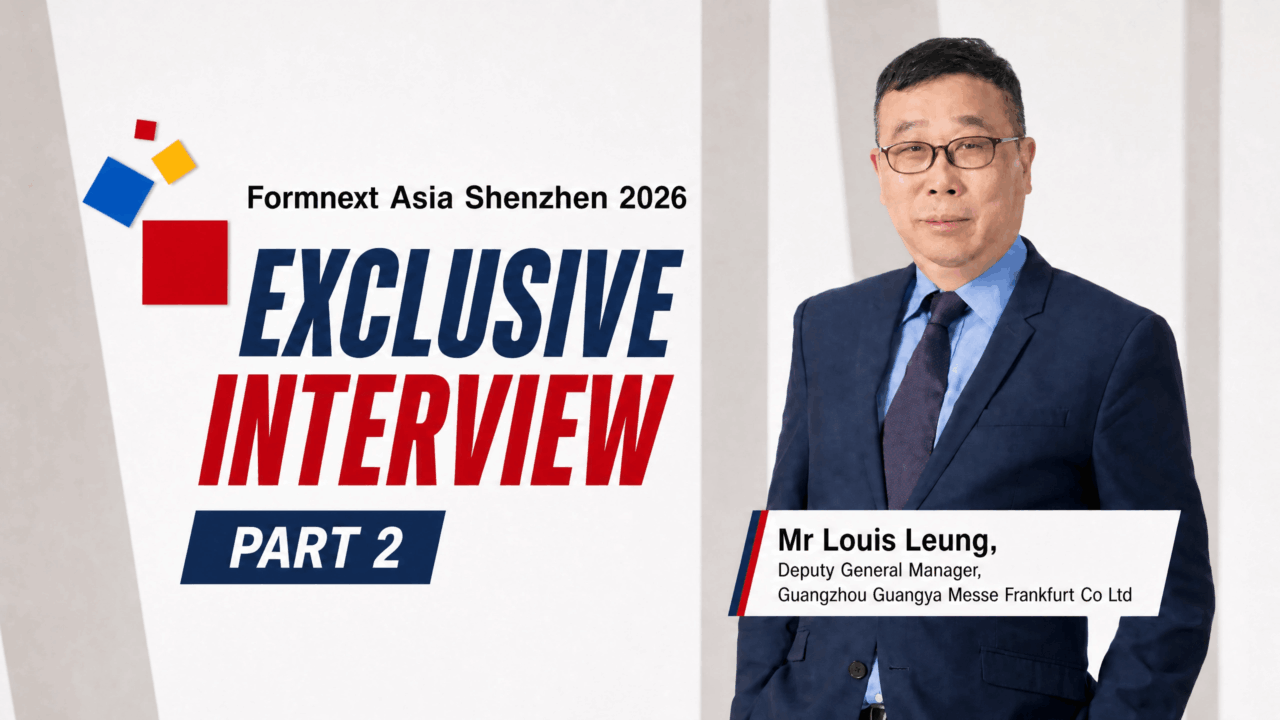
In Part 1, we spoke with Louis Leung, Deputy General Manager of organiser Guangzhou Guangya Messe Frankfurt Co Ltd, about the positioning of Formnext Asia Shenzhen and the industrial foundation of the Greater Bay Area behind it. In this second instalment, we continue our conversation with Louis Leung on the technology trends and new initiatives being introduced at this year’s show, as well as where China’s AM industry stands today and where it is headed. The answers below are presented as Louis Leung’s own words, without interpretive editing.
Q. Are there specific themes, technology areas, or new initiatives in 2026 that you would particularly like visitors and exhibitors to be aware of?
There is a lot to highlight this year, and it is not easy to choose only one or two, but there are a few additions I would certainly draw attention to.
One is thermal management and liquid cooling, where we are seeing much more activity in the market. We are debuting a new forum on this topic at Formnext Asia Shenzhen 2026, partly because of the amount of investment now going into AI, data centres and high-performance computing. Within these industries, AM is showing promise as a way to produce more efficient thermal-management components. We also have many of the relevant users and suppliers close to Shenzhen, so it felt like a natural subject to bring into the programme.
Another area we’ll be exploring in more detail is 3D printed footwear. What makes footwear interesting is that it is very easy for visitors to understand as an application, but from a production point of view, it is still very demanding. Comfort, durability, material performance and consistency all matter. For that reason, this year we’ll be debuting a new footwear forum, together with the first International 3D Printing Footwear Design Awards, to recognise innovation in the field and bring designers, brands, equipment companies and material suppliers together into a shared setting for discussion.
Finally, we are also introducing Formnext Asia Shenzhen Maker Day. The maker community is an important part of the wider AM sector, even if it is sometimes treated separately from the main conversation around industrial AM. In fact, many of the questions makers face around material choice, product commercialisation and 3D modelling are also relevant to product developers, print farms and the users more commonly associated with industrial AM.
With so many of the companies behind desktop 3D printing hardware, materials and tools based in the Greater Bay Area, Maker Day is also quite a practical addition to our programme. It gives us a way to bring this community into Formnext Asia Shenzhen more clearly and connect them with the wider industrial AM conversation here in Asia.
Q. Could you highlight one or two elements of this year’s conference and forum programme that you are especially excited about, and explain what prompted you to include them?
Another part of the programme I would mention is the China 3D Print Farm and Consumer-Grade AM Ecosystem Conference, because this is an area that has developed quite quickly for us.
When we first ran this back in 2024, the focus was more specifically on print farms: how to manage multiple machines, improve output, and control cost and quality. We knew from exhibitor feedback, visitor enquiries and what we were seeing in the market that this was a growing area of demand, but even so, the response was stronger than we expected. The forum area filled very quickly, with every seat taken and many visitors staying to listen from the aisles and around the sides. It was a very popular addition.
Since then, though, the market has developed quite considerably. The print-farm questions are still relevant, but desktop AM in China now involves a much wider range of activity, from AI design tools and materials to online sales channels, printed-product businesses and cross-border e-commerce. Particularly given how many of the companies involved in this supply chain are already based here in the Greater Bay Area, it made sense to expand the conference beyond farm operations and cover that wider consumer-grade ecosystem this year.
Q. The materials exhibitor category grew by 76% in 2025. What is driving that expansion, and do you see the materials segment continuing to be a priority area in 2026?
Metals, polymers, ceramics and composites remain important areas of growth, both for the show and for the industry at large. We are still seeing a similar pattern there this year, with participation from industrial-grade materials exhibitors already up by nearly 40% over 2025.
But if we look at where many of our new exhibitors are coming from this year, a significant proportion are actually coming from the consumer-grade materials and consumables side of the market. In fact, more than 60% of the consumables exhibitors at our show this year will be participating for the first time. So for us as an organiser, that is quite telling. It shows that a new group of suppliers is now looking at Formnext Asia Shenzhen as a way to establish an early position in the consumer-grade market.
This has also led to some conversations that we probably would not have expected to be having a few years ago. As an exhibition organiser that largely specialises in industrial trade fairs, we’ve had to think a bit differently about what these exhibitors need from us, and how we can better serve this more consumer-oriented part of the industry. That is why this year we are introducing the 3D Printing Shopping Festival as an additional segment within the fair, with special offers and other activities designed to encourage on-site purchasing and give visitors another reason to spend time with these exhibitors and their products.
Q. International attendance has more than doubled in consecutive years. What value does Formnext Asia Shenzhen offer to participants from outside Asia, particularly from Europe, the United States, and Japan?
Yes, and it is not only the number of international visitors that is growing. We are also seeing a much broader range of countries and regions represented. In 2025, visitors came from 64 countries and regions around the world. Japan was our largest international visitor market, and we are also seeing continued growth from Europe and the United States.
Many international visitors are coming specifically to spend time with Chinese AM companies here in their home market. They may already know some of the major names, or have met them at Formnext in Frankfurt, but in Shenzhen they can look much more closely: compare products, meet the technical teams, and have more detailed conversations around service, training, maintenance, materials and cooperation. These are conversations that are harder to have from a distance.
For overseas visitors, I think there is also a lot of value in simply seeing what is happening in the market here. They can see which technologies and applications are attracting attention and how Chinese companies are preparing for overseas markets. They can also meet companies that are still at an earlier stage of international expansion and may not yet be so visible outside China.
For 2026, we are continuing to look at how we can make overseas participation more valuable. As part of this, we are adding further bilingual support to selected sessions of the fringe programme, so more visitors can follow the technical and application discussions more easily.
We are also introducing the Global AM Channel Partner and Dealer Matching Meeting, a new format for international AM distributors, dealers and service providers, to more effectively facilitate these connections between international visitors and Chinese companies looking to expand their partner networks abroad.
Q. From your vantage point as show organiser, how would you characterise where the Chinese AM industry stands today? Are there particular shifts in technology, market adoption, or applications that stand out to you?
I would characterise the market as being in a very active phase of growth, and much more visible in the global AM conversation than it was a few years ago. Industry analysts are now regularly pointing to China as a major driver of global AM growth, and this is something we feel quite clearly from our position organising the show, in exhibitor demand, visitor interest and the level of attention Chinese AM companies are now receiving from overseas markets.
One area we are watching closely is AM for humanoid robotics. The design freedom that AM offers is opening up some very interesting applications here, and Shenzhen has developed a strong cluster in this field, with several of China’s top ten humanoid robot companies based in the city. There is a lot of discussion around this topic in the industry right now, so this is another area that we will be bringing into our fringe programme for 2026. As an application area, we expect it to see major growth, particularly here in South China, over the next few years.
The other major development we are responding to is the growth of consumer-grade 3D printing, which we see as part of a larger change in the industry. If we look at China over the past decade, AM has gone through a very fast progression: from R&D into application, and now towards wider adoption. For a long time, the conversation was led by advanced, technically demanding sectors such as aerospace and defence. But for a technology to truly mature, it has to become simple, practical and accessible enough to move beyond specialist settings and into much wider commercial and household use.
That is exactly what we are seeing now with consumer-grade 3D printing. The technical threshold is lower, material choices are more varied, and the cost-performance ratio is improving. As a result, print farms, distributed printing and consumer-product businesses are bringing a wider, and in many cases completely new, group of business users into AM, from small manufacturers and design studios to e-commerce sellers and print-farm operators.
This is something we see very clearly from our vantage point in Shenzhen, which has become one of the most important regions for consumer-grade 3D printer manufacturing worldwide. Local players hold the vast majority of the global entry-level desktop 3D printer market, and they are part of a wider Chinese supplier ecosystem that accounts for more than 70% of the global desktop segment. We see this as a sign that consumer-grade AM has entered a new, more widely adopted stage here in China, and that is why we are now bringing new topics around print-farm operation, materials, applications and business models more fully into the show.
Q. AMIA’s readership includes AM and manufacturing professionals across Asia and beyond. What would you say to international readers who are considering attending or exhibiting at Formnext Asia Shenzhen 2026?
I would say, come and see it for yourself. If you work in additive manufacturing, or in an industry exploring what the technology can do, whether that is 3C, new energy, robotics, automotive or another area of manufacturing, then Shenzhen is a very useful place to spend a few days.
Whether you are looking for new technology partners, new insights on the market, or even just a better understanding of where the market is heading in the region, I believe a few days at Formnext Asia Shenzhen will be time well spent.
We look forward to welcoming the AM Insight Asia community from 26 – 28 August at the Shenzhen World Exhibition & Convention Center.
AM Insight Asia Perspective
Among everything covered in this second instalment, what stands out most is that the expansion of consumer-grade AM is beginning to reshape the dynamics of the industry itself. Shenzhen-based companies account for 94% of the global entry-level desktop 3D printer market, as Louis Leung noted in Part 1. He also said that, taken together, the wider Chinese supplier ecosystem accounts for more than 70% of the global desktop segment. That 70% figure appears to refer to the desktop segment as a whole, spanning a broader range of price points and product categories rather than the entry-level tier alone, so it draws on a different population than the 94% figure. Either way, the scale involved is more than a matter of unit shipments. It looks like an early sign that the centre of gravity in AM, long led by high-value, low-volume sectors such as aerospace and defence, is beginning to shift toward higher-volume, lower-price players.
Louis Leung’s point that more than 60% of this year’s consumables exhibitors are first-time participants supports the same trend. For established material suppliers that have built their position around industrial-grade AM, this wave of new entrants is not something to dismiss.
At the same time, advanced application areas such as humanoid robotics are growing just as fast. This combination, a widening base alongside deepening advanced applications, is, in AMIA’s view, the defining feature of China’s AM market right now. For a technology to mature is for it to spread from specialist settings into everyday commercial and household use, while simultaneously opening up new possibilities at the high end. The show’s own programme this year tells that story on its own.
For more on Formnext Asia Shenzhen’s positioning and the industrial foundation of the Greater Bay Area behind it, see Part 1 of this interview.
Acknowledgements
Our thanks go to Mr Louis Leung for taking the time, in the busy run-up to the show, to answer all eleven questions so thoughtfully. This interview would not have been possible without the tremendous support of Sam McCadden and his team at Messe Frankfurt (HK) Ltd. Thank you, as always, Sam and team.