Why This Number Signals a Structural Shift in China’s AM Industry
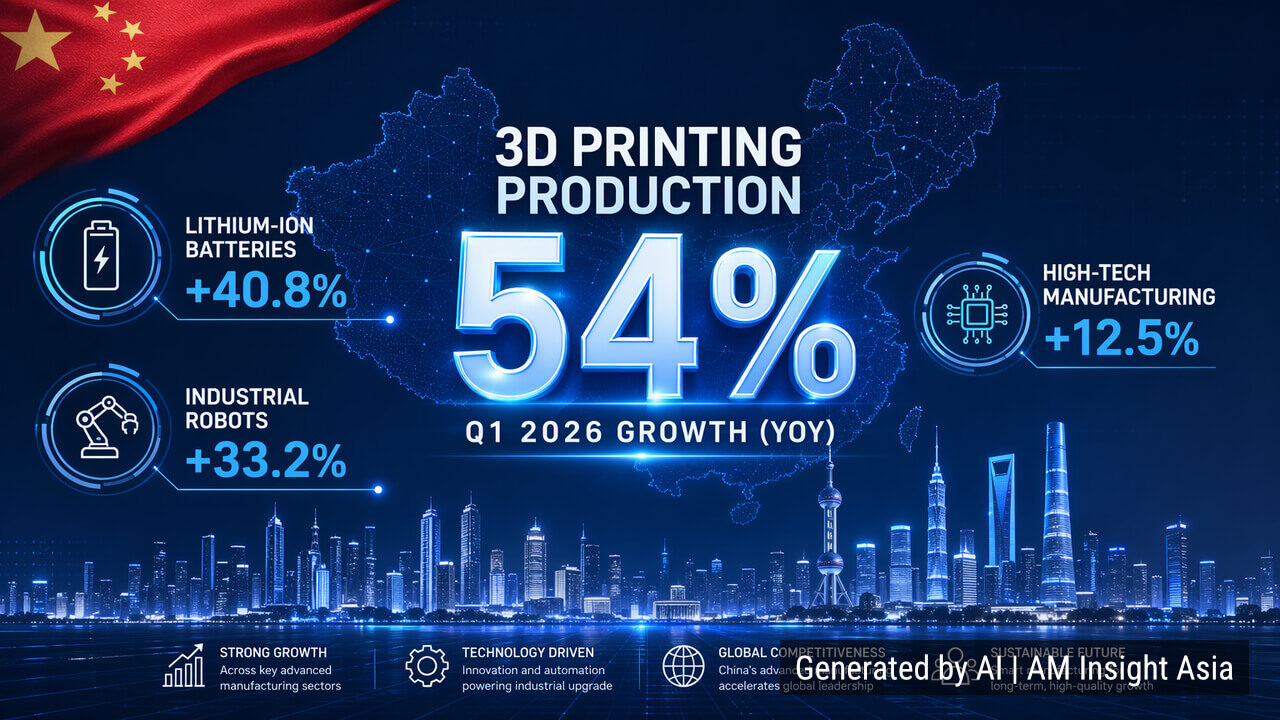
Buried within China’s routine Q1 2026 economic data release by the State Council Information Office (SCIO) on April 17, 2026, was a number that the additive manufacturing industry cannot afford to ignore. According to data from the National Bureau of Statistics (NBS), China 3D printing equipment production grew 54% year-on-year in the first quarter of 2026 — surpassing lithium-ion batteries (+40.8%), industrial robots (+33.2%), and the high-tech manufacturing sector as a whole (+12.5%). The fact that this figure made it into a routine government statistical release speaks for itself: this is no longer a niche number. It is a signal that China’s industrial structure is changing — and that 3D printing is at the center of that change.
China 3D Printing Output Up 54% — What’s Behind the Number
To understand what 54% really means, context is everything. In the same release, high-tech manufacturing overall grew 12.5%, industrial robots 33.2%, and lithium-ion batteries 40.8%. China’s 3D printing equipment production outpaced all of them — growing at roughly four times the rate of the broader high-tech manufacturing average.
What makes this even more significant is that this figure appeared as a single line item in a standard government economic briefing. No special emphasis, no dedicated announcement. It was simply large enough to belong there — and that, in itself, tells a story.
From Prototyping to Production — Evidence of Industrial Transformation
What this growth rate reveals is a structural shift: 3D printing is transitioning from a “prototyping and development tool” to a genuine manufacturing infrastructure.
Central to understanding this shift is what AMIA calls the “multi-layered demand” of China’s AM market. While Western markets are primarily driven by aerospace, defense, and military applications in metal AM, China’s growth spans a far wider range of industries. Footwear, jewelry, anime figurines, educational tools, home décor, and furniture — 3D printing has entered everyday life in China in ways that remain largely uncommon elsewhere. Unlike industrial robots (+33.2%) or lithium-ion batteries (+40.8%), which are driven by relatively clear single-sector demand, the 54% growth in 3D printing reflects an accumulation of demand across industries with no single dominant driver. Could this be precisely why China’s 3D printing growth outpaces every other high-tech indicator in the same release?
In China, metal AM and polymer AM are growing in tandem — and this dual-track structure is fundamentally different from Western markets. Furthermore, the same release revealed that 84.7% of China’s economic growth is now driven by domestic demand. This is not merely a macroeconomic footnote. It suggests that AM is becoming embedded as standard infrastructure within the Chinese manufacturing base that serves this vast internal market. While AM is still considered a “specialist technology” in most parts of the world, China may already be moving beyond that framing. And by continuously meeting the demands of this enormous domestic market, China’s AM industry is accumulating practical experience at a pace that no other country can match — accelerating its own technological evolution in the process, as AMIA sees it.
What This Means for the Global Additive Manufacturing Industry
The implications of China’s surging 3D printing production extend well beyond its borders.
First, there is the reality that China is rapidly establishing itself as the world’s primary supplier of AM hardware. As production capacity expands, competitively priced Chinese AM systems will increasingly flow into global markets.
Second, consider the supply chain dimension. As trade tensions and geopolitical risks intensify, AM technology is gaining recognition as a key enabler of distributed manufacturing — the ability to produce what you need, where you need it. China’s accelerating production capacity has the potential to redraw the map of the global AM supply chain.
For companies, investors, and policymakers across the AM industry, the 54% figure is not just a statistic. It is a signal demanding strategic attention.
AM Insight Asia Perspective
Faster, deeper, and broader than anywhere else in the world — China’s AM industry is accumulating hands-on experience that other nations can only envy. Yet AMIA does not view this as a threat. The experiential knowledge China is gaining through massive domestic demand and diverse applications has the potential to serve as a catalyst for the evolution of the global AM industry as a whole.
The key insight is that there is no single “right answer” for how AM evolves. Metal AM deepening around aerospace and defense in the West; polymer and metal AM expanding in tandem across consumer and industrial applications in China; and across Asia, each country finding its own path shaped by industrial structure, culture, and demand — this diversity of trajectories is, in AMIA’s view, the most fascinating chapter yet to unfold in global additive manufacturing.
But for this potential to be realized, each country must be capable of forming a clear national AM strategy. Looking across the landscape, AMIA observes that while individual companies are forging ahead with their own approaches, a unified national vision remains elusive in most countries — with notable exceptions. The gap between countries like China — and more recently Singapore and India — where national strategy and AM industry development move in lockstep, and those without such alignment, will only widen over time. For nations without a coherent AM strategy, the question is: where will they find themselves as this transformation accelerates?
For the country where this author lives — Japan — the picture is particularly sobering. Despite being home to one of the world’s largest manufacturing sectors, Japan’s AM strategy remains more form than substance. As the world moves at this pace, one can only imagine the frustration felt by Japan’s AM industry as it watches its government fall behind.