How Holcim, Amazon, and BII Are Backing Asia’s Next AM Expansion
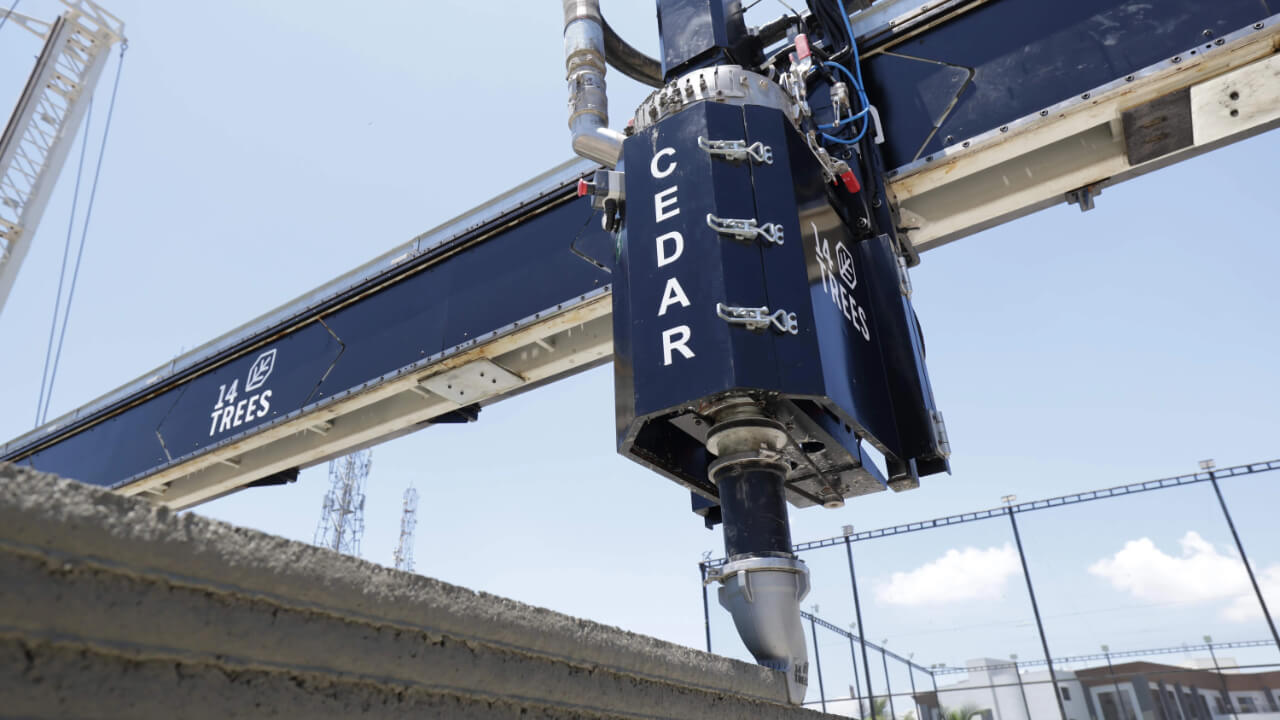
On May 17, 2026, 14Trees, a construction 3D printing company founded in Switzerland and operating globally from its roots in Africa, and Indian construction 3D printer manufacturer Tvasta Manufacturing Solutions jointly launched Cedar, a new concrete 3D printer system. Developed and manufactured in India, Cedar is designed for global deployment. Behind this product lies an interlocking web of three heavyweight backers: the world’s largest building materials manufacturer, a UK government-backed development finance institution, and Amazon.
What Cedar Is: Technical Overview
Cedar is a portal-frame concrete 3D printer capable of printing up to 10 meters in height and covering a footprint of up to 240 square meters. It is designed for a wide range of applications, from residential housing to commercial buildings and infrastructure.
Its headline feature is the ability to print using locally sourced standard concrete rather than proprietary mortar mixes. The pumping system handles aggregates up to 12mm in diameter, which the company says reduces material costs by up to 80%.
The second pillar is the “14Trees AI Companion,” an AI-driven mix design optimization system. Trained on thousands of mix data points, the AI is said to optimize the balance of cost, structural performance, and sustainability using locally available materials. Academic research on similar AI optimization approaches has reported lifecycle cost reductions of up to 20% and CO2 emission reductions of 30 to 40%. However, the real-world performance of the 14Trees AI Companion in commercial projects has not yet been disclosed, and field validation remains ahead. That said, AI-driven mix design optimization has the potential to be a significant advantage from the user’s perspective.
The claim that Cedar cuts equipment costs roughly in half compared to existing systems has also been highlighted, though no specific comparison baseline has been identified.
Who Are 14Trees and Tvasta?
14Trees was established in 2016 as a joint venture between Holcim and BII (British International Investment), the UK government-backed development finance institution, with a mission to advance sustainable construction in Africa. The company built Africa’s first 3D-printed house and the world’s first 3D-printed school in Malawi, and constructed 10 homes in Kenya in just 10 weeks using a single printing unit. In 2023, 14Trees launched its own proprietary printer IROKO, moving away from its earlier dependence on COBOD. In 2024, Amazon’s Climate Pledge Fund joined as a new investor in the company’s Series A-1 round, marking the beginning of its push into European and US markets. Today, backed by Holcim, BII, and Amazon, 14Trees is accelerating its global expansion.
Tvasta Manufacturing Solutions was founded in 2016 by three alumni of IIT Madras and is based in Chennai. The company first gained attention by constructing India’s first 3D-printed house on the IIT Madras campus, and later completed India’s first 3D-printed villa, a 2,200-square-foot two-story structure, for Godrej Properties in Pune. Tvasta has exported construction 3D printers to the United States and the Middle East, and has received certification from India’s Building Materials and Technology Promotion Council. The company has raised a total of $5.65 million across seven funding rounds from 41 investors, including Habitat for Humanity and ADB Ventures.
Three Giants in the Background
Reading this product launch as just another startup announcement would miss the bigger picture. The shareholder structure of 14Trees tells a different story.
Holcim is headquartered in Switzerland and is the world’s largest cement and building materials manufacturer, with annual revenues exceeding $27 billion and operations in more than 70 countries. A founding shareholder of 14Trees and its de facto parent company, Holcim already supplies its low-carbon concrete “EcoPact” for Amazon Web Services data center construction. The fact that the world’s dominant building materials company is investing heavily in construction 3D printing, a technology that inherently reduces material consumption, signals a deeper shift in the industry.
BII (British International Investment) is a development finance institution backed by the UK government, with a mandate to invest with social and environmental impact in Africa and Asia. A co-founder of 14Trees alongside Holcim, BII’s involvement fits that mission. The current trajectory, an Indian-manufactured printer being deployed globally, aligns closely with BII’s investment approach.
Amazon (Climate Pledge Fund) invested in 14Trees through its $2 billion sustainability fund, established in 2020, joining as a new investor in the 2024 Series A-1 round. The scale of Amazon’s data center buildout deserves attention here. AWS capital expenditure reached $96.5 billion in 2025 and is projected to hit $200 billion in 2026, representing the largest private infrastructure buildout in history. When Amazon announced its investment in 14Trees, it explicitly referenced data center construction as a use case. There is no confirmed evidence that Cedar will be used in AWS data center projects at this stage.
Yet three organizations of this scale have converged around a single printer. When organizations of this magnitude move, there is always something beyond product specifications driving them. Holcim’s building materials supply chain, Amazon’s AI infrastructure buildout, and BII’s emerging market development strategy — each carries its own business imperatives. Cedar may be where those imperatives meet.
AM Insight Asia Perspective
What deserves attention in the Cedar launch is not the printer’s specifications but the structure behind it. Developed and manufactured in India, backed by Holcim, Amazon, and BII, and positioned for global deployment, Cedar represents one emerging model for how Asian AM technology enters the global supply chain.
On the technical side, a measured assessment is warranted. Standard concrete compatibility is not new territory, as COBOD established that ground first. The commercial-scale validation of AI mix optimization is still ahead. Academic research points to meaningful gains in cost and carbon reduction from similar approaches, but whether the 14Trees AI Companion can reproduce those results in real projects will be the true measure of Cedar’s value.
The more provocative question surrounds Holcim’s position. A company with a substantial proprietary materials business is now backing a printer explicitly designed to make those materials unnecessary. Whether this is a self-disrupting bet on the future or a pivot toward hardware and construction services as a new revenue model remains to be seen. The answer may well define where construction AM goes next.