Steel Industry’s AM Use, Once Confined to Factory Parts, Expands Through Decarbonization
Indian steelmaker Jindal Steel Limited (formerly Jindal Steel & Power Limited, listed on the BSE and NSE) has disclosed, in its Integrated Report FY 2025-26 released on August 6, 2026, that it captures CO2 from its own DRI (direct reduced iron) plant and puts it to use in manufacturing parts such as heat exchangers through 3D printing.
From CO2 to Heat Exchanger Parts: The Process the Report Describes
In the “Intellectual Capital” section of its Integrated Report, under a discussion of carbon capture, utilisation and storage (CCUS), Jindal Steel outlines a new approach to manufacturing components starting from captured CO2.
A DRI plant produces reduced iron from iron ore using gas or hydrogen rather than coke, unlike a blast furnace. When the gas used is natural gas or coal-based syngas, CO2 is generated as a byproduct. Jindal Steel’s plant falls into this category, and the CO2 it produces appears to be the source used in this initiative.
Turning captured CO2 into a finished ceramic component involves several steps. One input, the CO2, comes from the company’s own DRI process, while the other, silicon carbide, is likely sourced externally (as discussed below) rather than produced in-house, meaning the process combines an internal byproduct with an external material to create a new product.
SiSiC (silicon-infiltrated silicon carbide) is a material made by infiltrating silicon carbide (SiC) with molten metallic silicon, prized for its heat resistance and hardness. It is used in semiconductor manufacturing equipment and precision components.
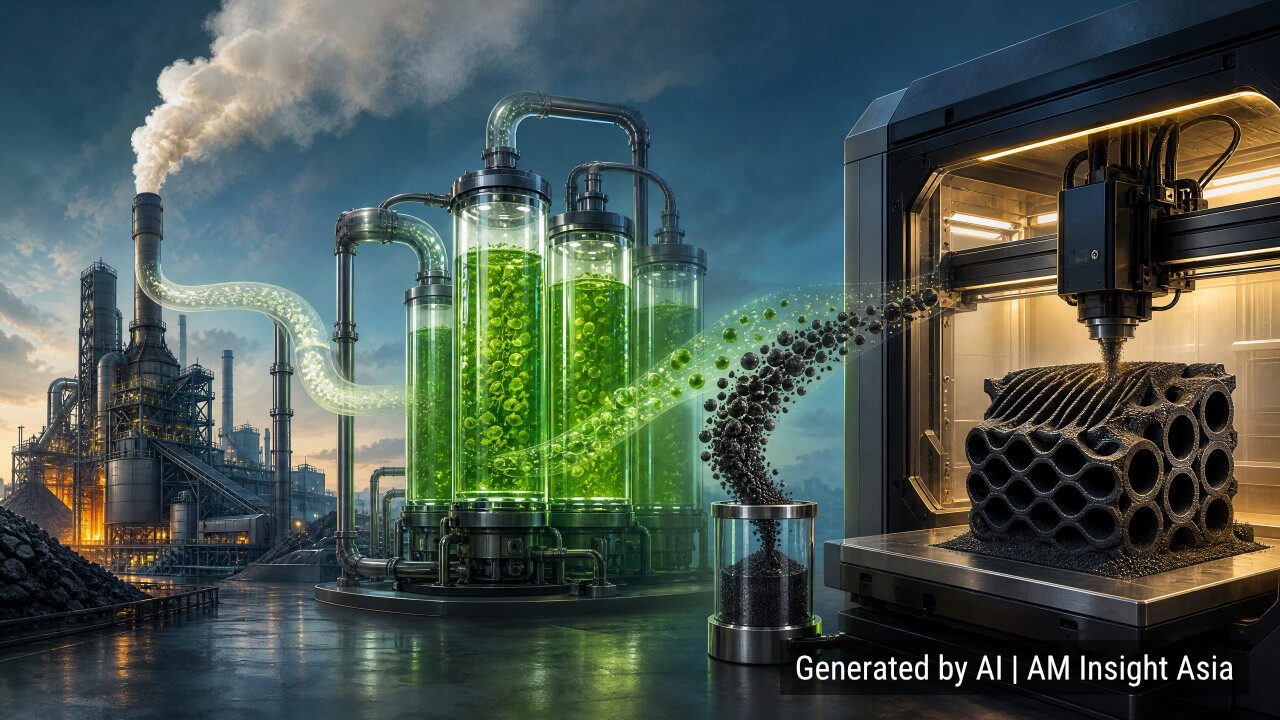
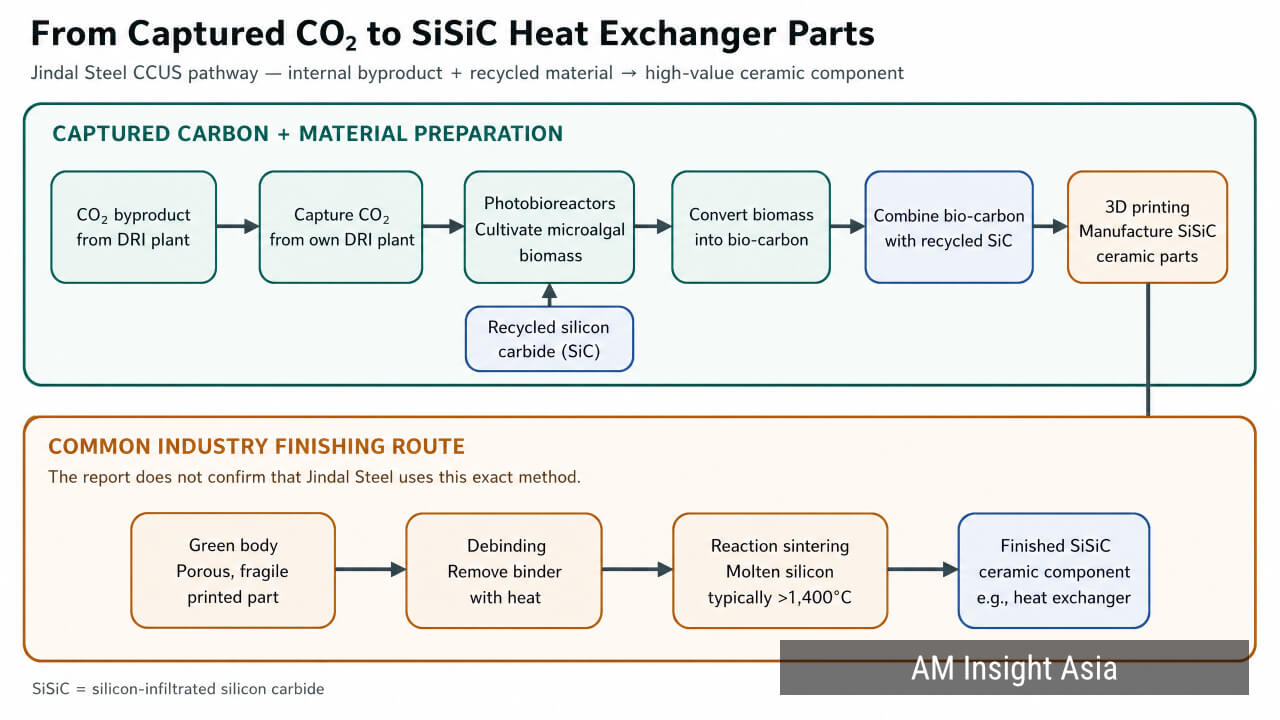
The process, as the report describes it, runs as follows:
- Capture CO2 from the company’s own DRI plant
- Feed the captured CO2 into photobioreactors to cultivate microalgal biomass
- Convert the cultivated microalgal biomass into bio-carbon
- Combine the bio-carbon with recycled silicon carbide
- Process this combined material through 3D printing to manufacture SiSiC ceramic parts such as heat exchangers
The report does not go into detail on how, mechanically, the printed material becomes a finished ceramic component. In the wider SiSiC 3D printing industry, binder jetting is a commonly used approach, typically following a sequence like this:
- A 3D printer spreads a thin layer of silicon carbide powder and jets binder onto it in the cross-sectional shape of the part, building up the form layer by layer. At this stage, the part is a porous, fragile “green body.”
- Heat is applied to remove the binder (debinding).
- The green body is dipped into molten metallic silicon heated above 1,400°C. Because molten silicon wets carbon well, it is drawn into the pores through capillary action, reacting with the carbon to form new silicon carbide that bonds the particles together. This step is also known as reaction sintering.
- The result, once the pores are filled and the part has densified, is the finished SiSiC ceramic component.
It should be noted that this is simply the process commonly used across the industry; the report does not confirm that Jindal Steel uses this specific method, including binder jetting.
Where This Fits Within Jindal Steel’s CCUS Strategy
The initiative sits within a government-backed effort to establish “bio-foundries” and “biomanufacturing platforms,” carried out in collaboration with Gujarat Biotechnology University, IIT Kharagpur, the University of Alberta and the University of Guelph. Separately, the report also lists a partnership between IIT Kharagpur and the Indo-German Centre for Science and Technology, focused on “ceramic additive prototypes using captured carbon,” as its own line item among the company’s strategic academic collaborations on CCUS.
This initiative forms part of the “Jindal Steel CCU Valley,” which the company envisions building at Angul in Odisha. The company describes it as one of “the world’s largest integrated carbon capture, utilisation and sequestration hubs,” aiming to build a circular carbon ecosystem, anchored by its 3,600 TPD CO2 capture capacity, that includes the production of green chemicals and mineralised construction materials.
Jindal Steel is pursuing several CCUS pathways in parallel. Trials of BOF slag-based mineral carbonation have demonstrated over 8% CO2 capture, with an annual storage potential of more than 100,000 tonnes. CO2 electrolysis, developed jointly with IIT Bombay, has moved from laboratory validation to pilot-scale deployment. Underground storage (ECBMR, combined with enhanced coal bed methane recovery), pursued with IIT Bombay, Carbon X Services and Schlumberger (SLB), is at the stage of identifying promising geological formations around Angul. Within this portfolio, 3D-printed SiSiC is the pathway that converts captured carbon into a high-value product.
Jindal Steel has set a Net Zero target for 2047. Its Angul plant uses India’s only coal-gasification-based DRI route, which the report describes as “the world’s first and largest coal gasification plant for steelmaking.” This makes capturing and utilising CO2 a key business priority for the company.
The report states only that the silicon carbide used is “recycled,” without specifying its source. Since silicon carbide, a material commonly used in abrasives and refractories, is not a byproduct typically generated by steelmaking processes such as DRI, blast furnaces or steel melting, it is likely sourced externally as recycled material rather than generated in-house.
A First for the Steel Industry: How This AM Use Case Differs
Looking across the world’s major steelmakers, AM adoption has, until now, consistently centered on one thing: making parts for use inside the factory.
| Company | Primary AM Use | Material | Purpose |
|---|---|---|---|
| ArcelorMittal (world’s 2nd largest) | In-house spare parts production, sale of AM steel powder | Steel (316L, H13, etc.) | Improving maintenance efficiency, new business (metal powder) |
| Nippon Steel | Mold-making by group subsidiaries, etc. | Steel | Indirect, limited scope |
| Jindal Steel | CO2 capture → biomass → 3D printing of heat exchanger parts | Ceramic (SiSiC) | New product development as part of decarbonization (CCUS) |
ArcelorMittal has been one of the industry’s biggest AM investors, producing around 10 tonnes and 1,600 different steel parts a year for its own factories since 2018, and forming a joint venture called TheSteelPrinters with Frankstahl in 2024. Yet its focus has consistently been on improving the efficiency of its own factory operations, and the material involved remains steel. Mold-making by Nippon Steel’s group subsidiaries occupies a similarly indirect, limited role.
Jindal Steel’s case departs from this pattern. Rather than treating AM as a tool for factory efficiency, it positions the technology as an outlet for decarbonization infrastructure, turning captured CO2 into a high-value product. What matters here is that this description appears not in a trade-show demo or a press release, but in an audited statutory disclosure aimed at investors and regulators. Where AM adoption in the steel industry has so far stayed at the level of practical, factory-floor part production, Jindal Steel has formally folded it into its decarbonization agenda, at the level of its annual report.
AM Insight Asia Perspective
In AMIA’s view, this is not just another technology story. It signals a shift in how AM is beginning to be treated within the steel industry.
Until now, AM has largely been a tool for improving factory operations at steelmakers, rarely placed at the center of corporate messaging. Even ArcelorMittal’s efforts have been framed mainly through operational announcements, not treated as part of the corporate agenda communicated to investors. What Jindal Steel’s disclosure shows is that AM has begun appearing in statutory filings as one of the implementation tools for decarbonization, the corporate theme investors watch most closely. Demos and press releases can be walked back or revised with ease; content disclosed in an audited annual report carries something closer to the weight of a formal commitment made by management to investors and regulators.
This may not be limited to the steel industry. If more industries, such as chemicals and energy, start folding AM into statutory disclosures as an implementation tool for decarbonization targets, that could reshape the customer base and capital flows available to the AM industry. Where AM companies have traditionally approached heavy industry through the door of “operational improvement,” a different entry point, closer to the executive level, “a partner for implementing decarbonization strategy,” may be opening up.
That said, the technical substance remains thin. The report gives no detail on the specific AM process used, the current stage of implementation, the scale of capital investment, or a commercialization timeline, making it impossible to say whether this is an established production line or an early-stage effort. Even so, the fact that the company chose to put this in a statutory filing at this stage is, in itself, worth noting.
About the Company
Jindal Steel Limited (formerly Jindal Steel & Power Limited) is a major Indian integrated steel producer, listed on the BSE (scrip code 532286) and the NSE (symbol: JINDALSTEL). It ranked 48th in the World Steel Association’s 2025 ranking of global producers, with crude steel output of 8.71 million tonnes, placing it as a mid-sized player within India, behind Tata Steel Group (10th) and JSW Steel Limited (11th). Its installed crude steelmaking capacity stands at 15.6 MTPA, with major production sites in Angul (Odisha), Raigarh (Chhattisgarh) and Patratu (Jharkhand). The company operates a vertically integrated business model that includes captive iron ore and coal resources, pelletization facilities, and captive power generation capacity of 2,684 MW. Jindal Steel has set a Net Zero target for 2047 and treats CCUS (carbon capture, utilisation and storage) as one of its key business priorities.