What the Shift from New Production to Repair Means for Additive Manufacturing
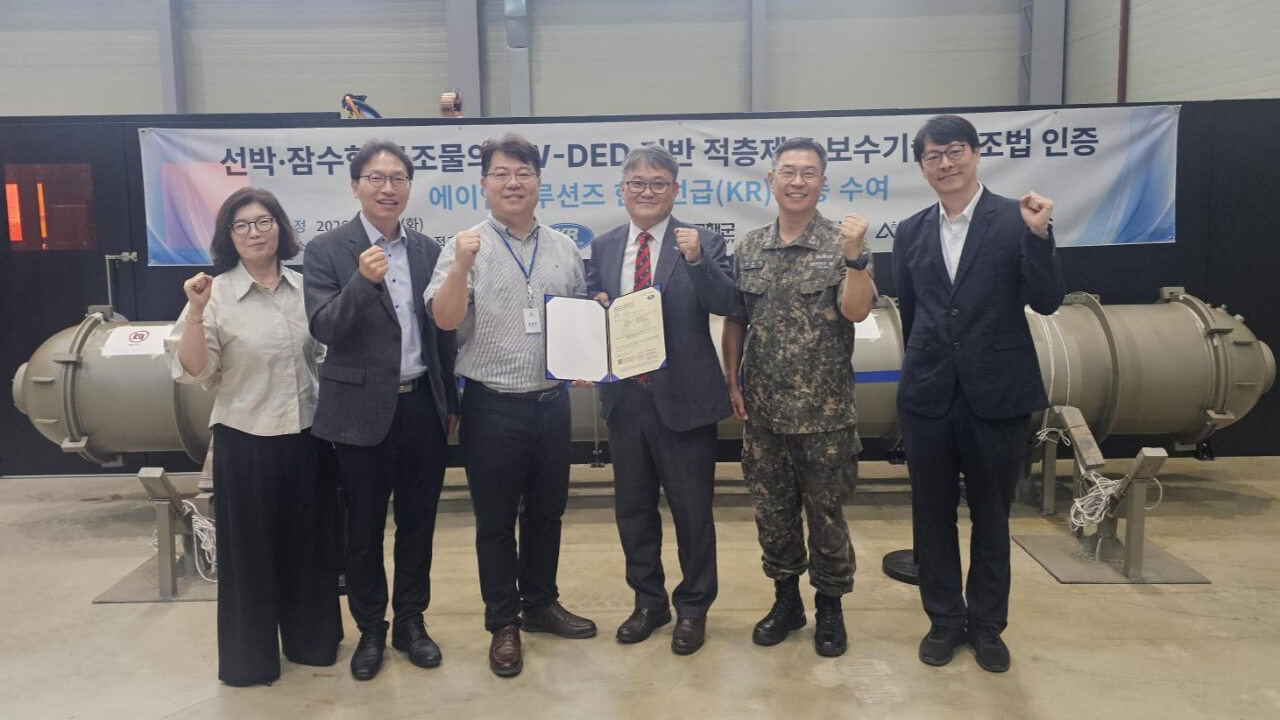
Korean Register (KR) awarded a manufacturing process certificate on July 28 to AM Solutions Inc. at the company’s additive manufacturing center in Daejeon, covering its metal 3D printing repair technology based on laser wire directed energy deposition (LW-DED). It is the first time KR has certified the safety and reliability of a process that uses additive manufacturing to repair damaged sections of existing metal structures. The move extends additive manufacturing’s scope beyond new part production into maintenance, repair, and overhaul (MRO) for shipbuilding and defense.
KR Certifies AM Solutions’ Repair Process
KR announced on July 29 that it had awarded AM Solutions a manufacturing process certificate for its LW-DED-based additive repair technology. The certification ceremony took place on July 28 at AM Solutions’ additive manufacturing center in Daejeon, with representatives from the Republic of Korea Navy Headquarters, KR, the Korea Institute of Industrial Technology (KITECH), Daejeon City Hall, and Daejeon Technopark in attendance.
The certified process melts metal wire with a laser and selectively deposits it only onto damaged areas. Unlike conventional methods that require manufacturing or replacing an entire part, it restores just the damaged section, cutting repair time and cost. KR says the approach can also extend the service life of discontinued or hard-to-source parts, and expects it to find use across a wider range of industries going forward.
Kim Sang-soo, head of KR’s Naval Ship Business Division, who led the certification effort, said the move was significant because it “extends the scope beyond repairing parts made through additive manufacturing to existing metal structures,” adding that it is expected to “offer a new alternative for maintaining and repairing high-value equipment and structures currently in use in the defense and shipbuilding sectors.”
The certification builds on IACS Recommendation No. 186, “Additively Manufactured Metallic Parts for Marine and Offshore Applications,” adopted by the International Association of Classification Societies (IACS) in 2025. In response, KR revised its own additive manufacturing guidelines and built a certification framework spanning materials, processes, products, and manufacturing methods. What distinguishes this certification is that it extends that framework to cover repair of existing structures, not just new production.
Founded in 1960 as a non-profit body, KR is a full member of IACS (since 1988) and a Recognized Organization authorized to carry out statutory surveys and issue certificates on behalf of more than 80 flag states, including Korea. Combined, IACS’s 12 member societies class more than 90% of the world’s commercial shipping tonnage.
The IACS Framework and Asia’s Parallel Push
Certification of additive manufacturing for maritime use is already well established. DNV issued the world’s first AM “Approval of Manufacturer” certificate to thyssenkrupp Marine Systems in 2018. DNV’s framework does not draw a sharp line between new production and repair; it approves a manufacturer’s process and quality-control capability broadly. In fact, as part of its standard-revision work, DNV compared the resource consumption of repairing worn parts with additive manufacturing against conventional part replacement, meaning repair applications have been part of its thinking since the early stages of standard development. More recently, Europe’s DEEP Manufacturing secured a full DNV Approval of Manufacture for wire arc additive manufacturing (WAAM), becoming the only company in Europe to hold that approval. KR’s latest certification places Korea firmly within this broader wave of classification-society AM certification led by DNV and others. KR itself describes the certification as a first for Korea.
A parallel move is underway in Japan. Tokyo-based Promethean Co., Ltd., whose core business is metal AM repair of discontinued and long-lead-time parts, has been working since April 2026 toward a DNV manufacturing certification (DNV-ST-B203 AMC1 and SE-0568 Module B), and DNV has already completed its on-site audit. If approved, it would be the first such case in Japan.
This highlights a difference in how AM Solutions and Promethean are approaching certification. AM Solutions is pursuing a domestically self-contained path, obtaining certification from its own national classification society, KR. Promethean, by contrast, is in the final stages of pursuing certification not from its own national society, Japan’s ClassNK, but from DNV, one of the largest classification societies in the world. ClassNK has had its own additive manufacturing guidelines since 2021, so the certification framework itself already exists domestically. Promethean’s choice of DNV appears to reflect a preference for the global recognition and credibility DNV carries.
AM Insight Asia Perspective
Korea and Japan, which together account for roughly half of global shipbuilding capacity, are moving on the same issue, third-party certification of metal AM repair for marine use, at almost the same time. AMIA sees this as a signal that the field is moving from an experimental stage toward real-world deployment. In Korea, AM Solutions has been certified by its own national classification society, KR. In Japan, Promethean is in the final stages of pursuing certification from DNV rather than its own national society, ClassNK.
What matters here is the difference in the markets each company has had in view from the start. AM Solutions has built its track record within Korea, supplying the Republic of Korea Marine Corps and contributing to the K2 Black Panther tank’s defense and shipbuilding applications. Certification from its own national society, KR, translates directly into credibility in the market where that track record was built. Promethean, on the other hand, has had international markets in view from early on, not just domestic demand, which is why it is pursuing DNV’s globally recognized certification rather than ClassNK’s. In a report on a visit to DNV’s headquarters, Promethean described its own work as “a standardization project from Japan to the world,” setting international standardization and overseas expansion as explicit goals. In other words, the difference in how the two companies are approaching certification is not a question of which one is superior. It comes down to a strategic choice, made from the outset, of whether to target the domestic market or the international one.
The diversity of circumstances across Asia’s shipbuilding industry is what leads different companies to make different certification choices. The fact that two of the world’s leading shipbuilding nations have begun investing in this field, each with its own aim, one domestic-facing and one global-facing, is itself an important data point for where this is headed next.
About the Company
AM Solutions Inc. is a Daejeon-based Korean company specializing in metal 3D printer and precision machinery manufacturing along with 3D printing consulting. It provides smart manufacturing solutions built on directed energy deposition (DED) metal additive manufacturing technology to customers in defense, aerospace, energy, and maritime. The company has supplied tactical mobile robotic metal 3D printers to the Republic of Korea Marine Corps Logistics Command as part of efforts to build local part-production and repair infrastructure for combat environments. AMIA has previously reported on the company’s work reducing the weight of the K2 Black Panther tank’s snow pads and deploying a robotic metal 3D printing system for the Republic of Korea Marine Corps.
Promethean Co., Ltd. is a Tokyo-based Japanese company that repairs, replicates, and reverse-engineers discontinued, long-lead-time, and high-cost industrial metal parts, tooling, and equipment components. It runs its DED-based metal AM repair business out of its Fujisawa factory in Kanagawa Prefecture and has been working since April 2026 toward a DNV manufacturing certification (DNV-ST-B203 AMC1 and SE-0568 Module B).
Source
- KR, 국방·조선 분야 적층제조 보수기술 제조법 인증서 수여 (via Korean Register official site, July 30, 2026)
- Visit report: Discussed a Japan-originated maritime standardization project at DNV’s Oslo headquarters (via Promethean Co., Ltd., November 2025)
- Additive Manufacturing enters the maritime mainstream (via DNV)
- DEEP Manufacturing secures DNV Approval of Manufacture for Wire Arc Additive Manufacturing (via DEEP Manufacturing)