3D Printer Makers Face a Survival Test. Who Falls Next?
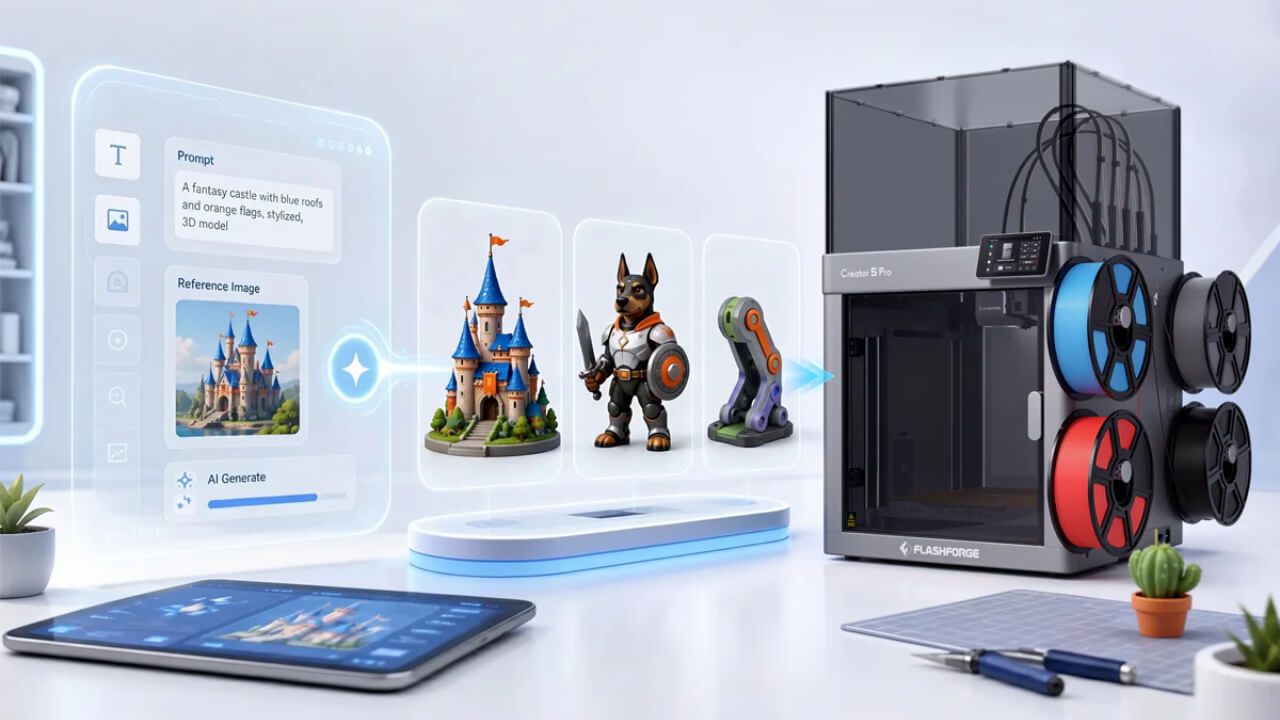
On May 21, 2026, Flashforge announced a direct integration with Meshy AI, embedding the AI 3D printing platform into its Flash Studio slicer software. Creator 5 users can now generate a 3D model from a text or image prompt, have textures automatically mapped to filament colors, and send the result to print in a single click. No manual slicer configuration required. The integration went live on the day of the announcement. At first glance, this looks like a straightforward feature update. But it may be pointing to something larger: a structural shift in how the 3D printing industry competes, and who gets left behind.
What Actually Changed
For years, multi-color 3D printing had a gap that no one had cleanly solved. AI tools could generate texture-rich models. Multi-color printers could execute them. But between the two sat an unavoidable manual step: opening a slicer, painting color zones by hand, assigning each zone to a filament, and configuring the output file before a single layer could print. The richer the texture, the more work required.
This integration removes that step. Meshy’s automatic texture-to-filament color mapping generates a print-ready file directly from AI output. Users see a textured model on screen, return to Flash Studio with one click, and the Creator 5 prints it in color. For hobbyists, multi-color printing is no longer a technical skill. For experienced users, hours of slicer configuration collapse into one click.
Three Generations of Competition in AI 3D Printing
To understand what this announcement means, it helps to look at how the competitive axis of the 3D printing industry has shifted over time.
The first generation was a hardware race. Precision, speed, and material compatibility were the differentiators. But as Chinese manufacturers drove prices down, hardware alone became increasingly difficult to compete on. Building a good machine was no longer enough.
The second generation added software. Bambu Lab became the defining example, reshaping the market through tight vertical integration of hardware, slicer, sensors, and UI. Ease of use became as valuable as performance. Makers who could not invest in software began to lose ground, and Flashforge, once a market leader, was among those pushed back by this wave.
Now a third generation is beginning. The competitive axis has become hardware plus software plus AI. What Flashforge has demonstrated with this move is that AI has entered territory where in-house software alone can no longer keep up. And the answer Flashforge chose was not to build AI itself, but to partner with an external AI platform.
It Looks Like Flashforge Is Using Meshy. But Look Again.
There is something worth paying attention to here. Meshy is not exclusive to Flashforge. The platform has also partnered with xTool and Snapmaker, positioning itself across multiple hardware ecosystems simultaneously.
On the surface, it appears that Flashforge has adopted Meshy as a tool. But looked at structurally, what is happening may be the reverse: an AI platform is assembling a layer above the hardware, with multiple manufacturers plugging into it.
The previous competitive logic ran like this: hardware makers owned their software, locked users into their ecosystem, and controlled the experience end to end. Bambu Lab executed this playbook in the second generation. But in the third generation, that logic may be inverting. AI platforms are beginning to bundle the hardware, and hardware makers are becoming the dependent party.
Who holds the leverage is not yet clear. But the fact that the question needs to be asked at all says something about how much the structure has already shifted.
AM Insight Asia Perspective
AM Insight Asia sees this as a structural inflection point for hardware-only manufacturers.
The transition from the first to the second generation offers a clear precedent. Makers who could not invest in software lost market relevance quickly. The same dynamic is now unfolding around AI. Few manufacturers have the resources to build proprietary AI capabilities. Most will do what Flashforge has done: turn to an external platform. But dependence on a platform is also a transfer of leverage. If an AI platform becomes the layer that bundles multiple hardware brands, those hardware makers will increasingly operate on the platform’s terms.
The Meshy integration currently covers the Creator 5. Whether this extends to other Flashforge models, or whether other manufacturers follow the same path, remains to be seen. But if this pattern spreads, the structural shift will accelerate.
Can a pure hardware maker survive what is coming? The choice is between investing heavily in AI or accepting dependence on platforms that may not have their interests at heart. Either way, the era of competing on hardware alone is drawing to a close. The market will tell us who adapts and who does not.